



A solitary hydroid drifts in currents approximately 380 meters deep at the recently exposed. (ROV SuBastian/Schmidt Ocean Institute)
It will probably take scientists years to describe all of the new species they have potentially found in this special habitat and the surrounding Bellingshausen Sea, let alone figure out how life survives beneath the cover of ice some 150 meters thick.
The tentacles of a solitary hydroid drift in currents 360 meters deep at the newly exposed seabed near the George VI Ice Shelf. (ROV SuBastian/Schmidt Ocean Institute)
"Based on the size of the animals, the communities we observed have been there for decades, maybe even hundreds of years," says Esquete.
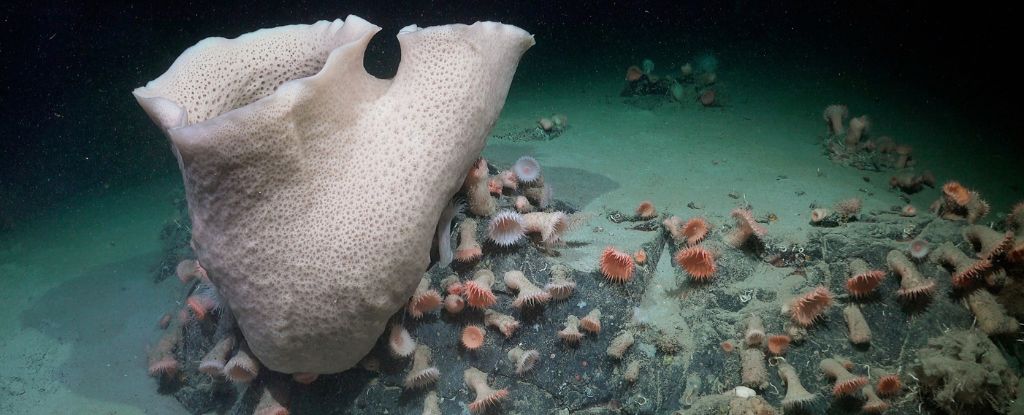
Take the large sponge in the image below, for instance. Sponges often grow only a few centimeters a year, which means this individual could potentially be decades or even centuries old. It exists 230 meters deep, and until very recently, it was closed off from the rest of the world by a big icy roof.
For days on end, SuBastian explored the newly exposed seafloor community, mapping the region and taking sediment cores and numerous samples for further analysis.
Co-leader of the expedition, Aleksandr Montelli from University College London, says this is the first time, to his knowledge, that "a comprehensive and interdisciplinary study like this was completed in a sub-ice shelf environment".
Deploying ROVs below floating glaciers is tricky business. Current navigation systems must rely on acoustics rather than GPS because of the thickness of the ice. Extreme pressures and temperatures merely add to the challenge.
The science team was originally in this remote region to study the seafloor and ecosystem at the interface between ice and sea," says Schmidt Ocean Institute Executive Director, Jyotika Virmani.
Being right there when this iceberg calved from the ice shelf presented a rare scientific opportunity. Serendipitous moments are part of the excitement of research at sea – they offer the chance to be the first to witness the untouched beauty of our world."
In a nearby region of the Bellingshausen Sea, which lost its ice shelf years before, the same team of researchers has found congregating corals, icefish, crabs, giant sea spiders, isopods jellyfish, and octopuses
The findings suggest that when floating ice moves away from a seabed, new life quickly moves in.


 www.sciencealert.com
It will probably take scientists years to describe all of the new species they have potentially found in this special habitat and the surrounding Bellingshausen Sea, let alone figure out how life survives beneath the cover of ice some 150 meters thick.
The tentacles of a solitary hydroid drift in currents 360 meters deep at the newly exposed seabed near the George VI Ice Shelf. (ROV SuBastian/Schmidt Ocean Institute)
"Based on the size of the animals, the communities we observed have been there for decades, maybe even hundreds of years," says Esquete.
Take the large sponge in the image below, for instance. Sponges often grow only a few centimeters a year, which means this individual could potentially be decades or even centuries old. It exists 230 meters deep, and until very recently, it was closed off from the rest of the world by a big icy roof.
For days on end, SuBastian explored the newly exposed seafloor community, mapping the region and taking sediment cores and numerous samples for further analysis.
Co-leader of the expedition, Aleksandr Montelli from University College London, says this is the first time, to his knowledge, that "a comprehensive and interdisciplinary study like this was completed in a sub-ice shelf environment".
Deploying ROVs below floating glaciers is tricky business. Current navigation systems must rely on acoustics rather than GPS because of the thickness of the ice. Extreme pressures and temperatures merely add to the challenge.
The science team was originally in this remote region to study the seafloor and ecosystem at the interface between ice and sea," says Schmidt Ocean Institute Executive Director, Jyotika Virmani.
Being right there when this iceberg calved from the ice shelf presented a rare scientific opportunity. Serendipitous moments are part of the excitement of research at sea – they offer the chance to be the first to witness the untouched beauty of our world."
In a nearby region of the Bellingshausen Sea, which lost its ice shelf years before, the same team of researchers has found congregating corals, icefish, crabs, giant sea spiders, isopods jellyfish, and octopuses
The findings suggest that when floating ice moves away from a seabed, new life quickly moves in.
Antarctic Iceberg Breaks Away to Reveal a Never-Before-Seen Ecosystem
A colossal iceberg the size of Chicago has broken from a floating glacier in Antarctica, and like a retractable roof at a stadium, the drifting structure has opened up a hidden habitat to the elements.
www.sciencealert.com


