


Earth's magnetic field dramatically flipped roughly 41,000 years ago. Now you can actually 'hear' this epic upheaval, thanks to a clever interpretation of information collected by the European Space Agency's Swarm satellite mission
Combining the satellite data with evidence of magnetic field line movements on Earth, geoscientists mapped the Laschamps event and represented it using natural noises like the creaking of wood and the crashing of colliding rocks.
The result – unveiled in 2024 by the Technical University of Denmark and the German Research Center for Geosciences – is an eerie, otherworldly audio track unlike anything you've heard before.
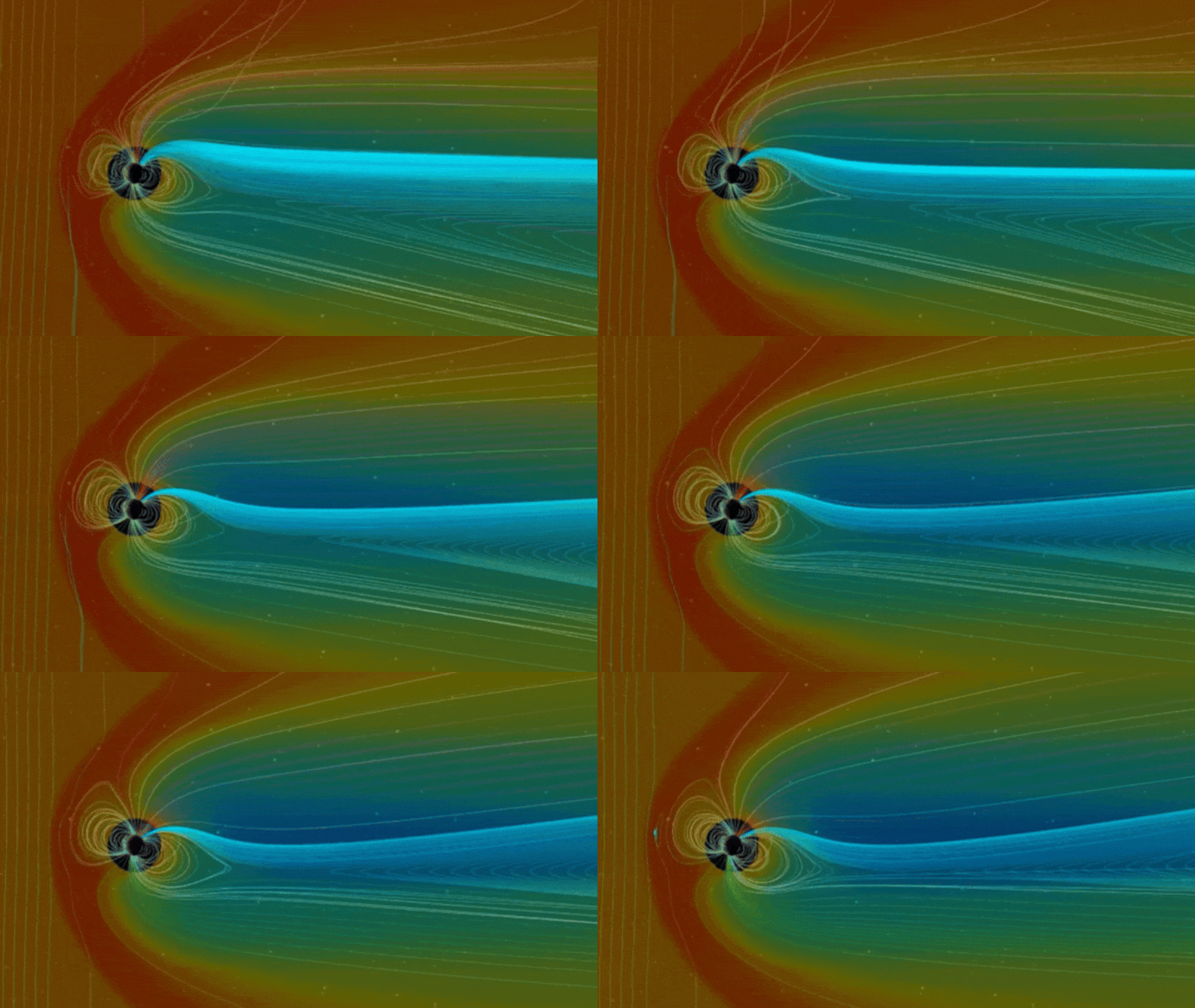
Generated by the swirling liquid metals in our planet's core, Earth's magnetic field reaches tens to hundreds of thousands of kilometers into space, protecting us all by deflecting atmosphere-stripping solar particles.
As the iron and nickel inside our planet shift, so does Earth's magnetic field, meaning the North (and South) Poles are also constantly on the move. Recently, the position of the magnetic North Pole was officially changed, as it continues its shift away from Canada and towards Siberia.
In its current orientation, the magnetic field lines form closed loops that are directed south to north above the planet's surface, and then north to south deep within it.
Yet every so often the field randomly flips its polarity. Were this to happen again today, our north-pointing compasses would point to the South Pole
The last such cataclysmic event occurred about 41,000 years ago, leaving a signature in the Laschamps lava flows in France. As the field weakened to only 5 percent of its current strength, the reversal process allowed a surplus of cosmic rays to pass into Earth's atmosphere
Ice and marine sediment preserve isotopic signatures of this higher-than-normal solar bombardment, with levels of beryllium-10 isotopes doubling during the Laschamps event, according to a study published last year.
These altered atoms are formed when cosmic rays react with our atmosphere, ionizing the air and frying the ozone layer. With global climate change being a potential consequence, it's speculated the extinction of Australia's megafauna as well as changes in human cave use may have been associated with this event

Understanding these extreme events is important for their occurrence in the future, space climate predictions, and assessing the effects on the environment and on the Earth system," German Research Center for Geosciences geophysics Sanja Panovska explained at the time.
It took 250 years for the Laschamps reversal to take place, and it stayed in the unusual orientation for about 440 years. At most, Earth's magnetic field may have remained at 25 percent of its current strength as the north polarity drifted to the south.
Recent magnetic field anomalies like the weakening over the Atlantic ocean have led to questions about an impending reversal today, but recent research suggests these anomalies are not necessarily connected to flipping events
The South Atlantic anomaly is, however, exposing satellites in the area to higher levels of radiation.
Since 2013, ESA's Swarm constellation has been measuring magnetic signals from Earth's core, mantle, crust, oceans, ionosphere, and magnetosphere so we can better understand our planet's geomagnetic field and predict its fluctuations.
 www.sciencealert.com
Combining the satellite data with evidence of magnetic field line movements on Earth, geoscientists mapped the Laschamps event and represented it using natural noises like the creaking of wood and the crashing of colliding rocks.
The result – unveiled in 2024 by the Technical University of Denmark and the German Research Center for Geosciences – is an eerie, otherworldly audio track unlike anything you've heard before.
Generated by the swirling liquid metals in our planet's core, Earth's magnetic field reaches tens to hundreds of thousands of kilometers into space, protecting us all by deflecting atmosphere-stripping solar particles.
As the iron and nickel inside our planet shift, so does Earth's magnetic field, meaning the North (and South) Poles are also constantly on the move. Recently, the position of the magnetic North Pole was officially changed, as it continues its shift away from Canada and towards Siberia.
In its current orientation, the magnetic field lines form closed loops that are directed south to north above the planet's surface, and then north to south deep within it.
Yet every so often the field randomly flips its polarity. Were this to happen again today, our north-pointing compasses would point to the South Pole
The last such cataclysmic event occurred about 41,000 years ago, leaving a signature in the Laschamps lava flows in France. As the field weakened to only 5 percent of its current strength, the reversal process allowed a surplus of cosmic rays to pass into Earth's atmosphere
Ice and marine sediment preserve isotopic signatures of this higher-than-normal solar bombardment, with levels of beryllium-10 isotopes doubling during the Laschamps event, according to a study published last year.
These altered atoms are formed when cosmic rays react with our atmosphere, ionizing the air and frying the ozone layer. With global climate change being a potential consequence, it's speculated the extinction of Australia's megafauna as well as changes in human cave use may have been associated with this event
Understanding these extreme events is important for their occurrence in the future, space climate predictions, and assessing the effects on the environment and on the Earth system," German Research Center for Geosciences geophysics Sanja Panovska explained at the time.
It took 250 years for the Laschamps reversal to take place, and it stayed in the unusual orientation for about 440 years. At most, Earth's magnetic field may have remained at 25 percent of its current strength as the north polarity drifted to the south.
Recent magnetic field anomalies like the weakening over the Atlantic ocean have led to questions about an impending reversal today, but recent research suggests these anomalies are not necessarily connected to flipping events
The South Atlantic anomaly is, however, exposing satellites in the area to higher levels of radiation.
Since 2013, ESA's Swarm constellation has been measuring magnetic signals from Earth's core, mantle, crust, oceans, ionosphere, and magnetosphere so we can better understand our planet's geomagnetic field and predict its fluctuations.
Earth's Flipping Magnetic Field Heard as a Sound Is an Unnerving Horror
Earth's magnetic field dramatically flipped roughly 41,000 years ago.
www.sciencealert.com