

Genomes from ancient Maya people reveal collapse of population and civilization 1,200 years ago
Ancient DNA from people buried up to 1,600 years ago in Honduras have revealed clues to the rise and fall of the Maya.
Ancient DNA from people buried up to 1,600 years ago in Honduras have revealed clues to the rise and fall of the Maya.
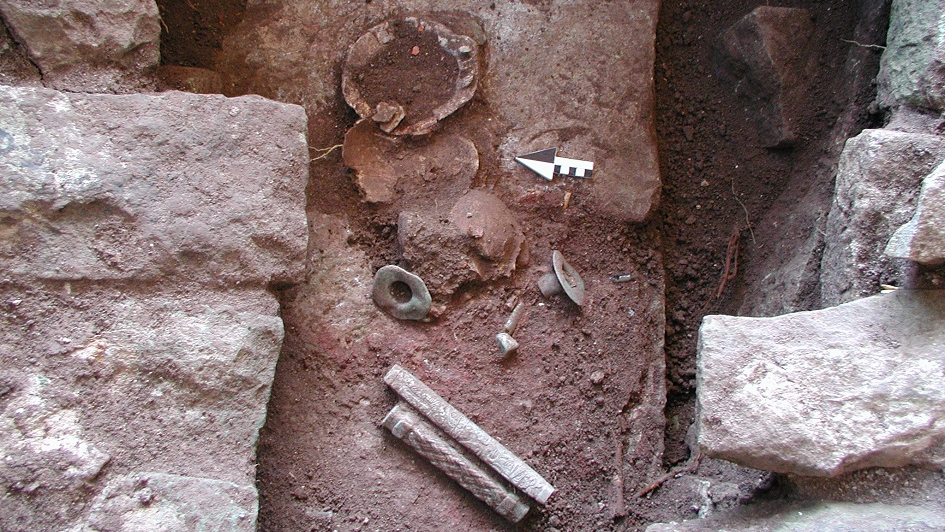
Skeletons buried near the ancient Maya city of Copán have revealed new clues about the collapse, but not total decimation, of the Maya civilization.
A study of the genomes of seven people from the Classic Maya period (A.D. 250 to 900) of Copán in what is now western Honduras showed that the population dramatically shrank around 1,200 years ago.
"Our findings indicate a decline in population size" among the Maya, study co-author Shigeki Nakagome, an assistant professor of genomic medicine at Trinity College Dublin, told Live Science in an email, which "aligns with a scenario proposed by archaeologists in which the population decreased but did not become entirely extinct."
Nakagome and colleagues published their findings Wednesday (May 28) in the journal Current Biology. In their study, the researchers investigated the hypothesis that outsiders assumed power at Copán in the late 420s and explored how interactions between locals and non-locals created social and cultural change at this important Maya center.
Copán was a major capital located at the extreme southeast of the Classic Maya civilization, functioning as a kind of crossroads between Central and South America. The royal dynasty that ruled for four centuries was established at Copán in A.D. 426 by a man known as K'inich Yax K'uk' Mo', who was an outsider according to inscriptions. Previous genomic and isotopic analyses of skeletons from other Maya sites have suggested that migration and gene flow were common, but the nature of that gene mixing at Copán had never before been investigated.
Based on their sequencing of genomes of seven people buried at Copán, the researchers discovered that the people all had different maternal lineages. Two males, however, belonged to the same Y-chromosome lineage and were buried together: one male in a wealthy burial was a possible dynastic ruler and the other male was a potential sacrifice.
But the men were not closely related. "Even though the dynastic ruler and the sacrificed individual share the same Y-chromosome haplogroup," Nakagome said, "we did not find any kinship." The lineage the men share is common among present-day Indigenous American populations, he said.
By comparing the seven ancient genomes to previously sequenced genomes across Siberia and the Americas, the researchers found strong evidence of genetic continuity in the Maya region from the Late Archaic period, roughly 3700 B.C. to 1000 B.C., to the present day. These genetic data suggest "the enduring persistence of local ancestry in the Maya region," the researchers wrote in the study.
They also found that during the Classic Maya period, there was an influx of people with highland Mexican ancestry, possibly from other Maya sites such as Chichén Itzá. These "outsiders" — perhaps part of the ruling dynasty of Copán — mixed with the locals, creating a population with two main ancestries.
Delving further into the genomic data of the seven individuals, the researchers were able to estimate the size of the Maya population at specific points in time. According to their model, "the population in the Maya region appears to have experienced significant growth in effective size, reaching approximately 19,000 [people]" around A.D. 730, they wrote. The increase may be related to the advent of maize agriculture, which could have supported a larger population. Then, the population size began to decline around A.D. 750, "coinciding with the onset of the collapse of Classic Maya civilization," they wrote.
Although the population dramatically dwindled with the collapse of the Maya political system, the researchers ultimately found support in their analysis for population persistence through time.
The genetic continuity observed in our study supports the idea that the population was not replaced by another group after the collapse." The genomes of the more than 7 million present-day Maya are closely related to the genomes of ancient Maya.