

Hope this is the correct spot for this.

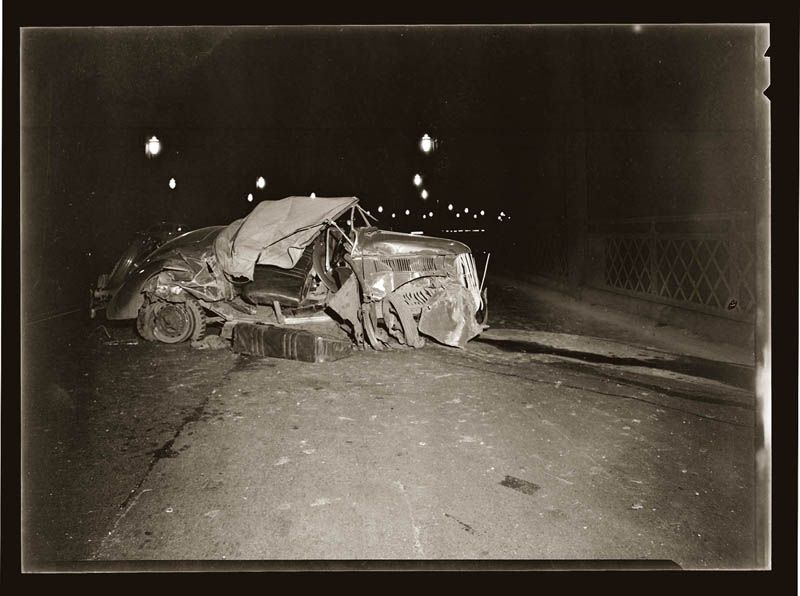
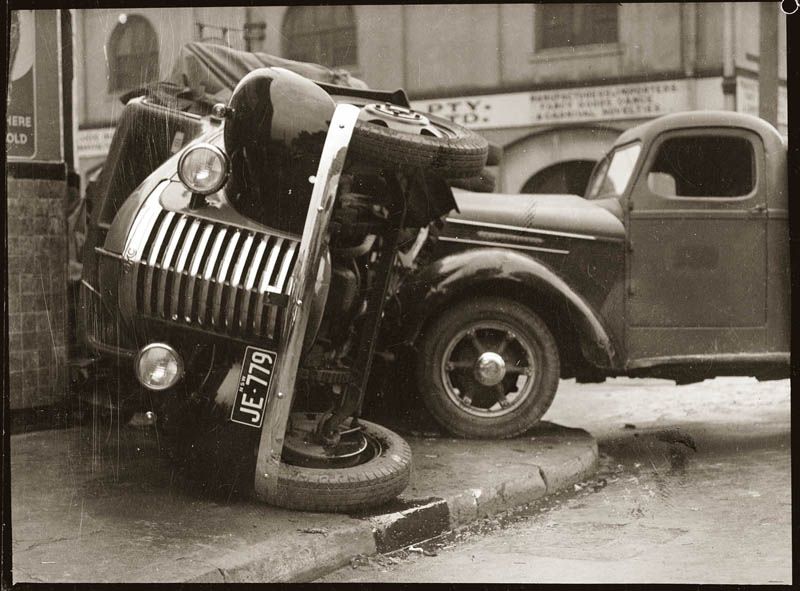
Car crash, night time, early 1940s. Details unknown, but possibly Liverpool street, Sydney.
This negative was found wrapped in a paper sleeve on which is written: ‘Group of criminals, Central 1921′. The subjects are not named, but the woman on the left is believed to be Eileen Leigh or Barry (daughter of Kate Leigh). The man on the far right in the back row may be Stephen Doyle, and the man to the left of him Kenneth McLelland (or McCrerrand). The man third from the left in that row may be the pickpocket and three-card trickster known as Frederick Mewson, and the man far left in the front row is likely the pickpocket known as Norman Smith.
The bottle next to the man is Waterbury’s Compound, a popular tonic and cough remedy. Spots of blood can be seen on his shirt. Other negatives indicate the site to be a toilet, apparently open to the sky, situated between two buildings, underneath a footpath/bridge in the inner city somewhere. It is unclear whether the man fell from the footpath/wall above, but the entire series of police photographs (from above looking down, from below looking up) suggest that police entertained that possibility.
Police photographers routinely made copies of studio photographs of missing people, then known officially as ‘missing friends’. This particular missing friend, Rene Flowers, had clearly been a vaudeville performer.
Other negatives found with this one show the exterior of the Camellia Grove Hotel (now the Sports Bar), Henderson Road, Alexandria, and various shots of a basement/cellar, showing signs of breaking and entering. These may all be related, in which case the photo shown here would likely be the hotel office, photographed following an attempt to crack the safe.
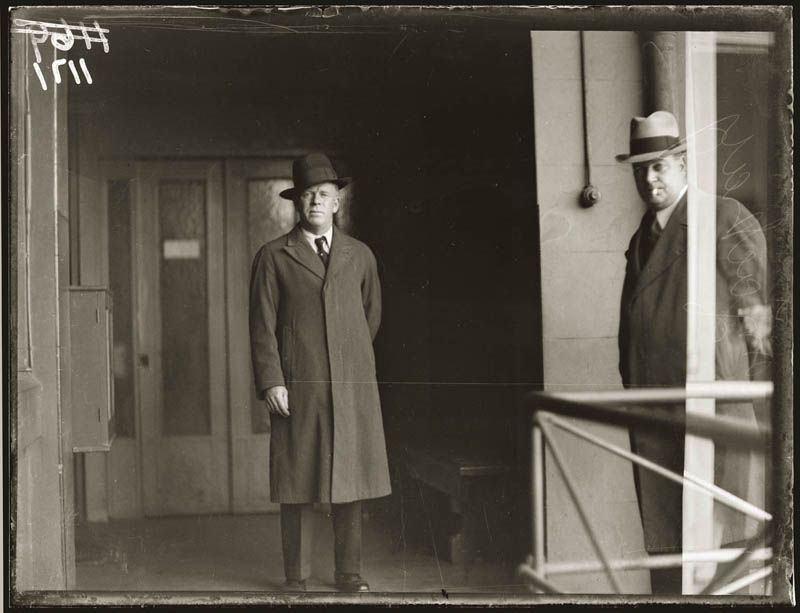
This photograph was published in Sydney newspapers in 1933, apparently at the behest of the then Commissioner of Police to demonstrate to a sceptical press and public that police could in fact operate undercover. This was apparently in answer to a suggestion that so distinctive was the build of the average detective, effective undercover work was out of the question. The men seen here are a mix of detectives and civilians. The figure third from the right is believed to be Sergeant Frank Fahy, aka “The Shadow”, the force’s most effective undercover operative at the time.
From a negative found in a box marked ‘IWW Dope’. The International Workers of the World, or ‘Wobblies’, carried out a program of direct action (which included sabotage and incendiarism) in Sydney in 1916, agitating for the release of their leader, Tom Barker. Barker had been jailed for sedition after making an anti-war speech in the Sydney Domain. ‘Dope’ refers to incendiary materials, such as cotton waste, turpentine, phosphorous and kerosene, allededly found during police raids on IWW headquarters in Sussex Street and in the rooms of various IWW members.
Street scene, Old South Head Road, Double Bay Sydney, showing collapsed shop wall and awning. Inscribed ‘Awning fatality Double Bay’, around 1926, details unknown.
Interior of commercial-industrial premises with bed and dresser. Details unknown, but assumed to be premises used for illegal abortions. Late 1930s.
Exterior, scene of car crash, from bridge onto storm water canal cover, early 1940s. Details unknown.
One of a series of photographs found in an envelope labelled ”persons selling tickets, Barrack St Sydney”. The unauthorised sellers have shrewdly set themselves up outside the State Lotteries Office. This photograph presumably taken without the subjects’ knowledge.
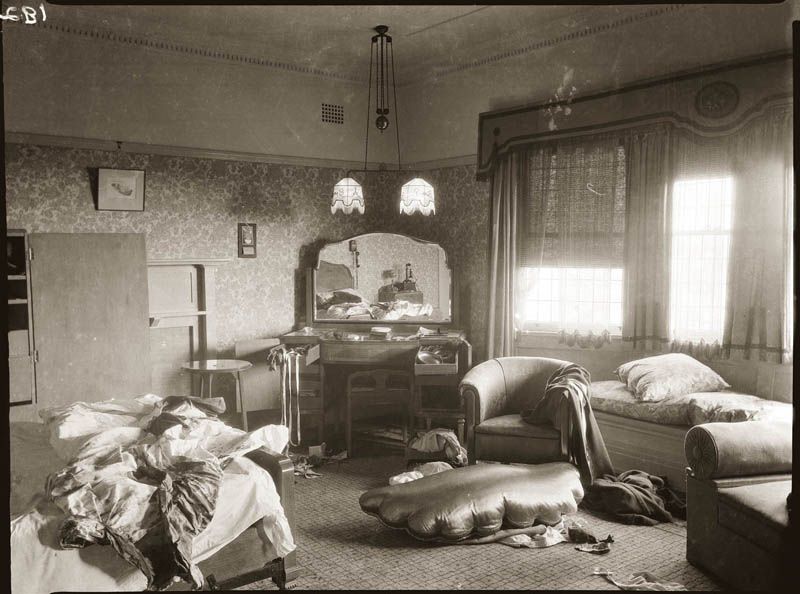
Bedroom with man’s hat on bloodstained bed. Mid-1940s. Details unknown.
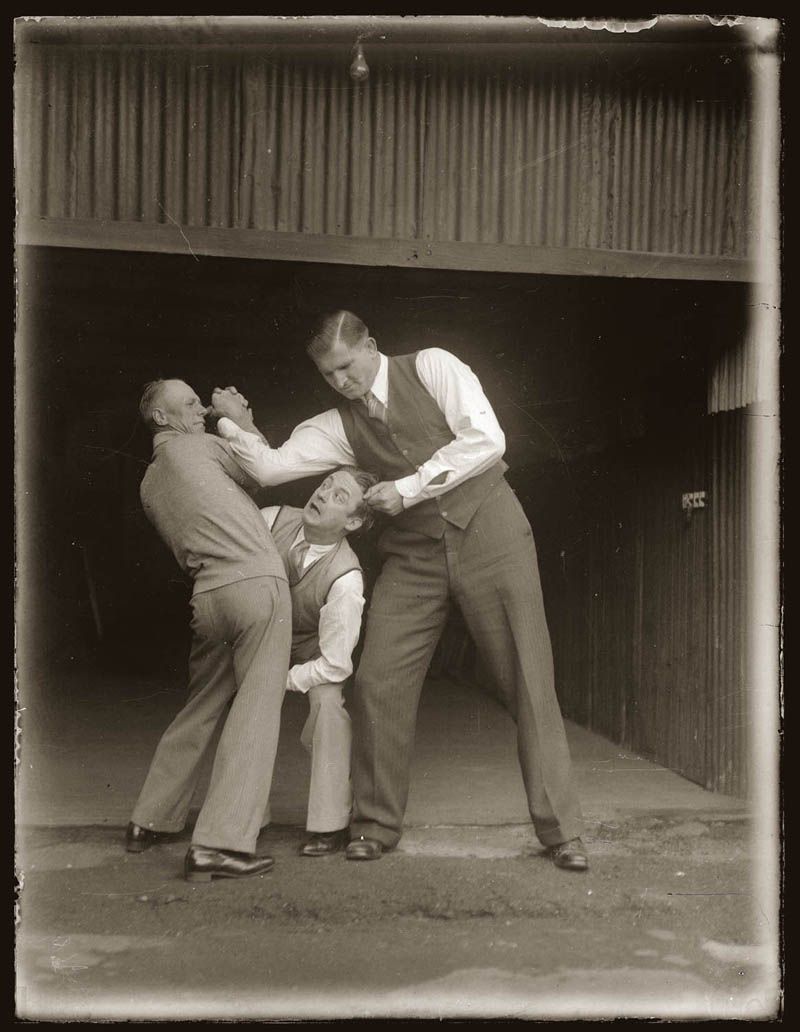
Demonstration of the techniques of pickpockets. Details unknown, but clearly a staged photograph, presumably made for police educational purposes.
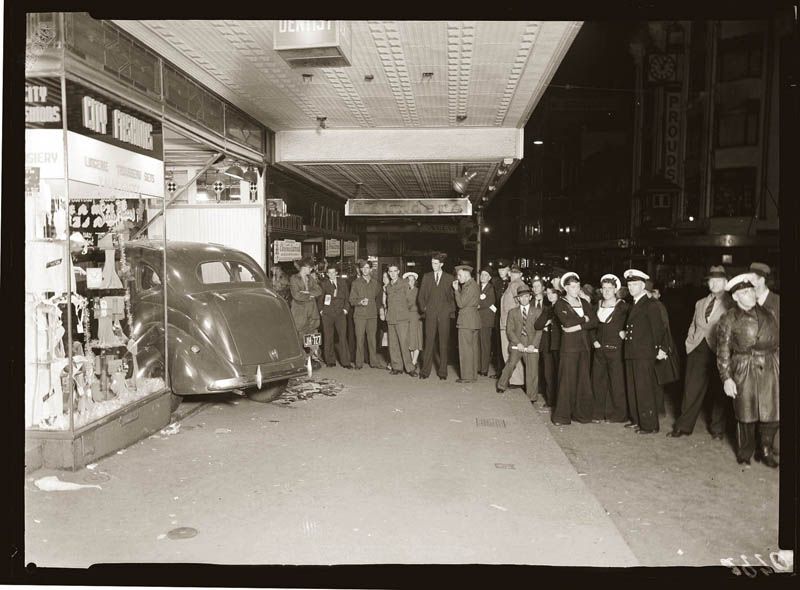
Car crash, night time, early 1940s. Details unknown, but possibly Liverpool street, Sydney.

This negative was found wrapped in a paper sleeve on which is written: ‘Group of criminals, Central 1921′. The subjects are not named, but the woman on the left is believed to be Eileen Leigh or Barry (daughter of Kate Leigh). The man on the far right in the back row may be Stephen Doyle, and the man to the left of him Kenneth McLelland (or McCrerrand). The man third from the left in that row may be the pickpocket and three-card trickster known as Frederick Mewson, and the man far left in the front row is likely the pickpocket known as Norman Smith.
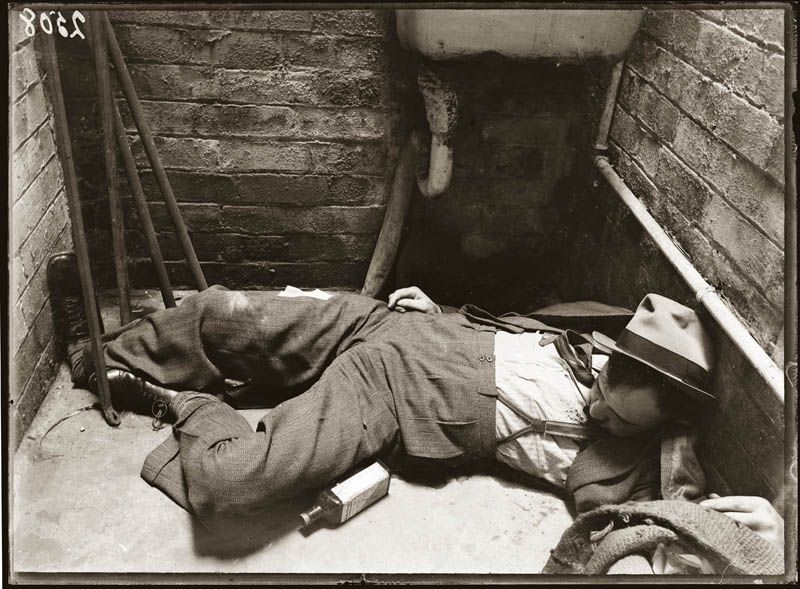
The bottle next to the man is Waterbury’s Compound, a popular tonic and cough remedy. Spots of blood can be seen on his shirt. Other negatives indicate the site to be a toilet, apparently open to the sky, situated between two buildings, underneath a footpath/bridge in the inner city somewhere. It is unclear whether the man fell from the footpath/wall above, but the entire series of police photographs (from above looking down, from below looking up) suggest that police entertained that possibility.
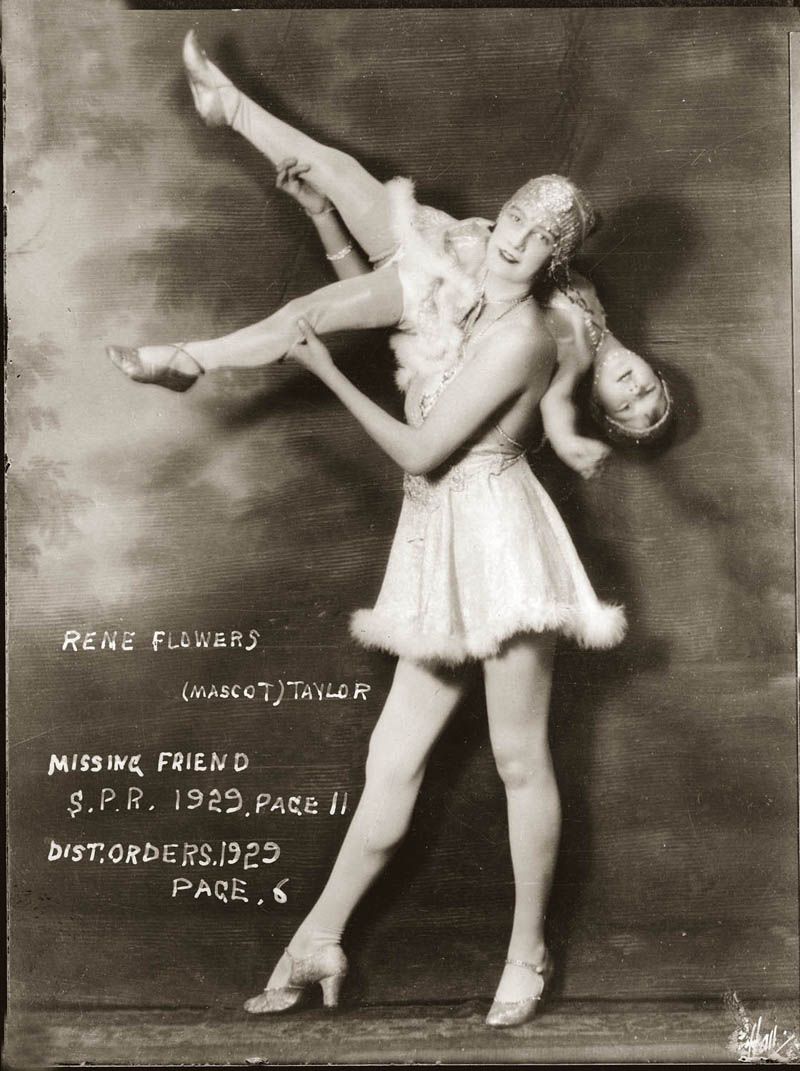
Police photographers routinely made copies of studio photographs of missing people, then known officially as ‘missing friends’. This particular missing friend, Rene Flowers, had clearly been a vaudeville performer.
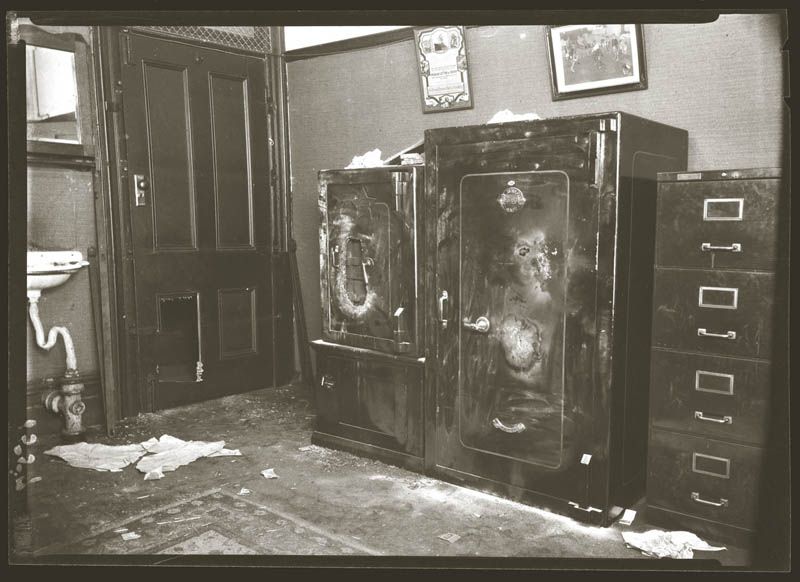
Other negatives found with this one show the exterior of the Camellia Grove Hotel (now the Sports Bar), Henderson Road, Alexandria, and various shots of a basement/cellar, showing signs of breaking and entering. These may all be related, in which case the photo shown here would likely be the hotel office, photographed following an attempt to crack the safe.
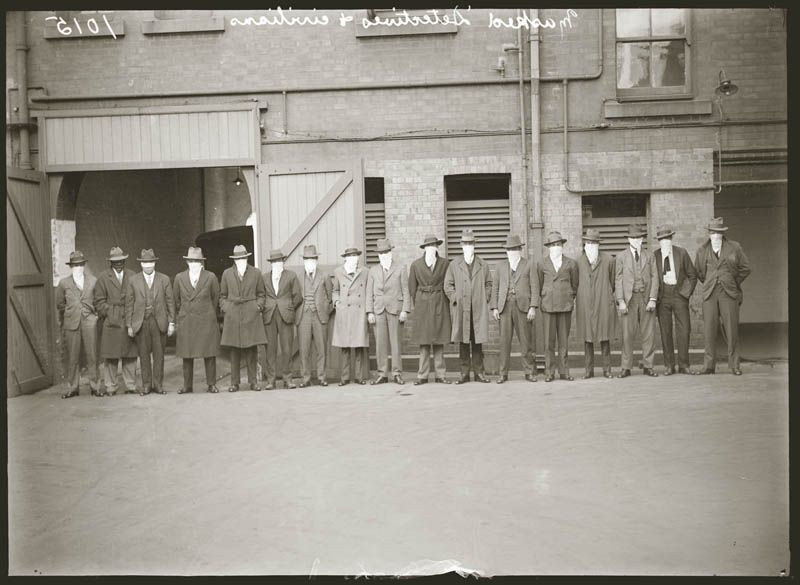
This photograph was published in Sydney newspapers in 1933, apparently at the behest of the then Commissioner of Police to demonstrate to a sceptical press and public that police could in fact operate undercover. This was apparently in answer to a suggestion that so distinctive was the build of the average detective, effective undercover work was out of the question. The men seen here are a mix of detectives and civilians. The figure third from the right is believed to be Sergeant Frank Fahy, aka “The Shadow”, the force’s most effective undercover operative at the time.

From a negative found in a box marked ‘IWW Dope’. The International Workers of the World, or ‘Wobblies’, carried out a program of direct action (which included sabotage and incendiarism) in Sydney in 1916, agitating for the release of their leader, Tom Barker. Barker had been jailed for sedition after making an anti-war speech in the Sydney Domain. ‘Dope’ refers to incendiary materials, such as cotton waste, turpentine, phosphorous and kerosene, allededly found during police raids on IWW headquarters in Sussex Street and in the rooms of various IWW members.
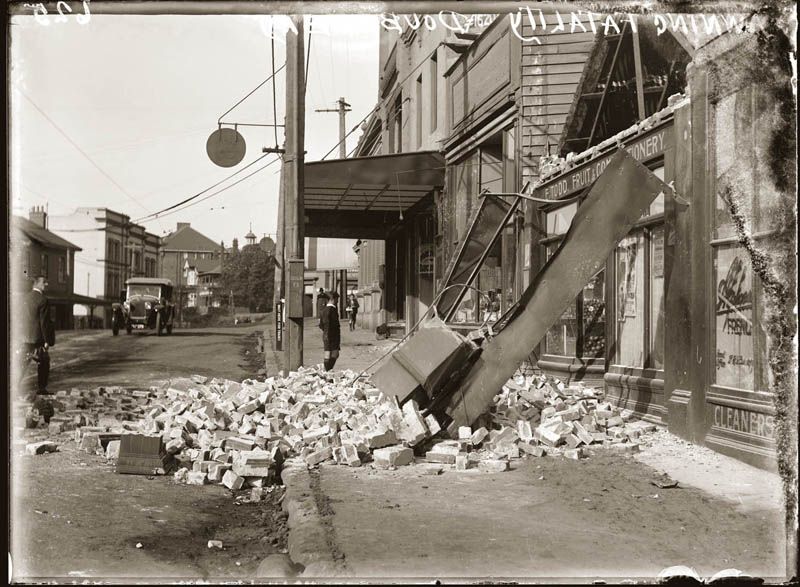
Street scene, Old South Head Road, Double Bay Sydney, showing collapsed shop wall and awning. Inscribed ‘Awning fatality Double Bay’, around 1926, details unknown.

Interior of commercial-industrial premises with bed and dresser. Details unknown, but assumed to be premises used for illegal abortions. Late 1930s.

Exterior, scene of car crash, from bridge onto storm water canal cover, early 1940s. Details unknown.
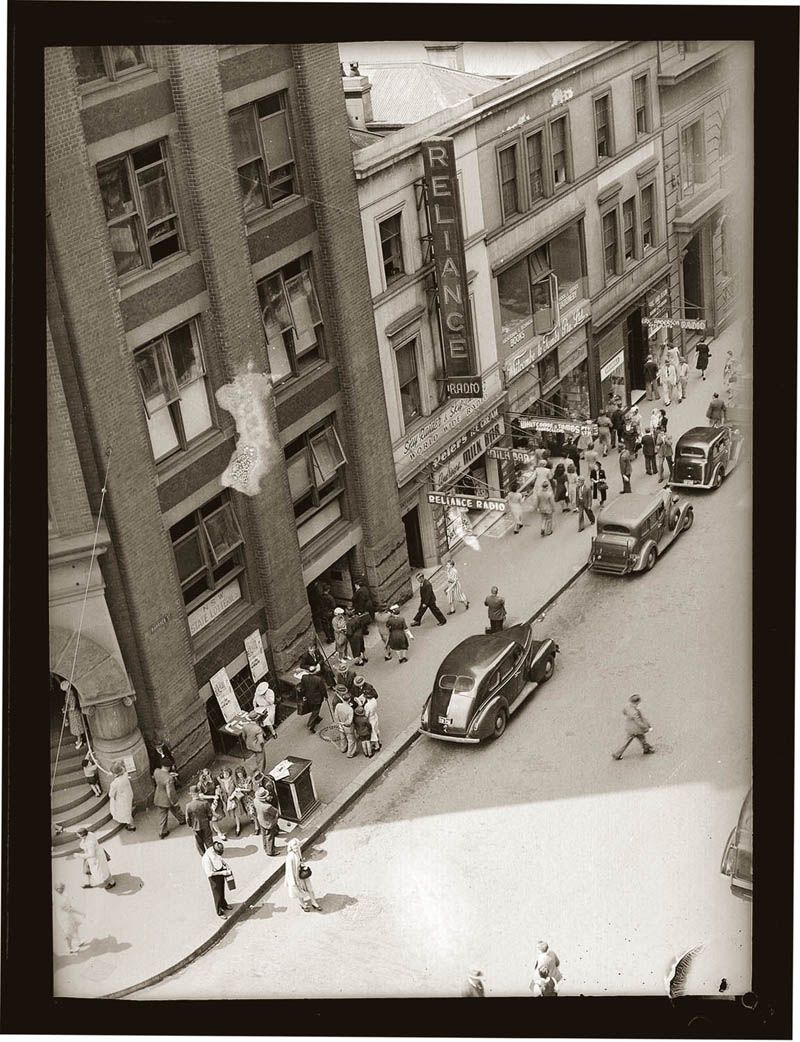
One of a series of photographs found in an envelope labelled ”persons selling tickets, Barrack St Sydney”. The unauthorised sellers have shrewdly set themselves up outside the State Lotteries Office. This photograph presumably taken without the subjects’ knowledge.
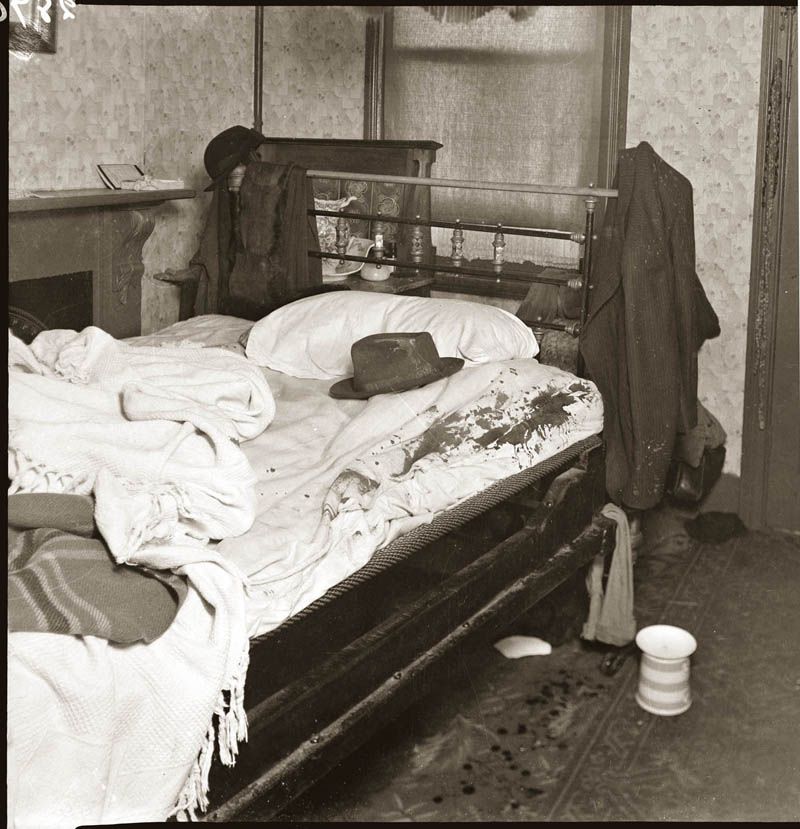
Bedroom with man’s hat on bloodstained bed. Mid-1940s. Details unknown.
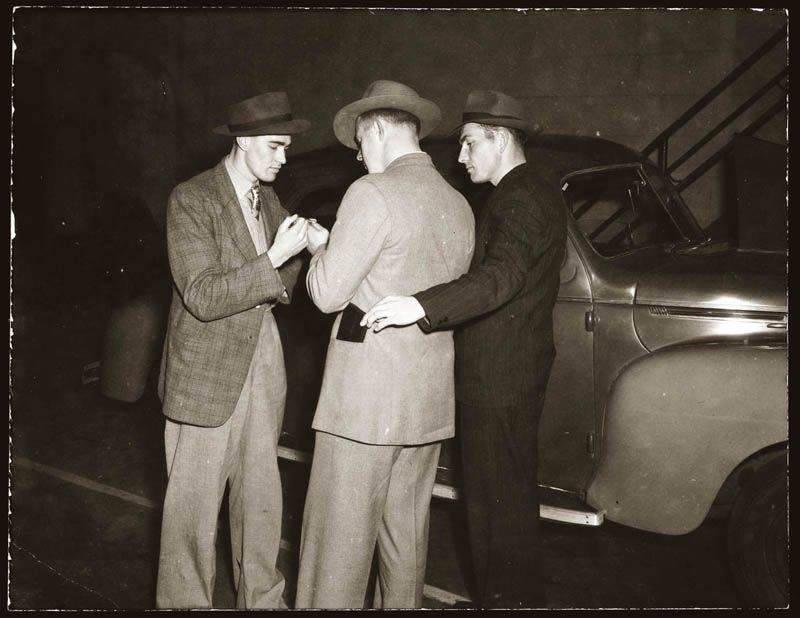
Demonstration of the techniques of pickpockets. Details unknown, but clearly a staged photograph, presumably made for police educational purposes.