


The "Blaze Star" T Coronae Borealis will erupt with a magnificent explosion sometime between now and September, becoming visible to the naked eye. Here's how to find it when it does.
A dim star in the night sky 3,000 light-years from our solar system could soon become visible to the naked eye for the first time since 1946 — and you can easily find it in the night sky.
The "Blaze Star" — officially called T Coronae Borealis (T CrB) — is expected to brighten significantly between now and September 2024 from magnitude +10 (beyond naked-eye visibility) to magnitude +2, according to NASA. That's about the same brightness as Polaris, the North Star, the 48th-brightest star in the night sky. (In astronomy, the brighter an object is, the lower its magnitude; the full moon's magnitude is -12.6, for example).
The Blaze Star can be found in the constellation Corona Borealis, the "Northern Crown," between the constellations of Boötes and Hercules. The easiest way of finding Corona Borealis is by first locating some of the brightest stars in the summer night sky.
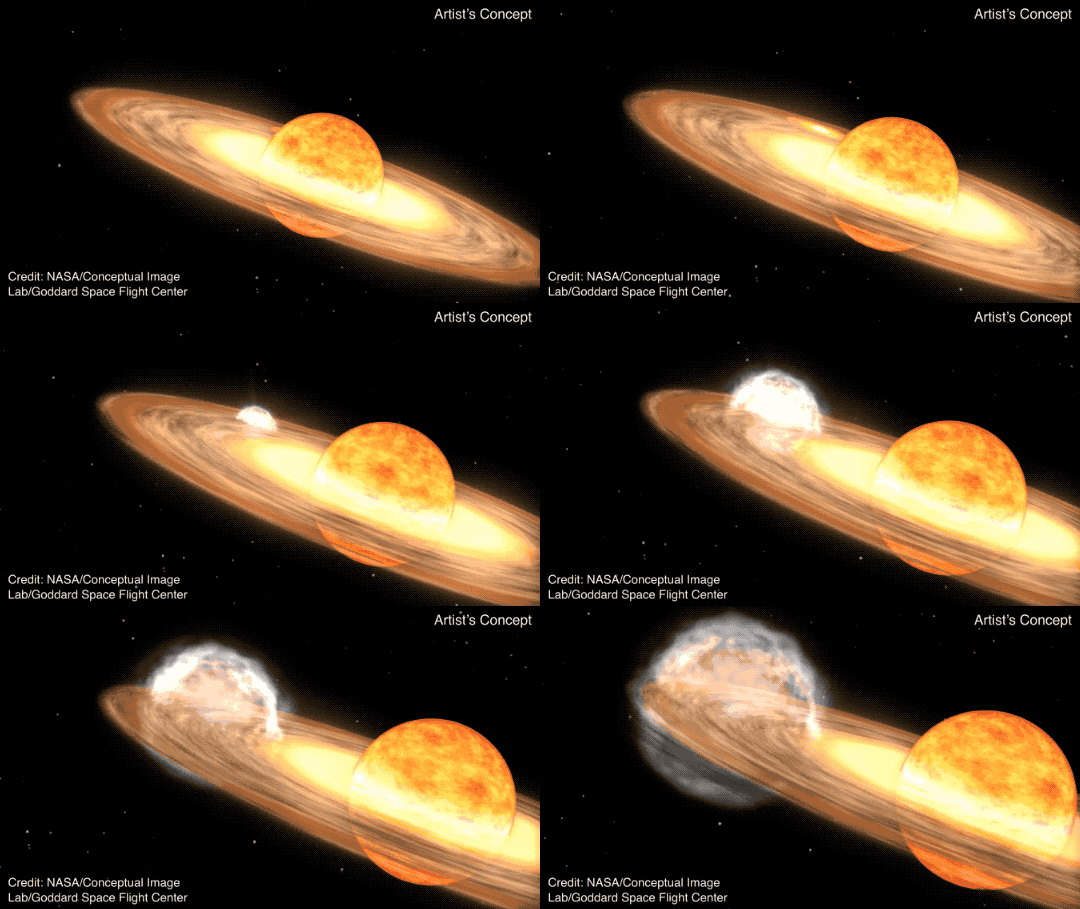
The Blaze Star is a rare example of a recurrent nova, which means "new star" in Latin. It's a binary star system with a cool, red giant star and a smaller, hotter white dwarf star orbiting each other. Every 80 years, the red giant propels matter onto the surface of the white dwarf, causing an explosion. Other stars do something similar, but not on such a short timescale.
Astronomers think the Blaze Star is on the cusp of exploding again because it's following the same pattern as the last two explosions in 1866 and 1946. Ten years before both explosions, it got somewhat brighter, then finally dimmed again just before the big blast. That's precisely what's been happening, with the star growing brighter since 2015, followed by a visible dimming in March 2023. This familiar pattern suggests that another explosion is imminent.
 www.livescience.com
A dim star in the night sky 3,000 light-years from our solar system could soon become visible to the naked eye for the first time since 1946 — and you can easily find it in the night sky.
The "Blaze Star" — officially called T Coronae Borealis (T CrB) — is expected to brighten significantly between now and September 2024 from magnitude +10 (beyond naked-eye visibility) to magnitude +2, according to NASA. That's about the same brightness as Polaris, the North Star, the 48th-brightest star in the night sky. (In astronomy, the brighter an object is, the lower its magnitude; the full moon's magnitude is -12.6, for example).
The Blaze Star can be found in the constellation Corona Borealis, the "Northern Crown," between the constellations of Boötes and Hercules. The easiest way of finding Corona Borealis is by first locating some of the brightest stars in the summer night sky.
The Blaze Star is a rare example of a recurrent nova, which means "new star" in Latin. It's a binary star system with a cool, red giant star and a smaller, hotter white dwarf star orbiting each other. Every 80 years, the red giant propels matter onto the surface of the white dwarf, causing an explosion. Other stars do something similar, but not on such a short timescale.
Astronomers think the Blaze Star is on the cusp of exploding again because it's following the same pattern as the last two explosions in 1866 and 1946. Ten years before both explosions, it got somewhat brighter, then finally dimmed again just before the big blast. That's precisely what's been happening, with the star growing brighter since 2015, followed by a visible dimming in March 2023. This familiar pattern suggests that another explosion is imminent.
A 'new star' will appear in the sky any night now. Here's how to watch the Blaze Star ignite.
The "Blaze Star" T Coronae Borealis is expected to erupt with a magnificent explosion sometime between now and September, becoming visible to the naked eye. Here's how to find it when it does.