• Adults Only Website 18+

    If you are under 18 you are not permitted to submit personal information to us or use this website. If discovered you will be banned.

    We will ban and report anyone posting illegal content.

    We will ban any forum user who breaks our terms.

    Freedom of speech should be wide open as long as it doesn't incite violence.

    We have a 15 year old thriving community here with 400,000+ members and hundreds of people online at any given moment, we encourage you to join!, there are 1000's of topics to discuss. Please be aware before registering and read our terms of service and privacy policy.

    By dismissing this notice and proceeding, you agree to the above.

Two Wheels

WSBK »
MV Agusta WSBK debut official
15 November 2013

"Our official return to racing is a very ambitious and important step for us” - Giovanni Castiglioni, MV Agusta.
  • AU1131674.jpg

    MV Agusta WSBK debut official

    More than 37 years after its last world championship race win, with Giacomo Agostini in 1976, MV Agusta will make its official comeback to top level racing in the 2014 World Superbike Championship.

    The iconic Italian brand, which has a record of 37 Riders' and 38 Manufacturers' titles, has finally confirmed its WSBK intentions, in partnership with Yakhnich Motorsport.

    "Our official return to racing is a very ambitious and important step for us,” said Giovanni Castiglioni, MV Agusta President. “Racing has always been my dad's greatest passion and this drove the brand to victory in many disciplines of motorcycle racing, from 500cc GP to Paris-Dakar and to the first Superbike World Championship titles won with Ducati.

    “His dream was to see MV back to racing and I am so proud to be the one doing so."

    Starting from 2014, MV Agusta will take on the challenge of both the WSBK and World Supersport series, recent won by Yakhnich (using Yamaha machinery) in only their second season in the series.

    "We worked very hard to achieve the great results of 2013. The partnership with MV Agusta opens a whole new set of opportunities,” said Alexander Yakhnich, Yakhnich Motorsport president. “We are truly happy of the agreement and we look forward to further success."

    MV Agusta took podiums in WSS with ParkinGO this year.

    Rider line-up for 'Yakhnich Motorsport MV Agusta Reparto Corse' will be revealed by the end of November.

    Javier Alonso, WSBK Executive Director, recognised the official presence of MV as being significant for the series as a whole.

    "We're glad to announce the official return of MV Agusta to the WSBK series,” he said. “The Italian brand is not only globally important but has an iconic and successful racing history, so welcome back and all the best to both the Manufacturer and the Team for the upcoming season."


Cool. We'll see...:)
 
Cool. We'll see...:)

it' s a step.

Suzuki, say they will be there in 2015 ( rumor is Randy De Puniet wont be ridin anything else but the Suz GP bike nxt year TESTING. Hoping/expecting, a Moto ride when they return, Hopper has just got a ride in BSB and he can/would run rings around Randy. Suzuki like the other 2 below need DEVELOPMENT rider. raced the beast over the last 5/6/7 years at least.

Aprilla with the loss of the goatee to the Ducati GP this year they claim to be "still" on track for a 2016 debut with a Moto GP bike. Numatic valves but they cant base the frame on the bike ( CRT ) they got.

MV . .. . . . . . good show in the super sportz/stocks. bit of a leap but they do have the BHP to go a long way.

If you read the rules there is going to be 2 clear classes again in both of our classes of WORLD CHAMPIONSHIP

MOTORCYCLING
 
  • Like
Reactions: McM
MOTOGP »
Provisional 2014 MotoGP entry list revealed
20 November 2013

Niccolo Canepa and Mike di Meglio join 2014 MotoGP entry list
  • PA1447617.jpg

    Provisional 2014 MotoGP entry list revealed

    The provisional entry list for the 2014 MotoGP World Championship has been released by the FIM.

    The grid is set to remain at 24 riders - 11 factory and 13 of the new 'open' class (using the full control ECU system, but having extra fuel and engine changes) - with former Pramac Ducati rider Niccolo Canepa and former 125cc world champion Mike di Meglio the latest additions.

    Canepa finished runner-up in FIM Superstock this year, and stood-in for Carlos Checa at two WSBK events, while di Meglio suffered an injury shortened season with JiR in Moto2.

    World champion Marc Marquez is set to continue with the #93, Iodaracing - which ran Suter-BMWs this year - are yet to confirm their machinery while the only seat still officially available is alongside Michael Laverty at PBM.

    Moto2 world champion Pol Espargaro, former title rival Scott Redding and di Meglio are class rookies.

    Riders who will not return next year, unless they get the PBM seat, are: Ben Spies (retired), Randy de Puniet (Suzuki test rider), Claudio Corti, Lukas Pesek and Bryan Staring.

    #4 Andrea Dovizioso ITA Ducati Team (Ducati *)
    #5 Colin Edwards USA NGM Mobile Forward Racing (FTR Yamaha)
    #6 Stefan Bradl GER LCR Honda MotoGP (Honda *)
    #7 Hiroshi Aoyama JPN Power Electronics Aspar (Honda)
    #8 Hector Barbera SPA Avintia Blusens (FTR)
    #9 Danilo Petrucci ITA Iodaracing Project (TBA)
    #17 Karel Abraham CZE Cardion AB Motoracing (Honda)
    #19 Alvaro Bautista SPA Go&Fun Honda Gresini (Honda *)
    #26 Dani Pedrosa SPA Repsol Honda Team (Honda *)
    #29 Andrea Iannone ITA Pramac Racing (Ducati *)
    #35 Cal Crutchlow GBR Ducati Team (Ducati *)
    #38 Bradley Smith GBR Monster Yamaha Tech 3 (Yamaha *)
    #41 Aleix Espargaro SPA NGM Mobile Forward Racing (FTR Yamaha)
    #44 Pol Espargaro SPA Monster Yamaha Tech 3 (Yamaha *)
    #45 Scott Redding GBR Go&Fun Honda Gresini (Honda)
    #46 Valentino Rossi ITA Yamaha Factory Racing (Yamaha *)
    #59 Niccolò Canepa ITA Iodaracing Project (TBA)
    #63 Mike di Meglio FRA Avintia Blusens (FTR)
    #68 Yonny Hernandez COL Pramac Racing (Ducati)
    #69 Nicky Hayden USA Power Electronics Aspar (Honda)
    #70 Michael Laverty GBR Paul Bird Motorsport (PBM/ART)
    #93 Marc Marquez SPA Repsol Honda Team (Honda *)
    #99 Jorge Lorenzo SPA Yamaha Factory Racing (Yamaha *)
    To Be Confirmed Paul Bird Motorsport (PBM/ART)

    * = Factory Entry: Will continue with their own ECU software but face four-litres less race fuel and a maximum of five, rather than twelve, engine changes during the season compared to the open class.


MOTOGP »
Provisional 2014 Moto2 entry list
20 November 2013

The FIM has announced the following 35-rider provisional entry list for the 2014 Moto2 world Championship...
  • PA1440443.jpg

    Provisional 2014 Moto2 entry list

    The new Caterham team has formed a partnership with Suter but will race with its own branded chassis. FTR returns with three full time entries - but Moriwaki departs as Idemitsu Honda switches to Kalex...

    2 Josh Herrin USA Caterham Moto Racing (CATERHAM)
    3 Simone Corsi ITA NGM Mobile Forward Racing (FTR)
    4 Randy Krummenacher SWI Iodaracing Project (SUTER)
    5 Johann Zarco FRA Caterham Moto Racing (CATERHAM)
    7 Lorenzo Baldassarri ITA Gresini Moto2 (SUTER)
    8 Gino Rea GBR AGT-Rea Racing (FTR)
    10 Thitipong Warokorn THA Stop And Go Racing Team (KALEX)
    11 Sandro Cortese GER Dynavolt Intact GP (KALEX)
    12 Thomas Luthi SWI Interwetten Paddock Moto2 (SUTER)
    15 Alex De Angelis RSM La Fonte Tasca Racing (SUTER)
    18 Nicolas Terol SPA Mapfre Aspar Team Moto2 (SUTER)
    19 Xavier Simeon BEL Federal Oil Gresini Moto2 (SUTER)
    22 Sam Lowes GBR Speed Up (SPEED UP)
    23 Marcel Schrotter GER Tech 3 (TECH 3)
    25 Azlan Shah MAL Idemitsu Honda Team Asia (TBA)
    30 Takaaki Nakagami JPN Idemitsu Honda Team Asia (KALEX)
    31 Kohta Nozane JPN JiR Moto2 (MOTOBI)
    36 Mika Kallio FIN Marc VDS Racing Team (KALEX)
    40 Maverick Vinales SPA Tuenti HP 40 (PONS KALEX)
    49 Axel Pons SPA Argiñano & Ginés Racing (KALEX)
    53 Esteve Rabat SPA Marc VDS Racing Team (KALEX)
    54 Mattia Pasini ITA NGM Mobile Forward Racing (FTR)
    55 Hafizh Syahrin MAL Petronas Raceline Malaysia (KALEX)
    60 Julian Simon SPA Italtrans Racing Team (KALEX)
    70 Robin Mulhauser SWI Technomag Carxpert (SUTER)
    77 Dominique Aegerter SWI Technomag Carxpert (SUTER)
    80 Luis Salom SPA Tuenti Hp 40 (PONS KALEX)
    81 Jordi Torres SPA Mapfre Aspar Team Moto2 (SUTER)
    88 Alessandro Nocco ITA Speed Up (SPEED UP)
    92 Alex Marinelarena SPA Tech 3 (TECH 3)
    94 Jonas Folger GER Argiñano & Ginés Racing (KALEX)
    95 Anthony West AUS QMMF Racing Team (SPEED UP)
    96 Louis Rossi FRA Stop And Go Racing Team (KALEX)
    To Be Confimed QMMF Racing Team (SPEED UP)
    To Be Confimed Italtrans Racing Team (KALEX)


MOTOGP »
Provisional 2014 Moto3 entry list
20 November 2013

The FIM has announced the following 33-rider provisional entry list for the 2014 Moto3 world Championship...
  • PA1440347.jpg

    Provisional 2014 Moto3 entry list

    The list confirms that Estrella Galicia 0,0 will switch from KTM to Honda machinery, with Romano Fenati and Francesco Bagnaia confirmed for Valentino Rossi's new VR46 team.

    Girl racer Ana Carrasco, who claimed eighth place in the final round of her rookie season at Valencia with Calvo KTM, is not listed...

    3 Matteo Ferrari ITA San Carlo Team Italia (MAHINDRA)
    4 Gabriel Ramos VEN Kiefer Racing (KALEX KTM)
    5 Romano Fenati ITA Team Sky-VR46 (KTM)
    7 Efren Vazquez SPA Caretta Technology (HONDA)
    8 Jack Miller AUS Red Bull KTM Ajo (KTM)
    10 Alexis Masbou FRA Ongetta-Rivacold (HONDA)
    11 Livio Loi BEL Marc VDS Racing Team (KALEX KTM)
    12 Alex Marquez SPA Estrella Galicia 0,0 (HONDA)
    14 Francesco Bagnaia ITALIAN Team Sky-VR46 (KTM)
    15 Bryan Schouten NED CIP Moto3 (MAHINDRA)
    17 John McPhee GBR Caretta Technology (HONDA)
    19 Alessandro Tonucci ITA CIP Moto3 (MAHINDRA)
    23 Niccolo Antonelli ITA Go&Fun Gresini Moto3 (KTM)
    31 Niklas Ajo FIN Avant Tecno (KTM)
    41 Brad Binder RSA Ambrogio Racing (MAHINDRA)
    42 Alex Rins SPA Estrella Galicia 0,0 (HONDA)
    43 Luca Grunwald GER Kiefer Racing (KALEX KTM)
    44 Miguel Oliveira POR Mahindra Racing (MAHINDRA)
    52 Danny Kent GBR Red Bull KTM Ajo (KTM)
    55 Andrea Locatelli ITA San Carlo Team Italia (MAHINDRA)
    57 Eric Granado BRA Mapfre Aspar Team Moto3 (KALEX KTM)
    58 Juanfran Guevara SPA Mapfre Aspar Team Moto3 (KALEX KTM)
    61 Arthur Sissis AUS Mahindra Racing (MAHINDRA)
    63 Zulfahmi Khairuddin MAL Ongetta-AirAsia (HONDA)
    65 Philipp Oettl GER Interwetten Paddock (KALEX KTM)
    80 Hafiq Azmi MAL Avant Tecno (KTM)
    84 Jakub Kornfeil CZE Team Calvo (KTM)
    95 Jules Danilo FRA Ambrogio Racing (MAHINDRA)
    98 Karel Hanika CZE Red Bull KTM Ajo (KTM)
    To Be Confirmed Go&Fun Gresini Moto3 (KTM)
    To Be Confirmed RW Racing GP (KALEX KTM)
    To Be Confirmed RW Racing GP (KALEX KTM)
    To Be Confirmed Team Calvo (KTM)
 
  • Like
Reactions: McM
This little girl did NOT cause the douche behind her to crash. A hot poker up the ass of the person who titled this clip -

And do you think he'll carry on like a pork chop if he gets 1 dislike cause someone did NOT like the title of his thread ?
 
MotoGP™ Analysis: The 2013 Falls Report

Monday, 25 November 2013
When competing on the limit in the MotoGP™ World Championship, the line between staying on your motorcycle and coming off it is an extremely fine one. That said, there were less falls in 2013 than there had been in 2012. We examine the facts…


Across the three classes of the World Championship, there were a total of 863 falls this season. This may be 42 less incidents than a year earlier, despite the number of Grands Prix having not changed, although when it comes to crashes in the MotoGP™ class alone 2013 has seen an increase on 2012 by 19, rising from 186 to 205.

Moto2™ leads for falls once again

In the MotoGP™ tier, the general experience of leading riders paid off as the mean crash rate per premier class race was only 11.4; this comes in stark contrast to the 18.5 of Moto3™ or 20.2 of Moto2™, although it must be taken into account that the average number per race is slightly more in the lower classes due to the fact that there was one less race (Moto2™ and Moto3™ did not compete at Laguna Seca). Nonetheless, this marks the fourth year in succession that the most crashes came in the intermediate class (the lightweight 125 class had been top in 2009).

Watch out for trouble in Free Practice 2…

A particularly intriguing area involves the sessions in which riders tend to hit most trouble. Across the three classes – with the exception of the race – it was Free Practice 2 which witnessed the most incidents, as the field began to experiment with race setups on a Friday* knowing a mistake would not count for as much as it might on a Saturday*. Sure enough, even double premier class World Champion Jorge Lorenzo – who only fell three times across the whole of the season – experienced his collarbone-injuring accidents of Assen and the Sachsenring in the second practice session.

*Assen: Free Practice 2 took place on Thursday afternoon before the Saturday race

The pressure of the occasion

For all classes, it is no great surprise to learn that more incidents came in races than at any other time in the weekend. However, prior to the racing action, it was not always Free Practice 2 that saw most drama; this may have been the case in MotoGP™, but in Moto3™ more incidents came in Free Practice 3, whereas in Moto2™ there were more crashes in Qualifying than in any other session. Perhaps this demonstrates the inexperience of younger riders while under extreme pressure to deliver a rapid flying lap. Granted, the Moto2™ field may be larger than that of MotoGP™, but no less than 69 falls took place in Moto2™ Qualifying in 2013, whereas the combined number of crashes in Q1 and Q2 for MotoGP™ was under half this number (30).

Marquez the leading championship challenger…for crashes…

Of the title contenders, rookie World Champion Marc Marquez was far and away the rider who crashed most in MotoGP™. The Repsol Honda Team rider suffered 15 falls across the season, although – unlike the aforementioned Lorenzo (three falls) or teammate Dani Pedrosa (six falls) – the newcomer would never suffer a broken bone.

In Moto2™, World Champion Pol Espargaro hit trouble on eight occasions over the year; this is double the four of rival Scott Redding, although the Englishman suffered the misfortune of a fractured wrist at Phillip Island. When it comes to Moto3™, World Champion Maverick Viñales crashed five times during the season, comparing to only two for championship runner-up Alex Rins and six for long-time championship leader Luis Salom; incidentally, half of Salom’s falls for the entire campaign came courtesy of crashes in the final two races alone.

Le Mans rain takes its toll

Predictably, it was Le Mans that claimed most crash victims in 2013 as the French Grand Prix took place amid mixed conditions. There were 68 incidents over the weekend; two more than the 66 of Misano and seven up on the 61 of the Sachsenring, when riders were constantly affected by the low number of left-handed corners which resulted in numerous crashes due to cold tyres. Laguna Seca’s 11 incidents cannot be compared equally - as only the MotoGP™ class competed in California - meaning it is the Qatar evening GP weekend that featured the lowest number of crashes (34), despite this being the season-opener when bike and rider combinations are freshest.

Beware of the Barcelona stadium!

When it comes down to the statistically most hazardous corner of the season, more riders hit trouble at Barcelona’s Turn 10 (La Caixa) than at any other corner.

‘La Caixa’ is located at the end of the back straight at the Circuit de Barcelona-Catalunya. Heading into the popular stadium section that is always packed with fans, it is a popular place for overtaking - not least on the opening lap of a Grand Prix. In the MotoGP™ race alone, three riders crashed at ‘La Caixa’ on the first lap of this year’s race, before Nicky Hayden followed suit later in the afternoon. Perhaps the most memorable incident was that of Lap 1, as Alvaro Bautista went down while attempting to avoid another clash with Valentino Rossi; this followed their infamous coming together on the opening lap of Rossi’s home Italian GP at Mugello just two weeks earlier.

Joining ‘La Caixa’ in the top three of corners for most crashes in 2013 are Le Mans’ Turn 7 (Musée), with 18 falls, and the Sachsenring’s Turn 1 and Turn 3, with 14 incidents apiece.
 
  • Like
Reactions: McM
MOTOGP »
Six races to decide Valentino Rossi's MotoGP future
27 November 2013

"The first six races will be crucial for deciding whether to continue or stop racing in MotoGP" - Valentino Rossi.
PA1406208.jpg

Six races to decide Valentino Rossi's MotoGP future

Valentino Rossi's performances during the opening six races of next season will be 'crucial' in deciding whether the Italian continues his MotoGP career beyond 2014.

The legendary seven time MotoGP champion claimed a record 80th victory during his return to Yamaha this year, but was left firmly in the wake of Marc Marquez (Honda), Jorge Lorenzo (Yamaha) and Dani Pedrosa (Honda) in the championship standings.

In an extract released by Sportmediaset.it from
MOTOGP »
Six races to decide Valentino Rossi's MotoGP future
27 November 2013

"The first six races will be crucial for deciding whether to continue or stop racing in MotoGP" - Valentino Rossi.
PA1406208.jpg

Six races to decide Valentino Rossi's MotoGP future

Valentino Rossi's performances during the opening six races of next season will be 'crucial' in deciding whether the Italian continues his MotoGP career beyond 2014.

The legendary seven time MotoGP champion claimed a record 80th victory during his return to Yamaha this year, but was left firmly in the wake of Marc Marquez (Honda), Jorge Lorenzo (Yamaha) and Dani Pedrosa (Honda) in the championship standings.

In an extract released by Sportmediaset.it from "The New Age - A year of MotoGP", to be broadcast by the Italy 1 TV channel tonight (Wednesday), Rossi states:

"If I'm here and I want to keep racing, I will have to stay ahead in 2014, closer to the first three. From February to June, the tests and the first six races will be crucial for deciding whether to continue or stop racing in MotoGP at the end of the season. I'd like to continue for another couple of years, but only if they are competitive."

As part of his efforts to bridge the gap to the class leaders, 34-year-old Rossi has split from crew chief Jerry Burgess, a decision he also addresses in the programme.

Rossi's most recent world title was in 2009, the #46 breaking a leg early in 2010 then making an ill-fated switch to Ducati for 2011.

The sixth race of the 2014 season will be Rossi's home Italian round, at Mugello., to be broadcast by the Italy 1 TV channel tonight (Wednesday), Rossi states:

"If I'm here and I want to keep racing, I will have to stay ahead in 2014, closer to the first three. From February to June, the tests and the first six races will be crucial for deciding whether to continue or stop racing in MotoGP at the end of the season. I'd like to continue for another couple of years, but only if they are competitive."

As part of his efforts to bridge the gap to the class leaders, 34-year-old Rossi has split from crew chief Jerry Burgess, a decision he also addresses in the programme.

Rossi's most recent world title was in 2009, the #46 breaking a leg early in 2010 then making an ill-fated switch to Ducati for 2011.

The sixth race of the 2014 season will be Rossi's home Italian round, at Mugello.

I cant find this anywhere atm if anyone can link me to it I would be grateful

"The New Age - A year of MotoGP"
 
wino
Just stumbled over a reportage about an event I'd accidentally visited in '88 here in Germany. This drag-racer named 'Red Porsche Killer', built from 4 x 400 ccm old 'Horex' motors, versus a tuned 911 Porsche. On a quarter-mile. It was about an old bet between the owners.
Around the race-track was big partying, biker rally and music. You'd have like it.
The 'race' itself, was a wit. The biker messed up changing the gear at start, and -hooray- went the Porsche.
They even made up a second race years later, with similar outcome...:facepalm:
No serious racing biz, but everyone had a good time... Old memories...
Horex 400x4.webp
 
Cool. We'll see...:)

-- Team MV Jerez Shakedown

Following two days of intense work at the Jerez circuit, the official MV team obtained some highly encouraging technical feedback.

The first day’s work focussed on getting the riders’ riding positions set up just right and making progress with the initial engine mappings.

On the second day things moved along even faster with a string of practice sessions and, by the time they were over, the happiest-looking man in the Yakhnich paddock was, without a doubt, Claudio Corti. The Varese-built Superbike - even with the engine still undergoing preliminary development and tuning and a chassis set-up that is still not definitive – was lapping at 1’42”9 by the end of testing.

In the Supersport category, both Leonov and Cluzel made several test runs to refine the electronics set-up. Here too, the F3 engine and chassis set-up are still at the initial development stage but, with both riders putting in lap times of around 1’45” without really pushing it, they had plenty to smile regarding the outstanding potential of the 3-cylinder MV.

Claudio Corti: “I’ve never ridden a bike with a front end that gives such great feedback; moreover, the engine also feels extremely promising. I can’t wait to ride the completed, definitive version of the bike in the January tests, and I get the feeling we could get good results even in our very first year”.

Jules Cluzel: “We didn’t ride as many laps as we wanted to set up the electronics and get the riding position right. I’m having to readjust to the Supersport riding style and tyres, but by the end of the second day I was really starting to enjoy myself and believe the F3 has outstanding potential”.

Vladimir Leonov: “I lost the first day tweaking the riding position as the bike's really small compared to the R6… But the sensations - with regard to both engine and chassis - were positive right from the word go. I think we're really going to ratchet up the performance of this bike very quickly indeed”.


If ya wann know more bud Google Yannik motorsport/racing
 
wino
Just stumbled over a reportage about an event I'd accidentally visited in '88 here in Germany. This drag-racer named 'Red Porsche Killer', built from 4 x 400 ccm old 'Horex' motors, versus a tuned 911 Porsche. On a quarter-mile. It was about an old bet between the owners.
Around the race-track was big partying, biker rally and music. You'd have like it.
The 'race' itself, was a wit. The biker messed up changing the gear at start, and -hooray- went the Porsche.
They even made up a second race years later, with similar outcome...:facepalm:
No serious racing biz, but everyone had a good time... Old memories...
View attachment 147478

I remember the bike but I cant find any fottage of it in action :(
 
MOTOGP »
Six of the Best: Jeremy Burgess inspired MotoGP wins
28 November 2013

Six of the best 500cc/MotoGP race wins inspired by crew chief Jeremy Burgess, set to retire after splitting from Valentino Rossi.
PA1295937.jpg

Six of the Best: Jeremy Burgess inspired MotoGP wins

Racing can appear a ruthless business at times - as illustrated at the Valencia MotoGP finale when Jeremy Burgess was shown the door after a record 80 wins while working as crew chief for Valentino Rossi.

As well as the seven titles with Rossi, Burgess - who entered grand prix racing in 1980 - also contributed to world championship honours for Freddie Spencer, Wayne Gardner and Mick Doohan (five).

To pay tribute to the Australian's mechanical genius we have chosen six of arguably the finest victories he inspired during a glittering grand prix career...

1988, Spa-Francorchamps - Reversing Gardner's fortunes
It wasn't an altogether strange phenomenon for the Honda Racing Corporation to get carried away with their own success in the eighties and early nineties. 1988 was a case in point. Wayne Gardner had won his first world championship the year before, yet his new NSR 500 sported few of the reliable components that took him to the crown.

The new model was lowered in a bid to improve handling while the engine had around 1,000 more revs. And in Burgess' own words the reigning world champion “got a little bit too much of an engineering brain on him, and decided he was going to reinvent the motorcycle.” The result was a bike that tried to throw Gardner off at every opportunity.

The Australian started the year strongly, narrowly missing out on wins to Kevin Schwantz, Eddie Lawson and Kevin Magee in the first three races, but when he finished 28 seconds behind the winner in Jerez, then 15 back at Monza cracks began to appear.

Personnel changes and lack of testing time were just some of the issues that irked Australia's first 500cc champion. “It's hard to keep it in line and stop it from shaking. They [Honda] need to be prepared to listen more,” he told the media midway through the season.

Luckily crew chief Burgess was listening and took matters into his own hands. “There's not a day gone by that I don't look at something on the bike and wonder if it couldn't be made better,” he told Michael Scott at the time. And make it better he did. Courtesy of hacking and welding the '88 frame into a different shape, Gardner began to pick up some momentum.

He crashed out when fighting for the lead at the Salzburgring but then won three races in a row, halving Lawson's lead in the championship from 40 to 20 points. The finest of these was undoubtedly his imperious ride through the puddles at a soaking wet Spa-Francorchamps. Of all places to ride an ill-handling NSR, this was surely the most daunting.
Handling improvements allowed Gardner to take the initiative at the start, building a comfortable lead over Christian Sarron. When the Frenchman crashed out he coasted home 30 seconds ahead of Lawson to breathe fresh impetus into his title defence.

The winning run not only demonstrated the undeniable bravery that took Gardner to the previous year's crown, but Burgess' ability to adapt and work with the materials afforded to him.

1992, Hockenheim - Getting the most out of Honda's 'Big-Bang' NSR
As 1991 came to an end and Yamaha's Wayne Rainey was toasting his second championship success at his home in Monterey, both Burgess and Mick Doohan were licking their wounds.

Three years into their working relationship and Doohan had only four victories to his name. The elusive 500 championship was notable by its absence.

Doohan had persistently told the Honda engineers to focus on driveability rather than their inherent desire to see their bike at the top of the speed charts. Over the winter Burgess was instrumental in changing their collective thinking. He reminded them of Freddie Spencer's title in 1983. Hadn't Spencer defeated Roberts on the sweet handling NS500 triple that lacked the V4 Yamaha's top end?

Speaking to Mat Oxley in the late '90s Burgess said, “We wanted the HRC guys to think in that direction rather than being blinded by top speed. We told them we needed acceleration between corners.”

The result was spectacular. Honda altered their engine design, packing the power pulses closer together, which allowed the rear tyre sufficient time to grip between each burst. In effect the rider had a more forgiving power delivery and the 'Big Bang' motor was born.

Lap times may not have dramatically improved but the new firing order didn't punish the rear tyre as it did before. Doohan took full advantage of the increased rideability. After he shattered the competition at the fourth round at Jerez, becoming the first rider since Agostini in 1972 to win the first four races, it seemed his first championship win was a mere formality.

The circus rolled into the awesome long, drawn-out curves at Hockenheim for round seven and Doohan produced, perhaps, the most dominant victory of his career at one of his favourite tracks. He qualified on pole by nearly one and a half seconds and, aided by a new concoction of Elf fuel that increased the top end, was never headed after the first chicane.

At the death Schwantz was a demoralising 24 seconds in arrears. Gardner was the closest Honda, a further 11 back. It was common knowledge Hockenheim had, in Lawson's words, a 'Honda lane' but one of its finest facets was the close racing it produced. The winning margin had been less than 0.3secs on the two occasions the 500s last raced there.
That Rainey was watching on the sidelines after a qualifying spill was almost irrelevant. Even with him there this kind of domination hadn't been seen, arguably, since the days of Agostini.

Burgess often cited this triumph as one of his greatest satisfactions, displaying that mechanical desire to witness the package ridden to its maximum. As he wryly commented in later years, “Hockenheim isn't a place where you normally win by 24 seconds.”

1997, Shah Alam - Laying down a marker with the 'Screamer' NSR
Àlex Crivillé arrived in Malaysia for the opening round of 1997 buoyed by pre-season talk of a title challenge. '96 proved he could consistently run with the might of Doohan, and on occasion beat him. This was the Spaniard's chance to make a true fight of the championship.

Yet on the other side of the Repsol garage Doohan and Burgess had been working on something a little different for the upcoming season. The Australian, now a three time world champion, was looking for ways to spice up his racing after years of serial dominance.

Honda reintroduced the 'pre-big bang' 500 with a 180 degree firing order where the cylinder pairs fired evenly, giving the NSR greater torque and midrange power. Crucially it gave Doohan, whose first grand prix experience was on the tyre splitting 'screamers' of the late '80s, a direct connection between the throttle and rear wheel. “I much prefer riding this bike,” he declared upon arriving for the first round.

The problem for team-mates Crivillé and Tady Okada was that they didn't. They turned down the opportunity to race 'The Screamer' as its power delivery was too fierce. The big bang configuration was gentle and predictable by comparison.

Okada took the first pole of the season but Doohan dominated the race, easing home ten seconds ahead of Crivillé. The Spaniard was dogged by tyre wear in the closing stages while Doohan's clever tyre management allowed him to quicken his pace as the race progressed. It was the first of a record twelve victories in 1997, five of those won by over ten seconds, as Doohan mauled the opposition.

Burgess and Doohan's tactic was clear from the off: Demoralise everyone in sight. Burgess helped out with the occasional snipe at Crivillé in the press. “I can understand why he prefers the other motor, because that's what he is familiar with. Mick knows both and likes this one more.” Crivillé ended the year a distant fourth, 168 points behind his team-mate. So much for a two-way title fight.

Doohan laid down a marker at the first race, proving he was not only faster than his rivals over a single lap but comfortably so on race rubber. And, more importantly, on a bike his rivals couldn't handle. In the murky humidity of Shah Alam the Australian had gone a long way to convincing his rivals he couldn't be headed all year.

2004, Welkom - Winning with Yamaha first time out
When asked to describe his working relationship with Valentino Rossi “Experience, understanding… and the quality to work through problems methodically,” was Burgess' reply.
 
  • Like
Reactions: McM
This systematic method was never more apparent than the beginning of 2004. The task of turning an ailing factory into championship challengers in little over two months represented Rossi's biggest challenge as a rider and Burgess' biggest as an engineer.

The Italian had grown disillusioned with Honda's corporate dealings and decided moving to Yamaha, a factory that hadn't won the MotoGP crown since 1992, would not only bring fresh enjoyment but motivation to his approach. Honda refused to release him from his contract at the end of 2003, meaning he couldn't test the revised M1 until February, just eight weeks before the 2004 season opener in South Africa.

Part of Yamaha's problem stemmed from chasing a set up that prevented the rear wheel from sliding. Burgess commented the bike wasn't “anywhere near where I thought it should be” when Rossi first tested it in Malaysia.

Another problem was the general malaise that eleven years of failure naturally brings. “At the grand prix level of Yamaha, there was no belief there that they could beat Honda. They just always accepted they couldn't,” he told Cycle News.

Yet at Sepang morale was boosted when Japanese engineering guru Masao Furusawa presented the cross plane crankshaft motor that proved smoother and more stable acceleration.

With the new motor aided by a new chassis the times started to fall and the operation gained momentum. Rossi posted sensational times at the official tests before topping every practice session at the opening round in Welkom. His slender win over Max Biaggi in the race would go down in history as one of his finest.

The celebrations were wild and even after nine world championships Burgess couldn't help but feel this ranked amongst his finest achievements. When journalists shoved their microphones in his direction as Rossi was ascending the podium all he could mutter was “Probably the biggest job I've ever done.”

But Burgess played down the part he and his team of mechanics had played in the instant reversal of fortunes. “I'm sure Valentino would have been successful with or without me… Perhaps it would have taken half a season to swing Yamaha around from the way they were thinking,” he told Cycle News. The fact they managed it during a single pre-season was a minor miracle.

2006, Sachsenring – Burning the midnight oil pays dividends
Although he and Rossi's exertions during their two years at Ducati resulted in limited success it would be foolish to forget Burgess' prowess at reversing the fortunes of an ailing machine.

After all, he had learnt at the altar of Erv Kanemoto in 1984 when Honda introduced the overly ambitious and slightly eccentric NSR, complete with single crankshaft and 'upside down' chassis. The fact Spencer still won grands prix on that model spoke as much of his talent as it did of the personnel surrounding him.
Rossi and Burgess won all before them with Yamaha in '04 and '05 but while engineers focussed on introducing the fully electronic throttle system for 2006 problems with the chassis emerged. The rigidity balance was lost and chronic front-end chatter was the result.

Rossi recorded memorable wins in Qatar and Mugello but none demonstrated the shrewd foresight of Burgess better than Rossi's triumph amidst a four-rider slog at the Sachsenring.

Still recovering from a broken bone in his wrist suffered two rounds prior at Assen, Rossi could only manage eleventh in final qualifying and a third row start. After the race Rossi quipped “I have to say is 'sorry' to my M1 because last night was the first time in our relationship that I ever doubted her!” Something dramatic was needed.

Burgess and his engineers decided if Rossi had the speed though the three left handed bends preceding the 'Waterfall' he could out-brake anyone at the penultimate corner. Their overnight changes reflected this. The M1 may have been slow and clumsy around the Omega curve but Rossi was fast where it mattered and utilised his improved set up in the race.

A frantic battle ensued with Honda riders Marco Melandri, Nicky Hayden and Dani Pedrosa all taking turns at the front.

Although it required Rossi riding at his peak of his powers to execute, Burgess' game plan paid off. The pack of Hondas had no answer for Rossi at the penultimate turn. Moreover, they didn't have sufficient time to re-pass him before the finish line. The size of Rossi's winning margin (0.145s) and gap to fourth placed Pedrosa (0.307s) reflected one of the closest races in history.

One man who attested to Rossi's genius that day was Colin Edwards, sitting on the other side of his garage. The Texan could only manage eleventh in the race and looked baffled upon hearing the result. “I never had the pace. It looked like Valentino was in the same situation but today he pulled out something like his 700th miracle.” What he failed to mention was that a certain Australian also played a part.

Laguna Seca, 2008 - Turning the tide with tactical nous
The role of chief mechanic in the garage is wide ranging. It has as much to do with personnel and motivational skills as it does technical knowhow.

Speaking to Cycle News Burgess said leadership and organisation are also essential. “The crux is getting the guys together and motivated, so that during the season they give everything they've got.”

Add a strong psychology to that list and you have a fair idea of what a MotoGP technician's CV requires. Burgess was always willing to engage in psychological combat and in Rossi, he had a rider who excelled in this field. "I enjoy that side of racing too. I like it more than just setting up the bike and fixing problems," he told Mike Nicks in 2004.

Having faced the likes of Kenny Roberts, Eddie Lawson, and Wayne Rainey, Burgess knew a threat when he saw one. After starting his title defence in 2008 in subdued fashion, Casey Stoner scored three stirring victories in the space of four weeks to whittle Rossi's title lead down by 30 points.
Again the Yamaha team had to act. And where better to do that than Laguna Seca, the scene of Stoner's most dominant MotoGP weekend in his championship year?

Stoner qualified on pole a full 0.447 seconds clear of the Italian. Rossi commented on Saturday evening, “maybe I need to start 30 seconds earlier!” referring to Stoner's dominance up until that point.

Burgess' message to Rossi that night was simple: “Casey hasn't thought about having to race anyone, he's thought only about winning the race,” he told David Emmett of Motomatters some time after.

Rossi's comments on Saturday evening proved a stroke of genius, goading Stoner into a false sense of security. With further modifications in morning warm-up Rossi lined up in the race knowing it was imperative to lead before the field descended the Corkscrew.

And he did. As one of MotoGP's most memorable battles played out Burgess' words once again rang true.
 
Speed Read-ing
by staff
Friday, November 29, 2013
Phil Read: on the Yamaha and hauling ass at Silverstone in the mid 1960s. He turns 75 next month.
image by filo draweria
In the pantheon of British Grand Prix riders, for many fans, the names Mike Hailwood, Barry Sheene, and even John Surtees spring easily to mind. But, one rider who is frequently mentioned further down the list--or, for shame, left off the list altogether--is, by all accounts, one of the best British Grand Prix riders of them all.

Phil Read won a total of EIGHT Grand Prix World Championships, including titles in four different GP classes: 125cc, 250cc, 500cc, and 750cc. He finished on the podium in 121 Grand Prix races. Read is one of only three riders to win Grand Prix titles in three or more different classes. The other two riders are the aforementioned Hailwood and some guy named Valentino Rossi. Also, along with Jon Ekerold, Read is one of only two riders to have won a Grand Prix World Championship as a privateer on a non-factory-prototype machine.

Phil Read was the very first rider to win a Grand Prix World Championship for Yamaha, and he was the last to win the Senior TT title for MV Agusta.

As a prolific rider in the '60s, Read predated Barry Sheene as a rider who developed a reputation as a gadabout. With his mop of black curly hair, Read sort of resembled a real-life Austin Powers. However, unlike Mike Meyers' fun-loving, shaggadelic character, Phil Read was generally as serious as a heart attack, whether on track or off. During his racing career, Read often came off as brusque, unapproachable, moody, and other things less printable. He was very focused, to say the least, and his intensity obviously reaped huge dividends on a motorcycle.

In 2010, Read told an interviewer that while he did classic and parade laps with period racers Jim Redman and Giacomo Agostini, neither were his friends in the present nor back in their heyday. Read said he made true friends away from the track and only came to the races to race.

One of the greatest examples of Read's intensity and gamesmanship occurred during the 1964 Grand Prix season where Yamaha--with Read in the saddle of their powerful RD56 two-stroke 250cc twin--had the upper hand. Honda could see the 250cc GP title slipping through their fingers.

Honda had planned to introduce an all-new, ultra-powerful 250cc six-cylinder GP bike in 1965, but they really needed the bike a year earlier. So, in the middle of the 1964 season and just prior to the Italian GP, they flew their rider Jim Redman to Japan to test the bike, in the hopes that he could race it immediately in order to stem the Yamaha tide. The new Honda six had plenty of power to outperform the Yamaha twin, but it handled badly, and there was just no time left before the Italian GP to sort it out.

Redman had to win at Monza in order to retain the coveted 250cc title that he and Honda had won in both 1963 and 1962, and he knew the Yamaha twin could outrun Honda's current four-cylinder two-stroke. So, Honda and Redman took a huge gamble and decided to race the not-yet--ready-for-primetime Honda six.

One of the greatest examples of Read's intensity and gamesmanship occurred during the 1964 Grand Prix season where Yamaha--with Read in the saddle of their powerful RD56 two-stroke 250cc twin--had the upper hand.
When the Honda was first rolled out at Monza, the bike immediately struck fear in the other riders and mechanics. Well, everyone except Phil Read. A report in CYCLE magazine by late reporter Jim Greening stated that after seeing the Honda, that Read promptly fabricated and attached two extra expansion chambers to his Yamaha twin, threw a blanket over the engine, and wheeled out the bogus Yamaha "four." This promptly caused panic in the Honda camp because they knew that Yamaha was hard at work on a four-cylinder 250cc bike.
The 250cc Italian GP went green, and Redman promptly took the lead on the new Honda six. But, after the first few laps, the bike would only run at three-quarter throttle, negating the power advantage that Redman had at the start. It was Redman's last chance at the 1964 250cc title, and he rode the race of his life, leaning the Honda at impossible angles and sending up showers of sparks in each comer. But, try as he might, he just couldn't catch Phil Read, who opened up a big lead, and ultimately won the 1964 250cc title, which was Yamaha's first Grand Prix World Championship.

When the calendar turns over to 2014, Phil Read will also turn 75 years old. He was a New Year's Day baby who grew up to become one of the best British Grand Prix riders of them all.

ENDS
 
The Golden Era of Win Ads #1

1.webp


This a Yamaha ad produced after Jamie James won in Wisconsin.

1a.webp

Dunlop's Daytona win ad from the early 1990s.
2.webp

Honda, too, produced some wonderful ads. Here is a pre-event USGP ad.
3.webp

Eddie Lawson has enjoyed 'He walks on water' status at Yamaha USA for nearly 30 years.
4.webp

Our Kev' in a classic Suzuki ad.
5.webp

Back in the 1980s, dirty pictures had RM125s in them and a 'Cam Girl' was a female mechanic who was good with a feeler gauge.
6.webp

In the 1980s Michelin USA had a very imaginative ad agency that produced some great win ads like this one for Eddie Lawson's world title.
7.webp

Yoshimura Suzuki rider Wes Cooley Jr in a Suzuki ad. The GS750 Superbike project was one of the more ambitious that Yosh pulled off in the 1980s.
8.webp

Our Kev in an ad after a win at the totally balls out Salzburgring.
9a.webp

A Ducati USA ad from the era when they were still struggling to shake the old Berliner days and strive for legitimacy. Dale Quarterley on a Ferracci 851.
9b.webp

The infamous Lawson vs Gardner ad. Producer Dennis Kanegae didn't know if it was going to be fight or flight when and if the two started swinging at the photo shoot. (Story here)
9c.webp

From the file labeled 'you'll never see this again': Australian WSBK rider Rob Phillis in a Kawasaki Australia ad--strafing fast on the street with his feet protected only by a pair of high top tennis shoes.
 
  • Like
Reactions: McM
MOTORCYCLES
Ride:HUD brings head-up display tech to existing motorcycle helmets
By Ben Coxworth

November 29, 2013


The Ride:HUD display (lower right) as seen through a motorcycle helmet

Image Gallery (3 images)
Head-up displays, or HUDs, are claimed to make driving much safer and easier – instead of looking away from the road and shifting their focus to the dashboard console, drivers just need to glance at an unobtrusive display projected onto their view of the road. NUVIZ now wants to bring HUD technology to motorcyclists, in the form of its Ride:HUD helmet system.

One of the things that makes Ride:HUD stand out is the fact that it's designed to be added to existing full-face helmets. Some other motorcycle HUD systems, such as those being developed by Skully, LiveMap and Reevu, are built into helmets that replace the rider's existing brain bucket.


The main Ride:HUD unit is attached to the chin bar of the helmet, via an adhesive-backed quick-release mount – this allows the device to be taken off when not needed, or transferred between helmets. Its translucent liquid-crystal-on-silicone screen sits in the rider's lower right-hand field of view, where it reportedly doesn't get in the way.

Information displayed on the screen can include basic riding stats (speed, distance traveled, etc.), navigation maps/directions and weather maps, plus incoming calls and music library access on a paired Android or iOS phone. That phone also serves as the brains of the device, via the Ride:CLOUD app.

The unit additionally has a built-in HD camera, so it can shoot POV stills or video. In order to do things like switching between screens, riders use a simple push-button Bluetooth controller that is mounted in an easy-to-reach location such as the top of their gas tank.

While Ride:HUD is being promoted as "the world’s first Head-Up Display for motorcycle helmets," it in fact is not. Even if you don't count the earlier-mentioned systems that are built into helmets, Motion Research Corporation has already been offering its add-on SportVue system for several years. BikeSystems is also taking preorders on its BikeHUD, although it uses a tiny opaque screen as opposed to a see-through projected display.

The NUVIZ team is currently raising production funds for Ride:HUD, on Kickstarter. A pledge of US$479 will get you a unit, when and if they're ready to go. More information is available in the pitch video below.

http://www.gizmag.com/nuviz-ride-hud-motorcycle/29967/
http://www.ridenuviz.com/index.html
http://www.kickstarter.com/projects...p-display-for-motorcycle-helmets?ref=category
 
  • Like
Reactions: McM
WSBK »
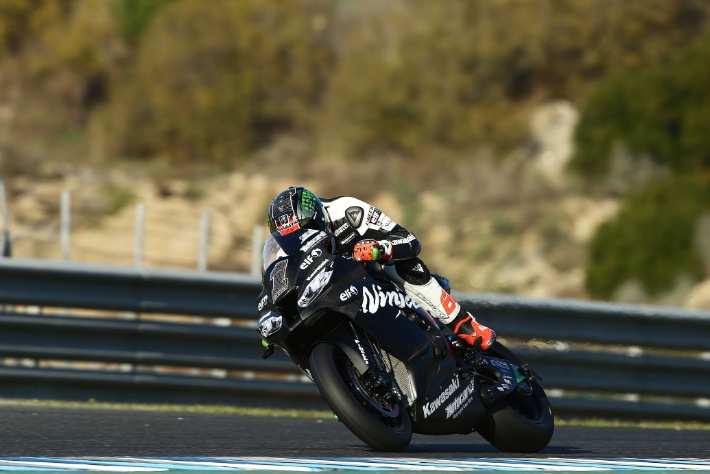
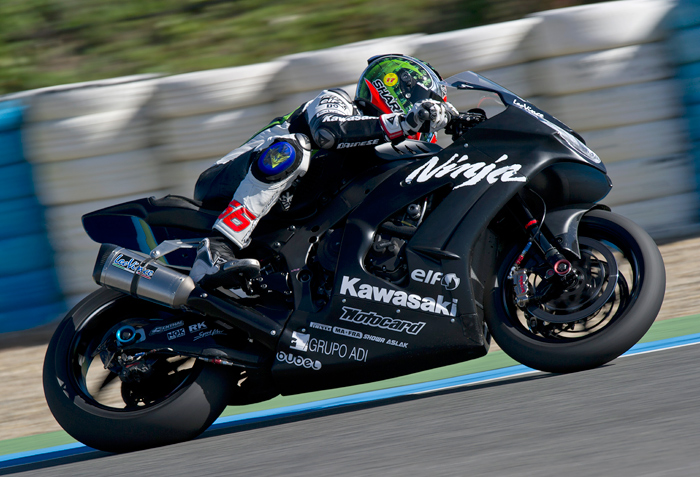
Jerez WSBK Test: Sykes: We've improved again
28 November 2013

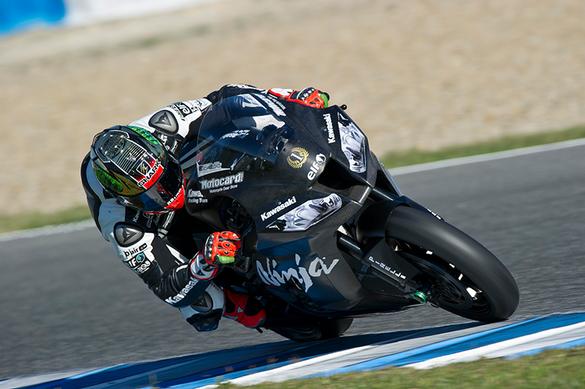
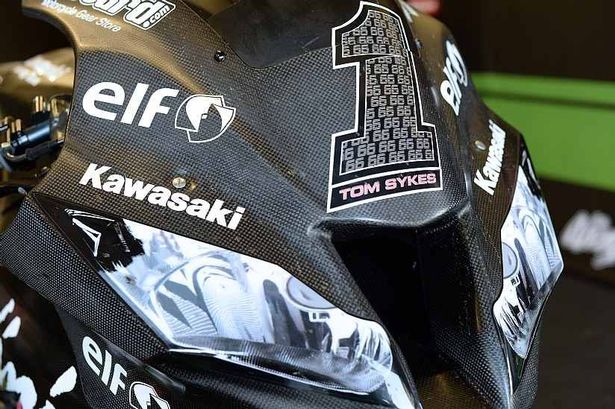
'The Ninja ZX-10R is working well even though Jerez is not one of my strong points. That shows we have improved our package' - Tom Sykes Jerez WSBK Test: Sykes: We've improved again

World Superbike champion Tom Sykes headed the times at Jerez to enter the winter break on top for Kawasaki.

Sykes set a best lap of 1m 39.6s to lead the way from team-mate Loris Baz at the three-day shakedown – the final test prior to the winter ban, which comes into effect on Sunday.

The British rider focused on race set-up with the ZX-10R as preparations continued for the opening round of the new World Superbike campaign, which gets underway in Australia at the end of February.

“We did a bit of everything at this test and it has been very good for us. I did a lot of laps again so my crew chief Marcel [Duinker] is working me well,” said Sykes.

“We tested many different components, which you do not always get the chance to do in the middle of the season. Our testing schedule during the season was quite minimal compared to what we used to do, so this test has been a good experience overall.

“We retried certain things to understand if they are definitely better, especially over race distance, and I am happy with how it has gone,” he added.

“The Ninja ZX-10R is working well even though Jerez is not one of my strong points. That shows we have improved our package, which is the main thing.”

Sykes, meanwhile, has opted to run the number 1 plate in 2014 as opposed to his favourite number 66.

The Kawasaki team will next be in action in mid-January at Almeria in Spain for the first test of 2014 after the winter ban.

f64GHXc.jpg
wYVBnZe.jpg

A0CvxUB.jpg
0oBFhce.jpg

sTdr0D3.jpg


vH3XZuV.jpg

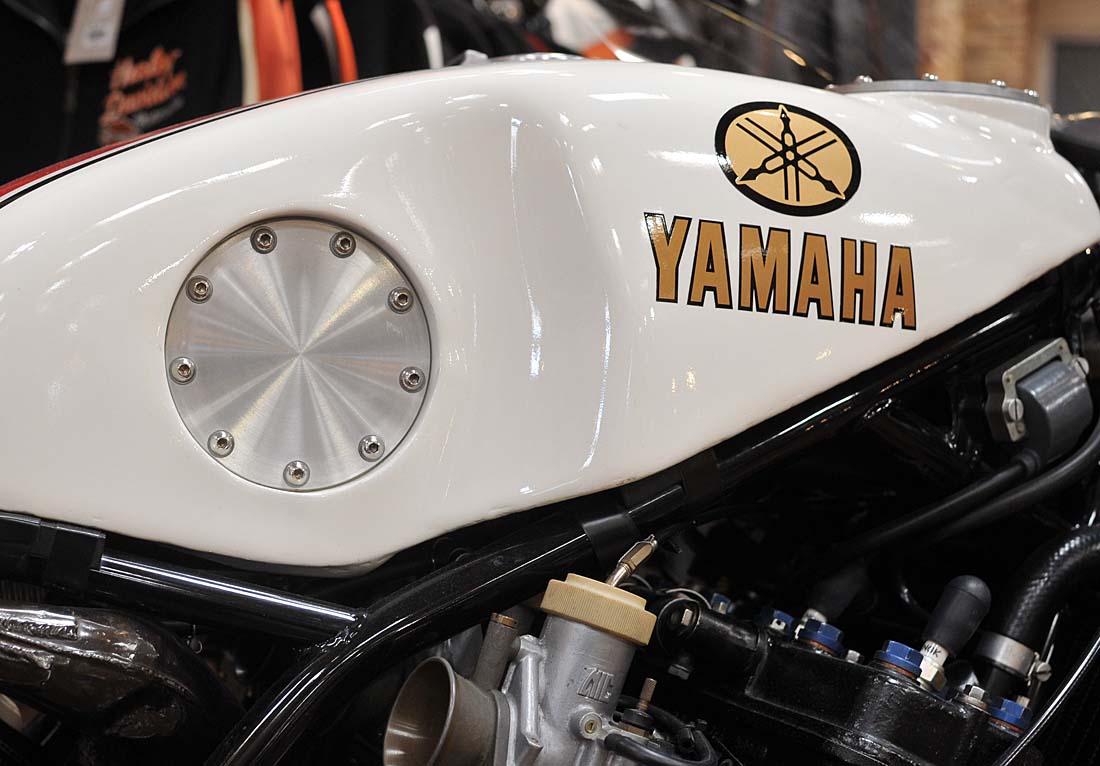
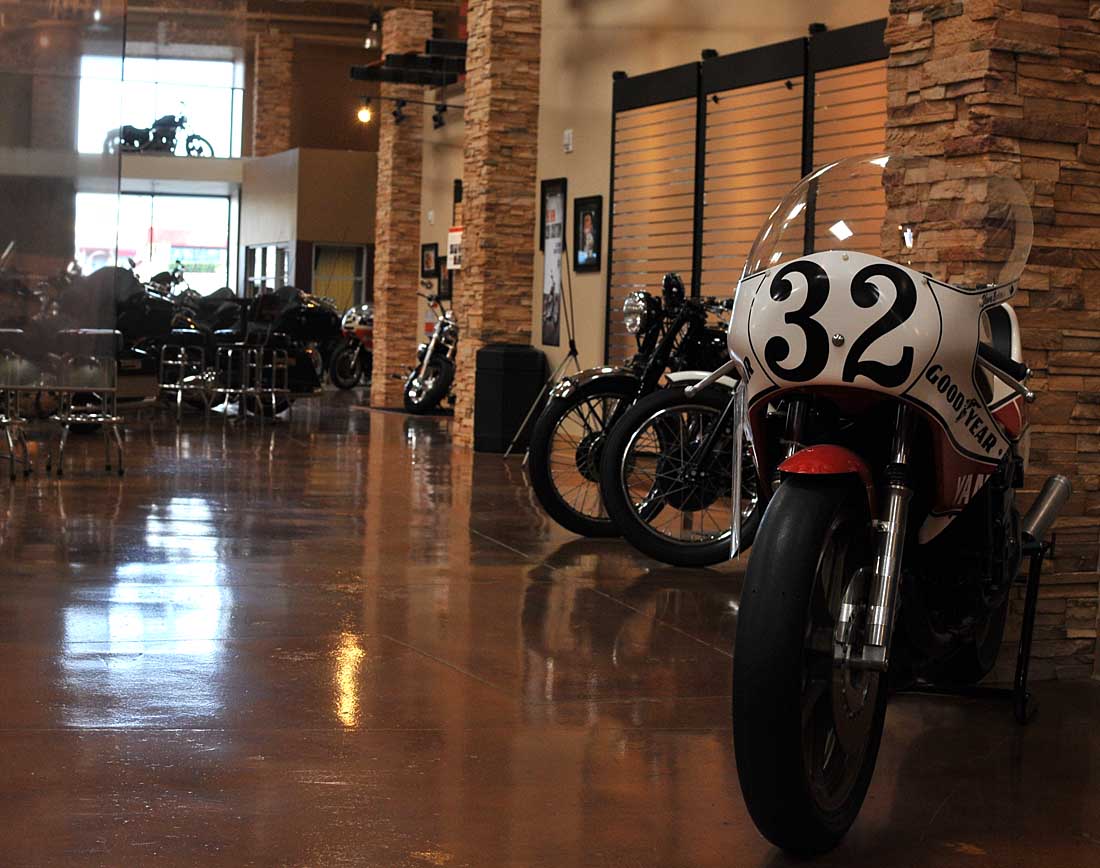
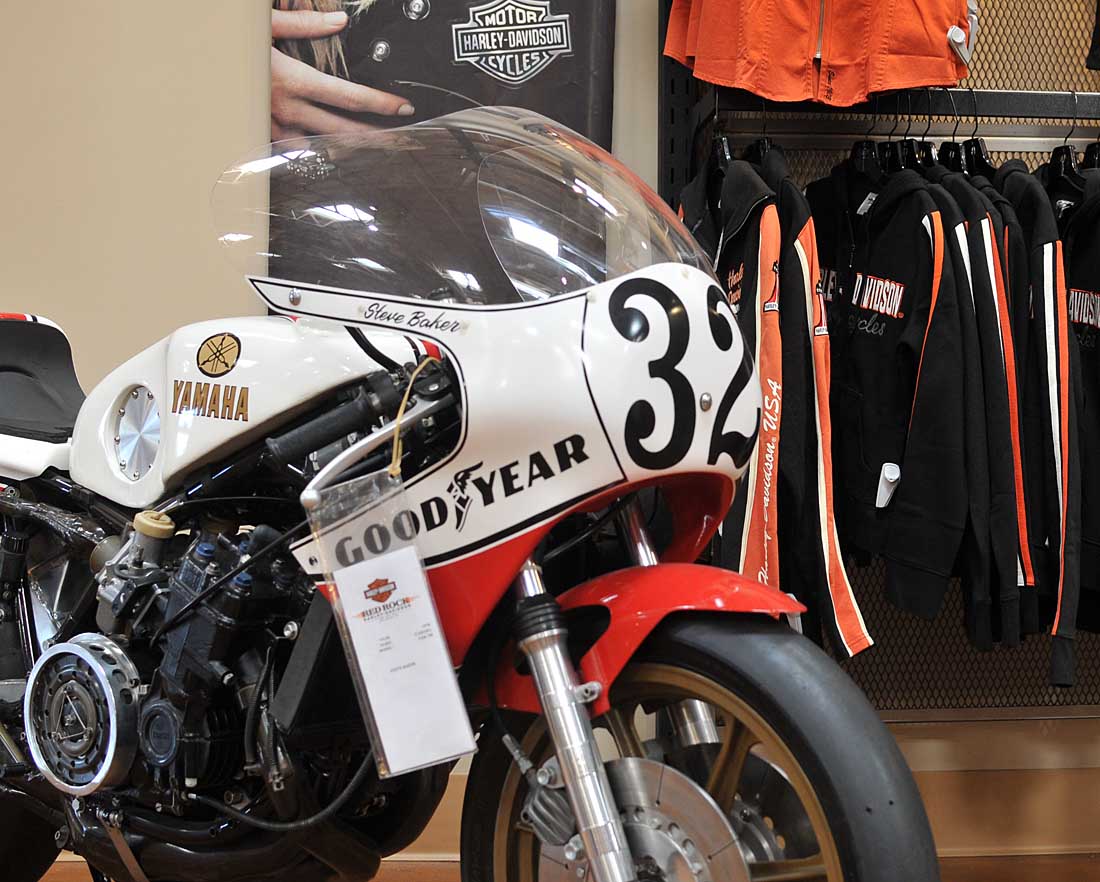
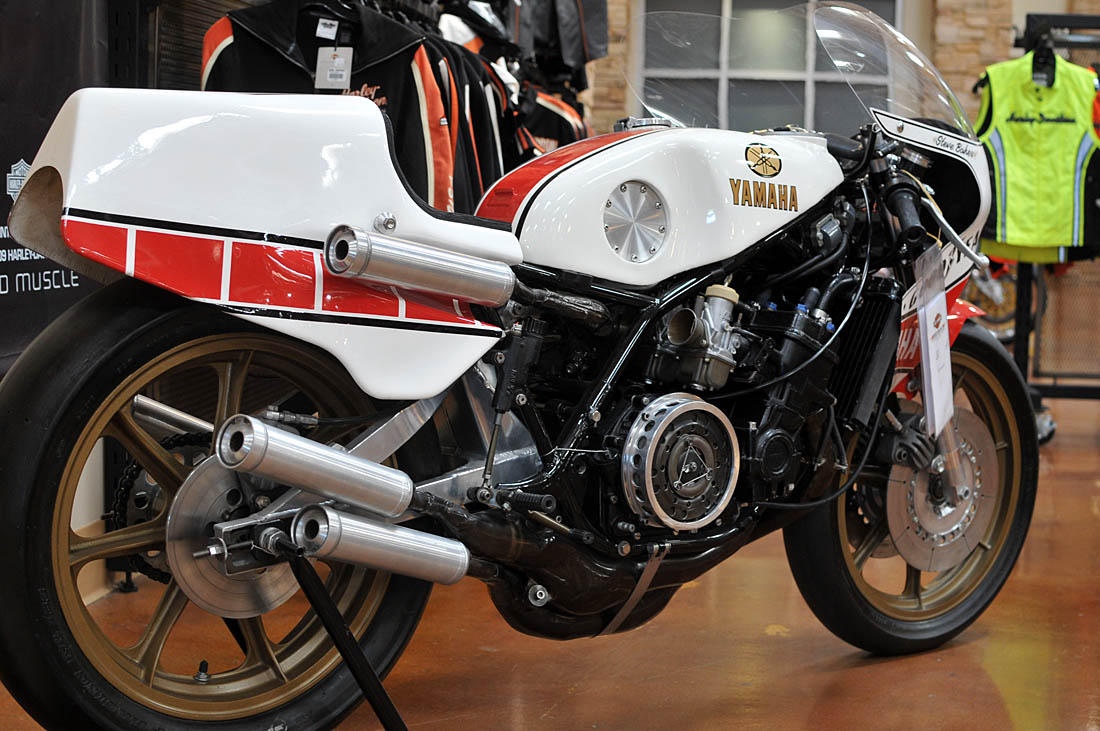
Definitely not something you normally see at a Harley dealership. Red Rock H-D in Las Vegas has a collection of vintage bikes on display in its showroom. Among them is one of Yamaha Legend Steve Baker's former Grand Prix racebikes. This is actually what remains of the last Yamaha that Baker rode, and crashed, at Mosport in the F750 race.
Nss72Vp.jpg

Steve won the 1977 Formula 750 World Championship on a Yamaha YZR750 OW31. This machine was Yamaha Canada's 1978 OW31. According to Baker has a non-standard frame. Also, if you need a jacket to match your Nationwide bike they have several styles. Well, okay, one style and two colors.
gy5bqyA.jpg

The Yamaha features a fire-breathing, in-line four-cylinder, reed-valve-inducted, two-stroke engine, along with a monoshock rear suspension and aluminum swingarm that were major innovations during that era of racing. It also has a set of magnesium carbs, and magnesium velocity stacks.
m0YBgM9.jpg

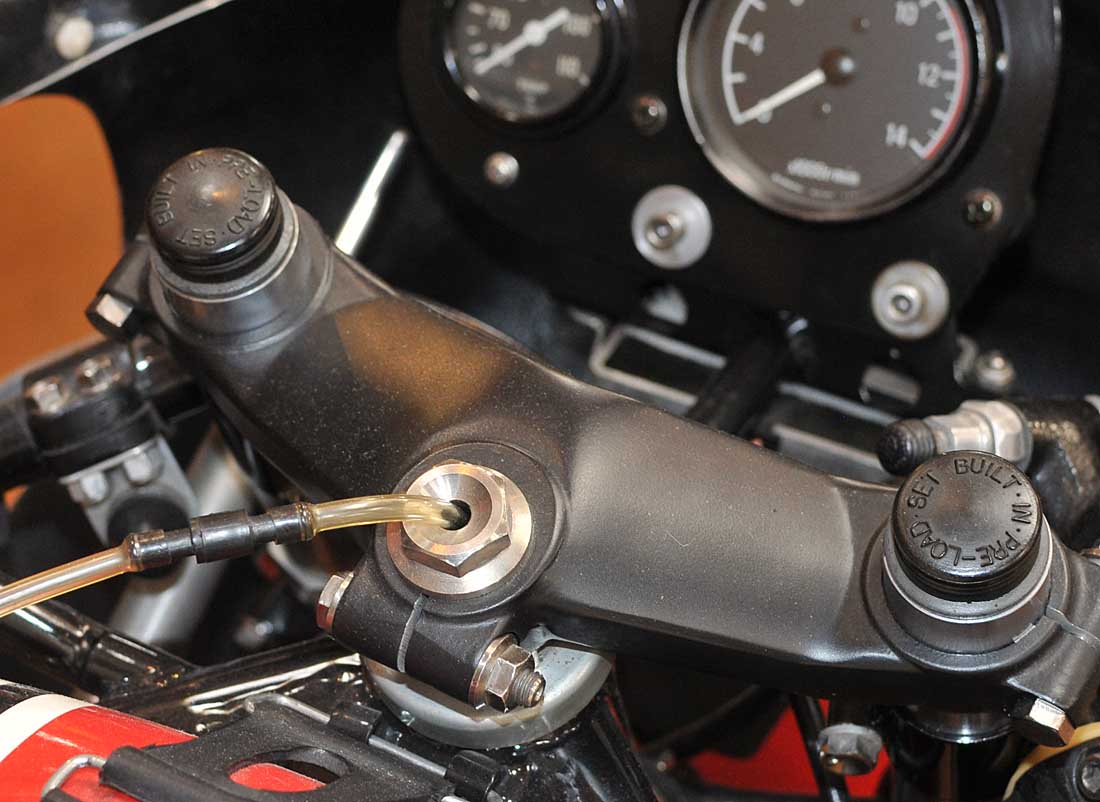
The lower triple clamp on Baker's OW31 is made of magnesium, and the steering stem is crafted from aluminum. If these two metals can get along in harmony, why do you always 'go for a ride' when your mother in law comes over?
wvjXd2G.jpg

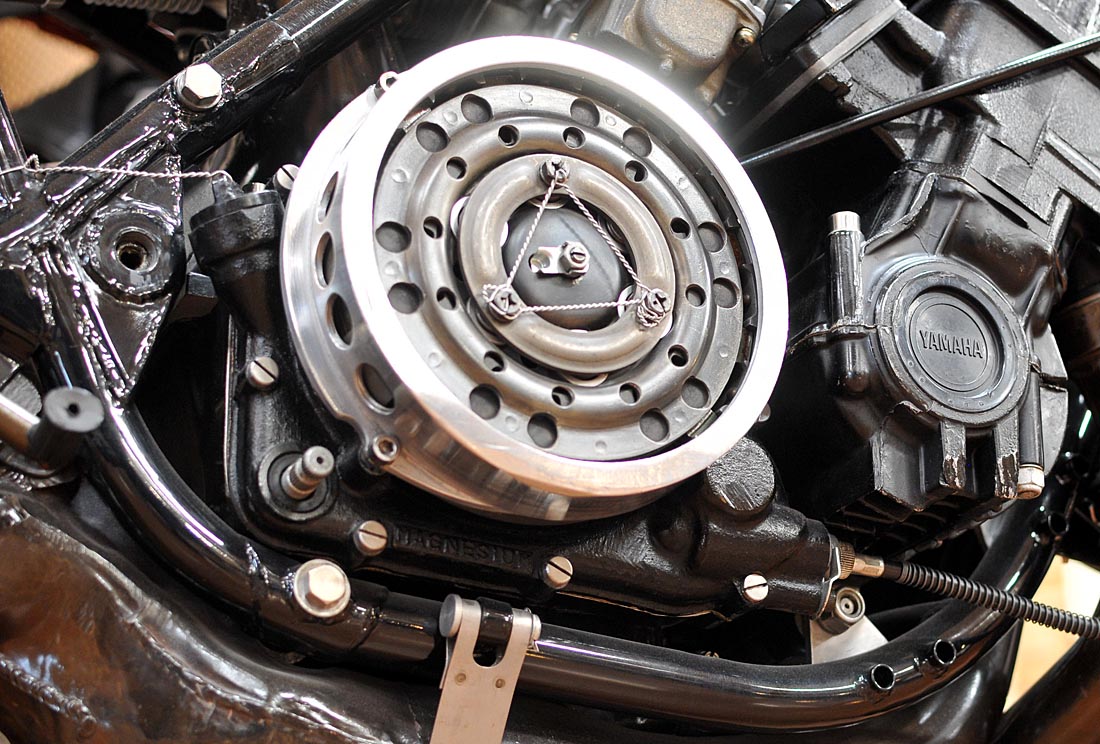
The massive dry clutch, still safety-wired and ready to roll. And what's that at about 7 o'clock? A kickstarter shaft on a 750 two-stroke prototype racer? Could it be? (It's the optional right-side shifter.)
tpTE118.jpg

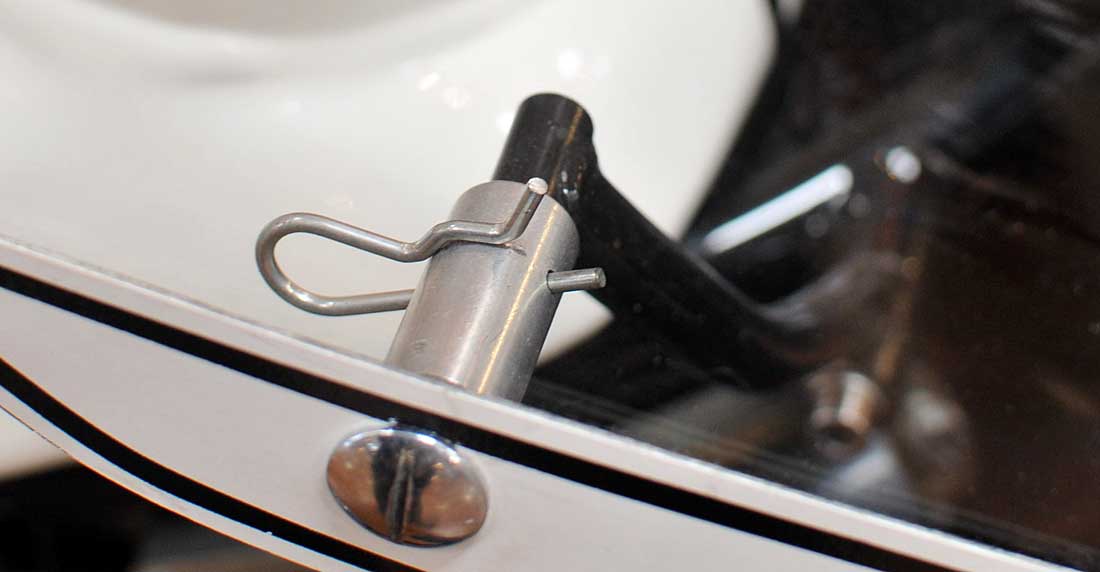
Titanium was used for all fasteners, axles, fairing stays, chain adjusters, brake caliper pistons, and anywhere else you could think of, all in an effort to trim weight. Dzus fasteners are still used in GP racing today. So are windscreens.
p1BUVJy.jpg

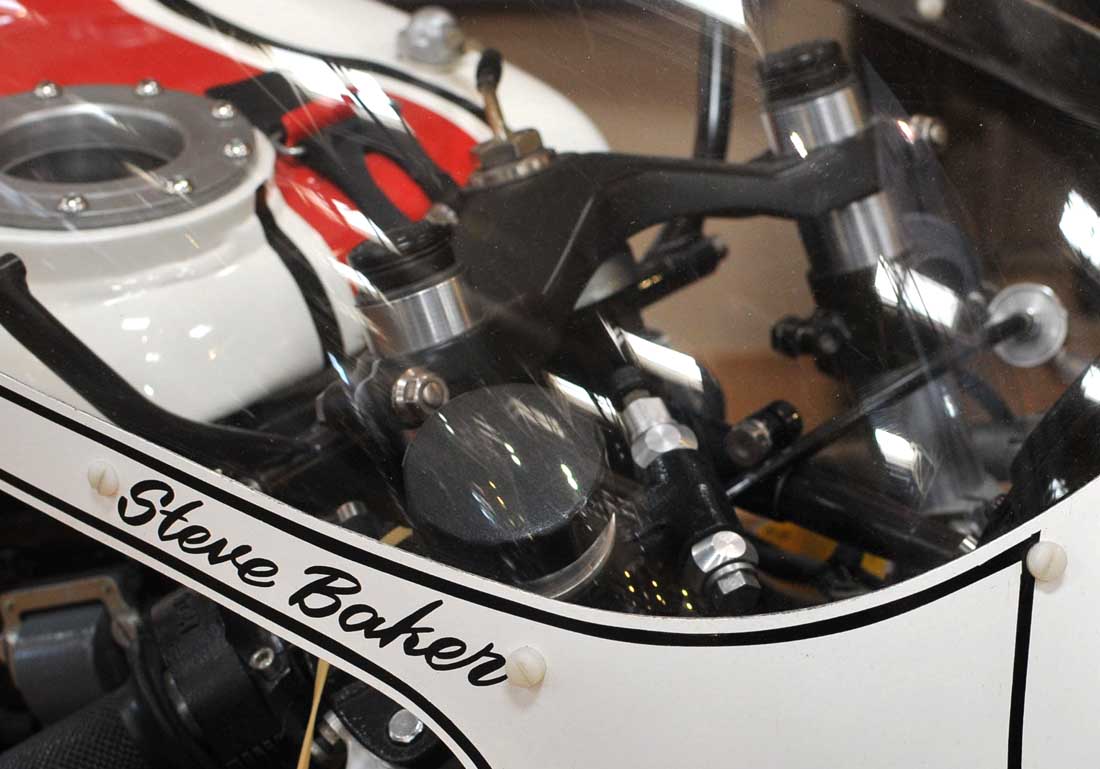
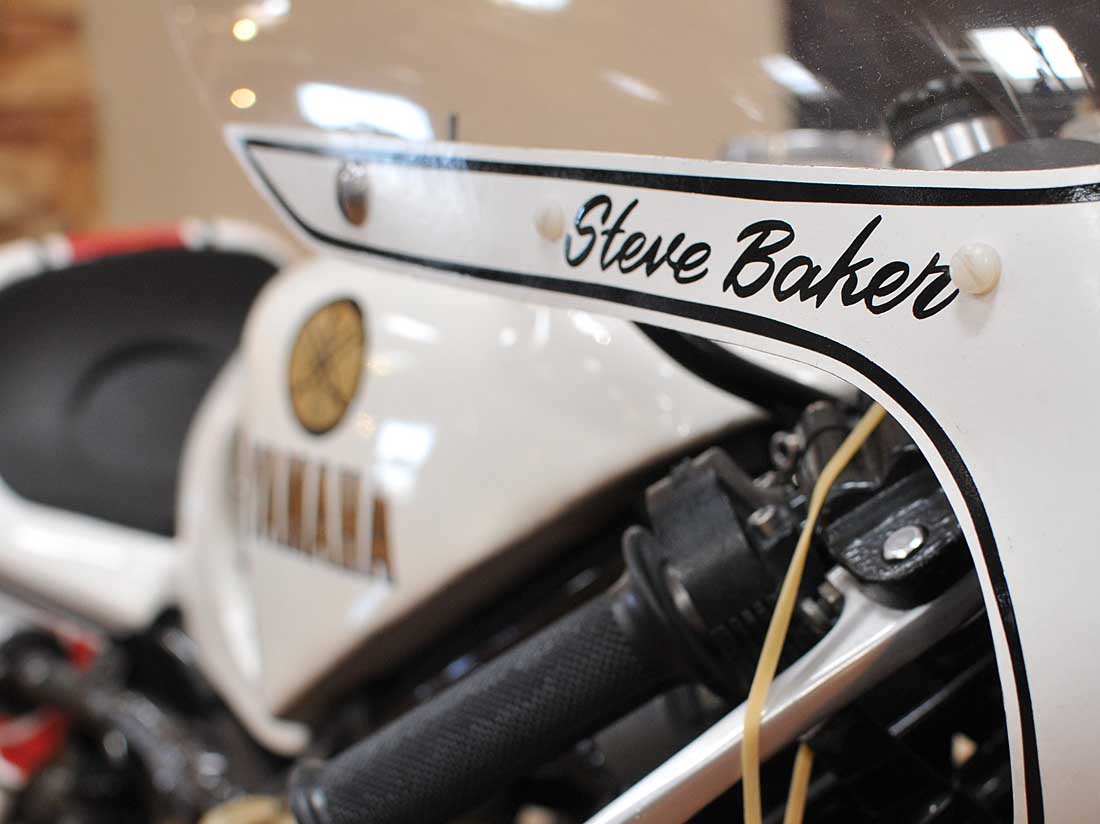
Baker's famous name was hand-painted on the fiberglass fairing, most likely by Henri 'The Brush', who was a regular fixture at Daytona in the 70s and 80s.
ezQiihL.jpg

Such spindly forks by today's standards, but in 1977, they did the business.
mAOpfVL.jpg

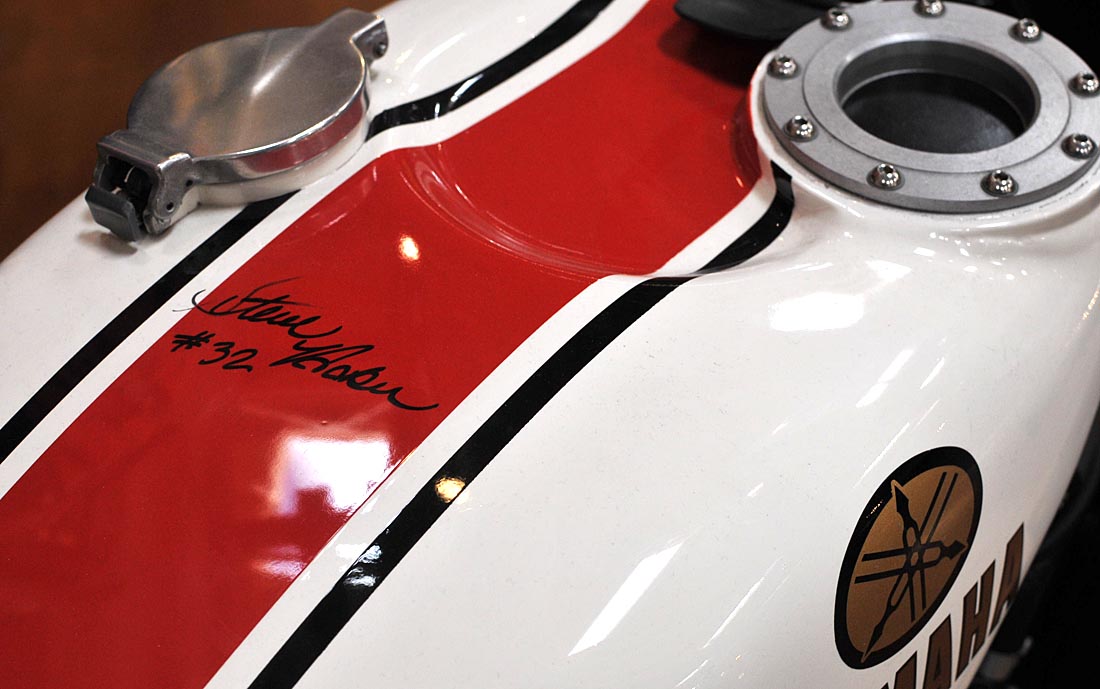
The OW31 had provisions for mounting a dry break fueling system on the side of the tank, but that setup was only used in Europe. Baker's career essentially ended after his Mosport crash. Today he works at Mt Baker Moto-sport in Bellingham, Washington.
hQ7N57x.jpg

The dry-break vent was mounted on top of the tank. It's a proven device that's still used for lightning-fast Daytona 200 pitstops to this day. In 1978, Baker raced this exact OW31 at Daytona, Laguna Seca, and at Mosport in Canada.
tRhOcDt.jpg

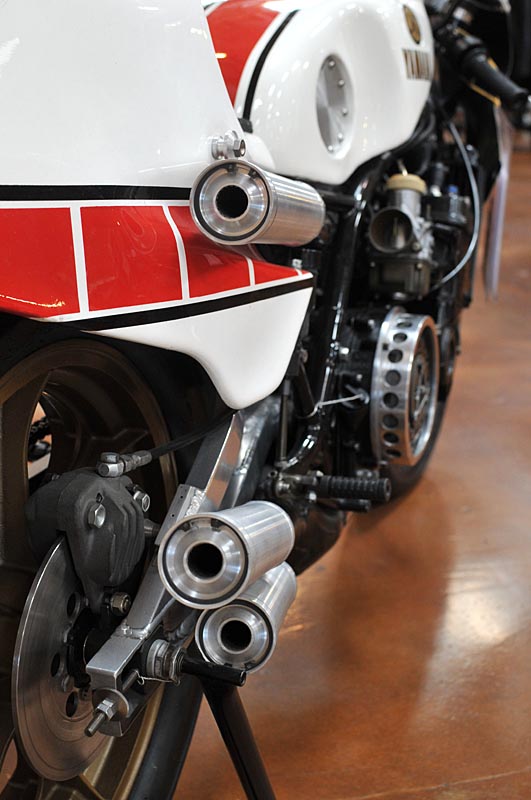
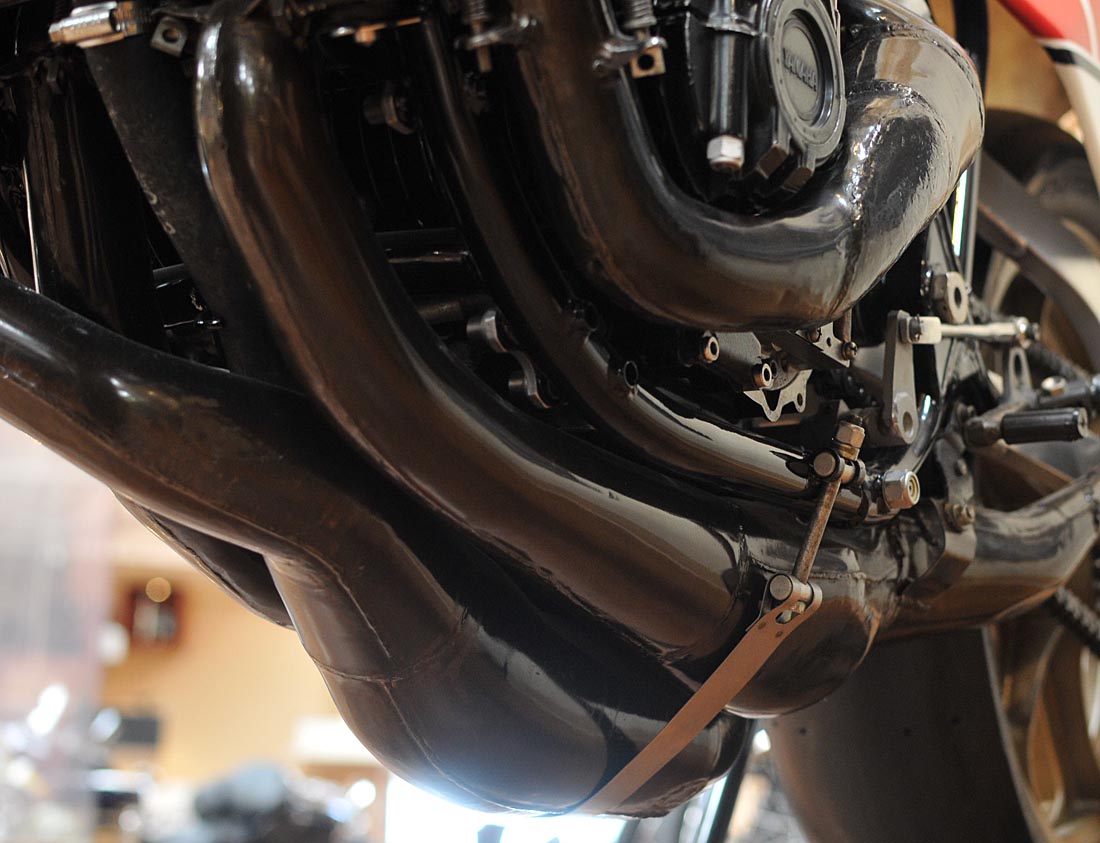
Three pipes akimbo with one sticking out the other side. They look haphazardly arranged, but they were engineered for massive--for the time--horsepower.
ytw4x5E.jpg

The two center pipes and one right-hand pipe went under the bike, but the left-hand pipe snaked up over the transmission and behind the carbs, then across the frame, and finally exited just below the seat on the right side. The arrangement allowed for more ground clearance and better pipe shape, resulting in more power. The clamp? Probably a million light years from Spies' M1.
 
  • Like
Reactions: McM
Back
Top