• Adults Only Website 18+

    If you are under 18 you are not permitted to submit personal information to us or use this website. If discovered you will be banned.

    We will ban and report anyone posting illegal content.

    We will ban any forum user who breaks our terms.

    Freedom of speech should be wide open as long as it doesn't incite violence.

    We have a 15 year old thriving community here with 400,000+ members and hundreds of people online at any given moment, we encourage you to join!, there are 1000's of topics to discuss. Please be aware before registering and read our terms of service and privacy policy.

    By dismissing this notice and proceeding, you agree to the above.

Two Wheels

Standard ECU Could Force Honda To Quit MotoGP
by staff
Thursday, December 19, 2013
Honda's long-term involvement in Grand Prix as a factory effort will be in peril if they are forced to use the spec ECU on the RC213V.
image thanks HMC
If standard electronic control units are in Dorna's upcoming crystal ball for MotoGP, then that future may not include Honda.

HRC boss Shuhei Nakamoto told European media Honda will quit the MotoGP World Championship if standard electronics are made mandatory, which is rumored to be introduced for the 2017 season. Factory teams must use the spec Magneti Marelli ECU hardware in 2014 but still can write proprietary software for those black boxes, with the penalty of a maximum fuel capacity of 20 liters and only five engines per season.

Honda always has used Grand Prix motorcycle racing for an engineering laboratory for young engineers as much as a tool to sell motorcycles since the Honda Motor Company formed HRC in 1982 to lead all of its motorcycle racing activities. So Honda would lose half of its vital mojo for competition at the highest level if no avenue for electronic exploration was available, Nakamoto said.

This proverbial line drawn in the asphalt by Nakamoto will set up a fascinating - and risky - high-stakes game of pokerbetween Dorna and Honda.

Dorna needs the competitive and marketing might of Honda in MotoGP. Honda riders have won the premier class world title 16 times since Freddie Spencer claimed the manufacturer's first championship in 1983. Riders such as Spencer, Mick Doohan, Wayne Gardner, Eddie Lawson, Valentino Rossi, Nick Hayden and Casey Stoner either built or enhanced their legend by winning championships on a Honda.

But Honda also needs a global platform for its engineering excellence and to show the technology that presumably trickles down to its street machines. World Superbike already is adopting EVO rules for all bikes in 2015. That formula, which includes little engine tuning and mandatory electronics, probably won't satisfy Honda's engineering jones.

So where will Honda go to flex its mental muscle in worldwideroad racing?

It will be fascinating to see whether Honda needs an elite-level global series more than Dorna needs the cache and factory expenditures of Honda.

Honda may not be able to ride a wave of resistance much longer. New Ducati Corse boss Gigi Dall'Igna said the Boys from Bologna are committed to the new Open class, which features spec software and black boxes. It's presumed Suzuki and the planned factory bike from Aprilia probably will toss their chips into the center of the Open table, too, to save money.

So Honda's effort to force Dorna to allow electronic development by factories could rely on ironic support from bitter Japanese rival Yamaha, which has been relatively quiet about its position on electronics development in the future. Nakamoto's strident stance could become amplified by a factor of 10 if Yamaha Factory Racing bosses echo it.

MotoGP without Honda is a weakened championship. MotoGP without Honda and Yamaha is unthinkable, the commercial equivalent of a neutron bomb landing on Dorna offices in Madrid and Barcelona.

ENDS
 
  • Like
Reactions: McM
34decal13.webp

34x34: The One That Got Away
by kevin schwantz
Wednesday, December 18, 2013

image by tim beaumont
In the past few weeks I have been fishing in Port Aransas, Texas. It was 85 degrees when I left there, and when I got back to Austin we had a high of 36. I didn't catch much of anything. We caught five fish, and I had one that broke my line.

I could tell by the pull that he was giving, that he was pretty big, but I never saw him. But exactly how big, who knows. It's always about the one that got away. It's like golf ... that one good shot that you hit, versus those 110 bad shots that you hit is what keeps you going back; in fishing it's that one big fish that got away that'll keep us going back.

There's been so much talk about Marc Marquez. My opinion on him: the kid did a great job. The other two guys, the serious rivals for the championship, Dani Pedrosa and Jorge Lorenzo, they made mistakes later in the season. He made his early and was able to recover from it. Their mistakes hurt them. His mistakes just cost him points. That's the luck of the draw. He could've just as easily been injured and had it hurt his season big time but he stayed pretty healthy.

Any of his crashes, for example that one where he got put on probation for crashing on a yellow flag when Crutchlow was on the ground, could have been very bad. He could've gone in, hit another bike and his season could've been done at that point. Then the one in Mugello when he crashed, was pretty nasty as well.

It's just the luck on how you bounce. It was either luck or finding a way to get on the ground gently enough that all that's done is hurt him mentally, but not physically. Normally crashing in the rain, like Lorenzo did, even though it was as fast as it was ... in a wet crash you can get on the ground pretty gently. It was just the unlucky way he landed, broke that chicken wing. And, yeah, Jorge came back and rode and scored points, but that's something that you're never back 100% that quickly. You're just out there riding and trying to circulate when you first come back.

The good thing about getting back on the bike quick, which is what I always tried to do, is you don't allow your mind to slow down. You continue to ride. You continue to have toprocess information. And then all you've got to do is find a couple of tenths, normally. You're still out there going a decent clip, but now, to go that 105% that's going to get you back in touch with Marquez and Pedrosa, isn't that hard to get. If you can ride through some pain, the mental aspect of it, I think, is much more tougher than the physical aspect.

It's one of the things that I told Ben Spies. I said, "I know your shoulder's bothering you, and I think you ought to just keep riding. Because now you're going to still be going fast." Whether you want to admit it or not, a couple of weeks off a bike, a month off a bike, however long it is, your mind slows down. It's hard to get back to that edge, where you're confident coming off the back straightaway, swapping from sixth to fifth gear and tipping it into a corner that's 160 or 170 mph. To do that you've got to be on your game. The mental aspect of it's much more difficult than the physical aspect.

That's one of the things that I think I learned this year at the Eight-Hour. I've been riding 600s, I've been riding, doing some racing, I'm doing decent lap times locally. But that 150 mph 600 is not nearly as hard to process as is 190 mph on a Superbike or 1000. Everything comes by you that much faster. I thought I'd been doing quite a bit of training, a lot of bicycle riding, I really felt like I was as fit as I could possibly be. And even in Japan, running, in that heat and that humidity, I was riding and running in that and doing well. But, you add that element of being on that motorcycle near the limit of your ability ... my heart rate was 10 beats higher than it ever has been on my motocross bike. I think that's just your mind not being able to process it, and you're physically trying to compensate.

I had a good summer. I'm glad I did the Eight-Hour. I hope I get an opportunity to go back and do it on a good bike with a good team again. If it's young kids and me, trying to work to get some kids up to speed, so be it. I compare it to the deep end of the swimming pool. Until you're thrown in it, you really don't know what it's all about.

We've got a decent group of kids here in the USA, but we're not seeing many of our kids go on at an international level, whether it's British racing, German racing, Australian racing, or the World championships whether it's Superstock, Supersport, Superbike. That's the breeding ground. You're not going to just ride a 600 here in America and get a ride on a MotoGP bike, not in this day and age.

That's how it used to work, here in the US. That's basically what I did here, I rode a 600 for a year, I rode Superbikes for three seasons, then I went Grand Prix racing. Which even before I went Grand Prix racing full-time, in '86 and '87, I rode three Grands Prix each year. And man, I talked to Wayne Rainey about those seasons in '86 and '87, and he said, "Every time you came back from a Grand Prix," he said, "you were that much better. You were that much faster."

I think we get a little stagnant just staying here playing in our own little playground. Especially as short on support as the American paddock is right now. Suzuki has a team out there, but it's not a factory team, it's a Yosh team, without much factory support, I think. Yamaha's about the only team out there seriously playing right now. It used to be just the opposite of that. It used to be there was Honda, Yamaha, Suzuki, Kawasaki, all the Big Four Japanese had representatives. Ducati was playing. Then, winning something, doing something, was a real accomplishment as far as the world was concerned.

Not to take anything away from what Josh Herrin did this year. I think Josh Hayes did a really good job of beating himself. He dug himself a big hole at Daytona with a couple mechanical issues. Then ... I've never seen somebody jump so many starts in one season. Tough deal. Martin Cardenas ... I think he did kind of what we expected. He put the bike about where Blake Young had put the bike a couple of years before. He was out there to challenge on occasion and pick up some pieces if everything fell the right way. But I don't think there were any real surprises there.

It's tough. I know it's not easy for anybody. The TV package not getting put together until really late, the last race not even being televised, it doesn't look like there's much interest in that group at DMG to continue to try and develop the series into at least what it used to be. I was convinced a couple of years ago, when they bought it, that they'd just try to make it go away. And looking at the way they did things this year, I think Jim France has maybe lost interest in it.

The Michael Jordan team dropping out was really strange. They just seemed to be getting kind of up to snuff this season, able to run with the Yosh guys with Rog Hayden running up there pretty regularly, running with Cardenas. Eslick, not nearly as regularly, but on occasion. For them to pull the plug and to cite no sponsorship and no interest, I think really ... when you've got the name Michael Jordan, and you've got bikes that run right up near the front most of the time, for them to be pulling out, I think that's a pretty big kick in the guts to DMG. It's unfortunate, for sure.

Ben Spies retiring: I can't say that I didn't maybe see that coming, but I think when physically you've got some issues, with his shoulders bothering him, the mental aspect then becomes that much more difficult. I think he's realized that the motivation is not there any more. I haven't spoken to him since before the Grand Prix in Austin, personally, so I don't honestly know but I feel like his heart wasn't in it any more. And the best thing to do when you're not motivated, when you get up every morning and you're not excited about getting better, being faster, if it's not something that just dominates your day, thinking about how you're going to make yourself better, that's the time to quit.

I support him in whatever his decision is. Am I disappointed? I'm not going to say disappointed. I just think there was a whole lot more of Ben Spies that we didn't see on a MotoGP bike.

Good luck to Josh Herrin in Moto2, and the rest of the Americans. I sure hope that customer Honda's a good bike for Nicky Hayden, and I sure hope that Yamaha that Colin's riding at least gives us Americans here something to watch and keep interested in.

It's tough, really tough, to see Laguna Seca go away. I kind of felt like it was a staple for American racing, and that it would be here as long as there was a MotoGP race. Ticket sales have been down and I think unless we've got Americans in the classes of Moto3, Moto2 and MotoGP, you're going to have a hard time getting Americans interested. When I go to a race, I know—now that I'm not a racer, as I go as a spectator—I want to hear the Star Spangled Banner play. I want to hear our anthem play. Not the Spanish anthem or the Australian anthem or the Italian anthem.

We need kids in all three classes, racing at the front, for us to support Grand Prix like we've always supported Grand Prix. Maybe it's the best thing for Laguna. Maybe just backing off to two races is the best thing in the short term.

Indy's remodel, changing the layout of the track a little bit, I think it'll make the place even more challenging than it already is. I think it'll be good for racing and I think it'll be good for motorcycles. So with Austin and Indy on the calendar, maybe it's best that Laguna supports a World Superbike race. Maybe we can start getting some Wild Card entries in there, whether it's in World Superbike, Moto2, Moto3, or MotoGP.

And with that, I will wish a Merry Christmas to all. Have a great new year.

ENDS
 
Very good articles you've posted, wino . Thanks. The post of Kevin S. was really interesting for me, especially when he wrote about the mentally conditions. And he gave a good overview what's going on. Your thread is a cool info source for me; I'm not the 100% sports fan, but I like the racing - scene, primarly because the technical aspect.

I haven't known, that 'black boxes' and computer parts are going to have (or already have) such influence in motorbike races. Thought the electronics would be limited to ignition and light....;) But I guess, only the catalyser needs his own chip.
 
Very good articles you've posted, wino . Thanks. The post of Kevin S. was really interesting for me, especially when he wrote about the mentally conditions. And he gave a good overview what's going on. Your thread is a cool info source for me; I'm not the 100% sports fan, but I like the racing - scene, primarly because the technical aspect.

I haven't known, that 'black boxes' and computer parts are going to have (or already have) such influence in motorbike races. Thought the electronics would be limited to ignition and light....;) But I guess, only the catalyser needs his own chip.

bud I dont know where to start.

I will say that SBK this year has an EVO class. Or the whole SBK has become an EVO class.
I know where the new rules are but I'm too afraid to read them until the championship is about to start.
As for Moto the ECU is a huge battle at the moment. Honda are standing their ground, Yamaha are saying nothing atm they are in the same boat as honda cause they use in-house electronics. I personally hope they both walk away and say fuck you. The lose of HRC will turn the class into a sitting duck if Yamaha go it's dead.

However if you were to fuck off the spanish guy who runs Dorna which controls both the Moto and Sbk and Herv'e ( team principal of Tech 3 ) blurb as well. Who knows they might just be able to return to prototype bikes which is what we wanna see race.

I can link you to english sites to give you all the info you need but I rekon there would be plenty of German sites you could find.

I always glad to see your posts here and have a chat to you.
 
  • Like
Reactions: McM
bud I dont know where to start.

I will say that SBK this year has an EVO class. Or the whole SBK has become an EVO class.
I know where the new rules are but I'm too afraid to read them until the championship is about to start.
As for Moto the ECU is a huge battle at the moment. Honda are standing their ground, Yamaha are saying nothing atm they are in the same boat as honda cause they use in-house electronics. I personally hope they both walk away and say fuck you. The lose of HRC will turn the class into a sitting duck if Yamaha go it's dead.

However if you were to fuck off the spanish guy who runs Dorna which controls both the Moto and Sbk and Herv'e ( team principal of Tech 3 ) blurb as well. Who knows they might just be able to return to prototype bikes which is what we wanna see race.

I can link you to english sites to give you all the info you need but I rekon there would be plenty of German sites you could find.

I always glad to see your posts here and have a chat to you.

Yep, there are some good german sites, and I'll have a look later on. The pro of this thread for me is the 'editor's choice', therefore I know it's no crap.

The new rules can become a fu.. issue.
 
Marc Coma wins fifth Dakar – Toby Price Podium – By Trevor Hedge

Out of the 168 motorcycle competitors, all well proven and well established competitors, that started Dakar 2015 just 79 made it to the finish. That result alone spells out just how much of a challenge to man and machine the Dakar presents, and what an achievement it is to finish such an event successfully.

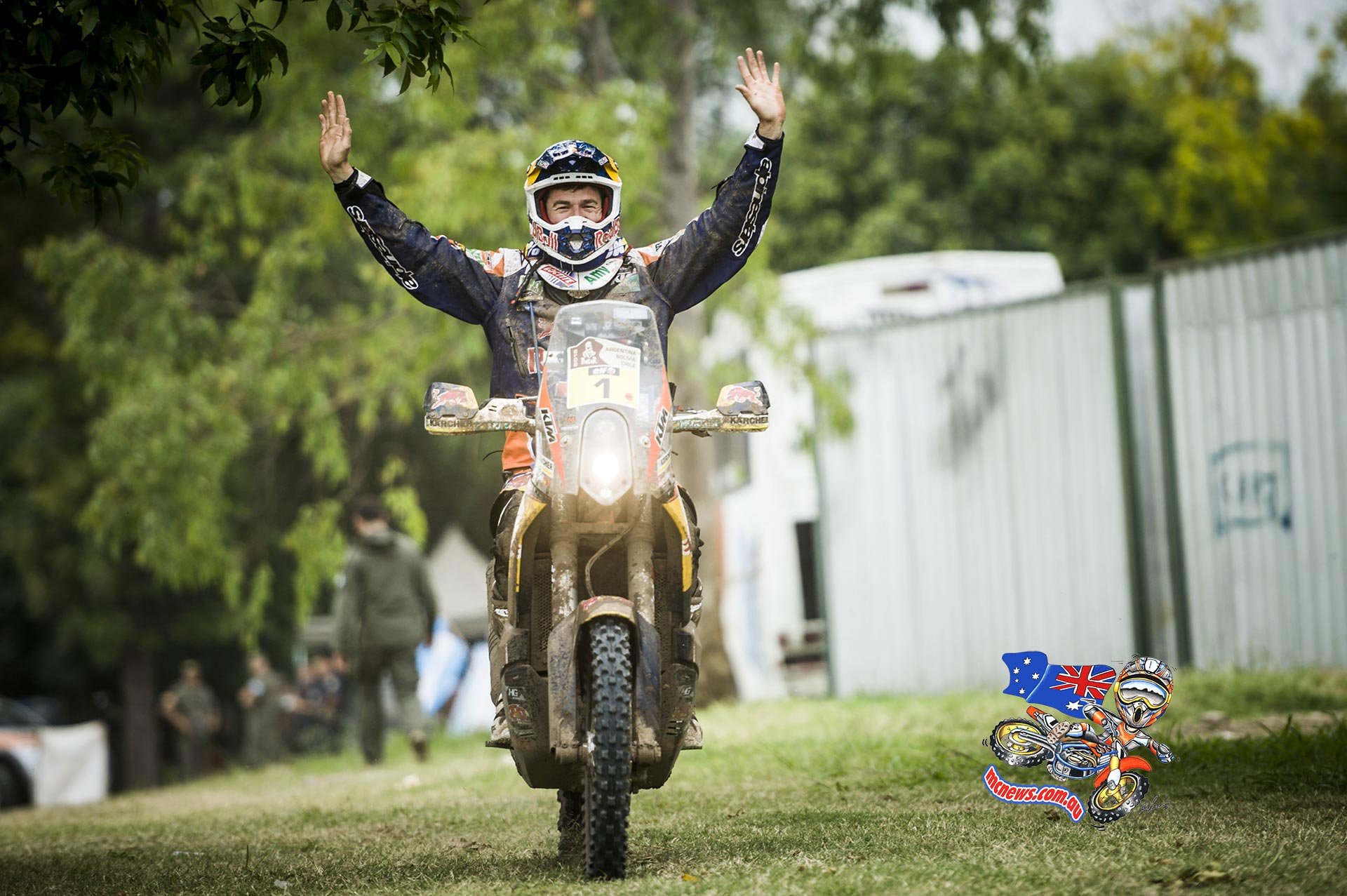
Marc Coma drew upon his experience to take his fifth Dakar and bring home the 14th Dakar success for KTM who successfully fought against a high-level effort from HRC to rob the Austrian manufacturer of the coveted Dakar title.

If not for the penalty against Paulo Goncalves for an engine change then the result may have been reversed but Dakar is not just about riding prowess and navigational skills, but also on how to preserve your machine to ensure it makes it to the end with as few technical problems as possible. Goncalves finished 16-minutes 53-secondsb behind Coma but the 17-minutes of penalties applied to his result placed him second outright in Dakar 2015. To be fair, Coma has ridden conservatively as he was well aware of that buffer and no doubt had some more speed in reserve should he have needed to stave off any challenge in the final days of Dakar.

Joan Barreda took four stage wins to prove the speed of the Honda package but alas it was the wily Coma that made the least errors and like third place Toby Price, also rode smart enough to ensure they could compete Dakar without an engine change.

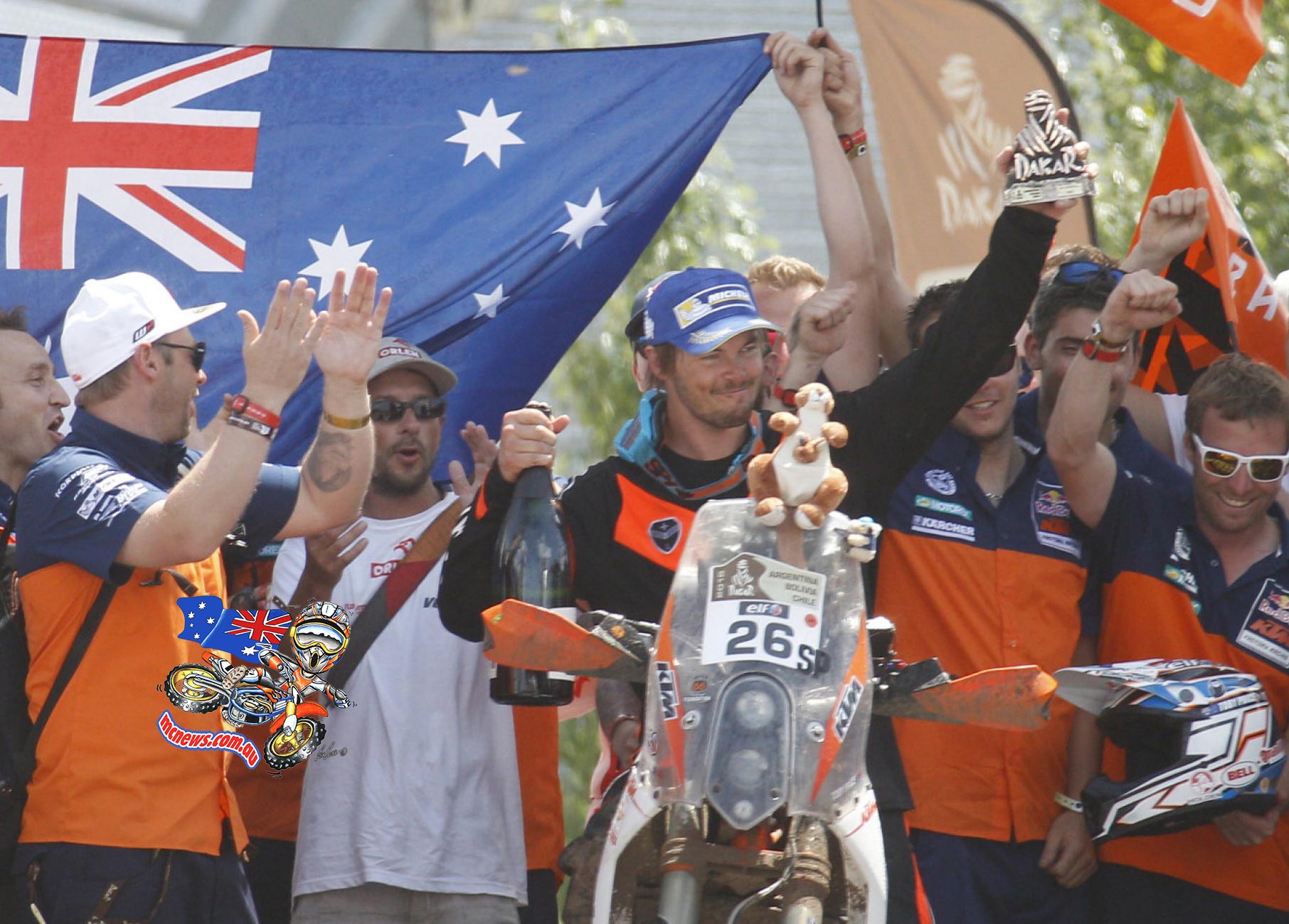
Toby Price went to Dakar with only one rally under his belt and was new to road-book style navigation. The Australian did have some navigational confusion in stages four and six but towards the end of Dakar 2015 he had taken his first stage win, an amazing feat for a Dakar rookie, and managed to climb from fifth to third outright in the rankings across the final days of competition. Add to that the fact that Toby Price finished amongst a gaggle of ‘full factory’ riders, in comparison to Price’s ‘factory supported’ status, there is a big world of difference between those two sets of words, that only further underlines the greatness of Price’s achievement.

Toby Price was obviously ecstatic but still a man of few words on the podium – “Being here in third place is insane!

“I’m at a loss for words. When I decided to sign up three or four months ago, I was quite nervious, I didn’t know what I was getting into. And now I’m on the finish line… happy.”

Toby need not say much more, he is better to let his actions speak volumes for themselves.

As an Australian, I say to Toby, ‘you have done us so proud and every motorcycle enthusiast in this country salutes you and recognises the enormity of what you achieved. Your name will go down in the history books as one of Australia’s most accomplished motorcycle racers ever.’

And at 27-years-young, a relative baby in off-road rally terms, surely the best for Toby Price is yet to come….

Dakar Rally 2015 Stage 13: Rosario to Buenos Aires

1. Ivan Jakes, SVK (KTM) 00:52:06

2. Stefan Svitko, SVK (KTM) 00:52:51

3. Toby Price, AUS (KTM) 00:53:13

4. Paulo Gonçalves, PRT (Honda) 00:53:21

5. Marc Coma, ESP (KTM) 00:55:17

6. Hans Vogels, NLD (KTM) 00:55:42

7. Frans Verhoeven, NLD (Yamaha) 00:56:41

8. Pablo Quintanilla, CHL (KTM) 00:56:58

9. Xavier De Soultrait, FRA (Yamaha) 00:58:00

10. Laia Sanz Pla-Giribert, ESP (Honda) 01:00:01

11. Olivier Pain, FRA (Yamaha) 01:00:05

12. David Casteu, FRA (KTM) 01:00:22

13. Emanuel Gyenes, ROU (KTM), 01:00:41

14. Fabien Planet, FRA (Sherco TVS) 01:01:19

15. Paolo Ceci, ITA (KTM) 01:01:25

Dakar Rally 2015: Overall Ranking

1. Marc Coma, ESP (KTM) 46:03:49

2. Paulo Gonçalves, PRT (Honda) 46:20:42

3. Toby Price, AUS (KTM) 46:27:03

4. Pablo Quintanilla, CHL (KTM) 46:42:27

5. Stefan Svitko, SVK (KTM) 46:48:06

6. Ruben Faria, PRT (KTM) 48:01:39

7. David Casteu, FRA (KTM) 48:04:03

8. Ivan Jakes, SVK (KTM) 48:22:07

9. Laia Sanz Pla-Giribert, ESP (Honda) 48:28:10

10. Olivier Pain, FRA (Yamaha) 49:12:58

11. Hans Vogels, NLD (KTM) 49:35:39

12. Helder Rodrigues, PRT (Honda) 50:04:04

13. Xavier De Soultrait, FRA (Yamaha) 50:24:07

14. Paolo Ceci, ITA (KTM) 51:02:03

15. Frans Verhoeven, NLD (Yamaha) 51:17:29


Marc Coma a picutre of relief after realising Dakar 2015 was his

 
Dakar-2015-Toby-Price-Podium-Spray-1024x682.jpg

Dakar-2015-Marc-Coma-Podium.jpg

Dakar-2015-Marc-Coma-Celebrate.jpg

Official Dakar Report

216. The number of competitors who managed to finish the 2015 Dakar (79 motorcycles, 18 quads, 68 cars and 51 trucks) out of the 420 which started the rally. Two of them, Ivan Jakeš and Robby Gordon, won the final stage in the motorcycle and car categories, respectively. However, the spotlight was on Marc Coma, who drew upon his experience to take his fifth Dakar, and Nasser Al-Attiyah, who claimed his second one after dominating the entire two-week rally.

Marc Coma is now level with Cyril Despres, a fact which will please the Frenchman’s eternal rival at the Dakar to no end and —just like his former teammate— puts him just one triumph away from the record held by legend Stéphane Peterhansel. Their equal number of wins takes on a special dimension considering the dominance of the two men throughout the last ten editions of the Dakar, as well as the good-natured competition which fuels their ambition. For the first time in ten years, Despres was not there to take the fight to Coma, having switched to the car category this year, but the Spaniard still had to fight tooth and nail for his resounding victory in Buenos Aires… As in 2014, Joan Barreda was clearly the toughest rival the KTM rider came up against in Argentina, Chile and Bolivia. The HRC rider won stage 2 with the added bonus of the overall lead, opening a crucial 12-minute gap thanks to the latter’s tyre problems. From the very next stage, the two Spaniards played cat and mouse, riding together and taking turns to claw back the two minutes separating them at the start of the special. This little game lasted several days to the benefit of Barreda, who looked like he had finally acquired the experience needed to fight for victory until the end without making any mistakes.

However, Coma bided his time like a feline waiting to pounce at the slightest opportunity. Marc found an opening in stage 8 after his Spanish rival suffered a mechanical. The no. 2 Honda, damaged by the crossing of the waterlogged Salar de Uyuni, had to be towed to Iquique by Jeremías Israel Esquerre. This decisive turn of events gave Marc Coma the reins of the rally, which he kept until Buenos Aires. However, the KTM rider still had to see off a determined Paulo Gonçalves who was out to avenge the honour of the world’s leading maker, thwarted by its Austrian nemesis for the third time since its official rally raid comeback. The Portuguese rider never gave up, but he finally had to settle for a well-deserved second place. As well-deserved as amazing Toby Price’s third step on the podium. The 27-year-old rookie from Down Under will be worth keeping an eye on in upcoming editions. The KTM rider claimed stage 12 and kept getting stronger as the race went on, pulling off an impressive streak of eight top 5 places and bested Pablo Quintanilla for third place at the end of the rally, making him the best rookie since his fellow countryman Andy Haydon in 1998.

However, his Chilean rival has good reason to be happy with his rally after having to withdraw from his first two editions of the Dakar, winning the gruelling eighth stage. He too will probably come back with loftier goals in 2016. Among those who did not make it to the finish, Sam Sunderland will be seeking to bounce back and gain consistency in 2016 after winning the first special this year, just like Matthias Walkner, who also won a stage in his maiden Dakar and represents the new generation of rally raid together with Price. Laia Sanz did reach Buenos Aires and showed flashes of brilliance throughout the 2015 edition, claiming a fantastic fifth place in Iquique and, even more importantly, ninth overall, up there with the big guns. The pretty Catalan even beat Olivier Pain, who barely had any presence in the race for the Yamaha clan.

In the quad category, Rafał Sonik finally tasted glory in his sixth Dakar start, following four top 5 finishes. The Pole hit the ground running, but he spent a big chunk of the rally battling Ignacio Casale, who was determined to make it two in a row after his brilliant victory in 2014 —Chile’s first at the Dakar. Casale won the first two stages and put his cards on the table, locked in a fierce battle with Sonik until a mechanical problem in stage 10 sent him home. The same special also eliminated Sergio Lafuente, opening a gap of almost three hours between the leader and second-placed Jeremías González Ferioli, who grabbed his first special at the young age of 19! Christophe Declerck’s two amazing stage wins thrust him into the limelight as the only French stage winner at the 2015 Dakar..

KTM Report

Red Bull KTM factory rider Marc Coma of Spain on Saturday sealed his fifth Dakar title and presented KTM with its fourteenth win in this offroad classic. Paolo Goncalves of Portugal took second place and KTM rookie Toby Price of Australia took the minor podium place.

Coma, A Red Bull athlete, rode to the start of the final Stage 13 with a 17-minute lead over Goncalves however riders were unable to complete the 393 km of the final stage into Buenos Aires after heavy rain made the track surface slippery and too dangerous. The race was halted at CP2 and Coma was declared the winner. The win for Coma equals that of his former KTM teammate Cyril Despres and represents the domination of these two riders on the event for a decade.

Coma tackled the Dakar with his usual passion and attention to detail, true to his belief that the only result that counts was that in the final day. He took victory in Stage Five and was top three in six other stages. He also rode with care and prudence in the two marathon stages, nursing a damaged tire in the first and safely bringing his KTM 450 RALLY home across the salt flats of Bolivia in wet conditions that resulted in many riders having to exit the rally after salt clogged their engines and electronics.

Marc Coma: “I’m happy and proud. As usual it was a grueling rally. We had to overcome a problem on the second day that slowed us down a bit in the rankings. So from then on we had to change the strategy a little and push to recover that time. We knew that the marathons would be key stages and they were. I am happy with the team and the people we have around us. This fifth win says a lot about all of us.” Coma also congratulated his two rivals Joan Barreda and Paolo Goncalves who he said were tough opponents. “The level was very high and this also makes the win very valuable,” he added.

The 2015 rally was an emotional roller coaster for the Red Bull KTM Factory Racing Team and the KTM-supported riders. Factory racer Sam Sunderland got things off to a brilliant start with a solid first stage win, only to get lost at the tail end of Stage Two in what was the longest stage in the 2015 edition. He then crashed out early in Stage Three and had to retire.

At the same time it was already clear that two young pretenders, KTM-supported Dakar newcomers Matthias Walkner of Austria and Australian Toby Price were out to impress. Both came to the Dakar with only one rally under their tires having raced the Morocco Rally in October. Both were also new to road book-style navigation.

Walkner drew attention early. After finishing 8-6 in the two opening stages he then won Stage Three. The rest of his rally saw him making great recoveries after difficult days until he finally succumbed to altitude sickness and stomach problems in Stage Nine and had to withdraw. It was an unfortunate end for a rider with great potential and as yet little experience and he exited after making his mark as a rider to watch in the future.

Price, a four-time winner of Australia’s Finke Desert classic said at the beginning of the rally that navigation would be difficult. He did have some difficulties in stages 4-6 but by the time he started in the final stage he had eight top five finishes and including a win in Stage 12. Price by then had moved up to third overall and was able to make it stick until the race was declared over.

Regular Red Bull KTM Factory rider Ruben Faria of Portugal finished sixth overall, which was a solid result given that Faria had broken his collarbone only six weeks before the rally. His teammate Jordi Viladoms was one rider who was unable to finish the difficult stage over the Bolivian salt flats. Villadoms was fifteenth overall when he retired from the race. KTM-supported rider Riaan van Niekerk also retired after Stage Seven left Bolivia. He was overall twelfth. Jakub Przygonski of Poland, a regular KTM-supported rider who competes for Team Orlen was eighteenth overall. He has had a difficult season after a serious injury in Abu Dhabi at the beginning of 2014.

Line honors in the final shortened stage went to three KTM riders. Ivan Jakes of Slovakia won the stage. Countryman Stefan Svitko finished second and Price was third. Svitko finishes fifth overall and Jakes was eighth overall. KTM riders took seven of the top 10 places in the 2015 edition.

HRC Report

The Dakar 2015 ends after circling the loop and ending up back in Buenos Aires a fortnight later, bringing new successes for Team HRC. Paulo Goncalves finishes the world’s toughest rally in second place, while Laia Sanz breaks new ground with an unprecedented ninth place overall finish.

After picking up the world championship runner-up prize last October at the Morocco Rally, Portuguese ace Paulo Goncalves has once again pulled off another achievement for Team HRC. It was a display of grit, tireless effort, consistency and teamwork, which finally brought the rider’s Rally Dakar 2015 adventure to a close as runner-up in the final rankings.

Paulo Goncalves very nearly pulled it off in the world’s greatest rally challenge too. The rider had collected a total of 17 minutes of penalties, and eventually finished just 16’53” behind the eventual race winner Marc Coma.

Another of the big Team HRC success stories from this Dakar has been the astonishing ninth-place finish for a brilliant Laia Sanz. The Spaniard claims the best ever final position in the race’s female category. Besides showing excellent riding dexterity and a true command of navigation aboard the Honda CRF450 RALLY, the athlete proved herself by finishing several of the special timed stages up among the top ten riders.

Noteworthy too, was the overall performance of Joan Barreda, with four stage victories, and always the man to beat at this Dakar 2015. The Castellon rider was unstoppable at the head of the race until stage eight, when extreme weather conditions at the Uyuni salt flats put an end to his chances of a win in the campaign. Barreda’s final overall ranking was an unjust 17th.

Helder Rodrigues has, likewise, been a cornerstone of the Team. In addition to two stage victories, Hélder finished in 12th place on the final leaderboard.

Honda South America Rally Team close their crusade after a valiant effort that sees Javier Pizzolito and Jean Azevedo take 19thand 22ndrespectively. HSA Rally Team offered crucial support to the riders of Team HRC throughout the event.

The rally came to an end in Baradero, with what had been planned as a 174 kilometre special, reduced by 73 kilometres due to the conditions, before the final connection phase brought the entourage into Buenos Aires, where the final ceremonial podium was held in Tecnopolis.

Paulo Goncalves – 2ND +16’53 – “I think the whole team deserves this result, especially after all the hard work that they have done. All that’s needed now is to go one small step further and win the rally. We are well-prepared and on the right track. I’m pleased with the result, and I want to thank the whole team, but most especially my team-mates Joan, Hélder and Jere, who were there to help me out in the most delicate moments. If it wasn’t for them I wouldn’t be on the podium here in Dakar.”

Laia Sanz – 9TH +2:24’21 – I’m very happy. Really! If they had offered me a top-ten finish before the race, I would have signed. Many said that it was plausible, but the Dakar is a highly-unpredictable, difficult and risky race. You’ve got to have your wits about you all the time. It’s a great result that I want to share it with the whole team, who have put their trust in me from the first moment, giving me this great chance, and also with the fans and followers who been with me all the way through. ¡Muchas gracias!”

Helder Rodrigues – 12TH + 4:00’15 – “For me the Dakar has been a bit unlucky I couldn’t really do much due to a couple of setbacks, but I’m pleased all the same, not just for the two stage wins, but most of all because Team HRC has made the podium with Paulo. The squad has worked really well together and now we are off to begin preparing the next one.”

Joan Barreda – 17TH + 5:54’35 – “After the problems in the marathon stage, I think that we made a great team effort and have got a good final result. I was leading the race for a few days and I won four stages, and I don’t think there’s much more I need to show. The thing that I’m most proud of is Paulo’s result. He really deserves it.”

Yoshishige Nomura – HRC President – “Unfortunately, we were not able to win overall, but our riders and team members have made an excellent effort, and we won second place on the podium. I’m really proud to their professional work. I also appreciate all the rider’s great support in helping to get Paolo onto the second step of the podium. I’m very disappointed that we will have to wait another year for a first place on the podium of the Dakar. Anyway, our challenge at the Dakar continues. Lastly, I’d like to wish all the riders and team staff a good rest. Thanks for a job well done!”

Yamaha Report

The 2015 Dakar has once again established itself as the world’s toughest rally-raid challenge. Yamaha Netherlands Verhoeven Team’s Frans Verhoeven and Yamaha Factory Racing Rally Team Yamalube’s Olivier Pain had to battle fierce conditions on the last stage to finish in 7th and 11th place.

The start of the 13th race day was already atypical due to the reverse start order, but more havoc was on its way. Soon torrential rain hit the thirteenth stage, making the course extremely slippery. Riding in groups, the competitors slowly made progress on their journey to Buenos Aires where the podium at the Tecnópolis awaited, but before they could reach their final destination the circumstances got so dangerous that it was decided to stop the race at CP2.

The cut- short last special of 101 km saw no changes to the overall positions of the leading Yamaha riders. Olivier Pain finished in 10th place overall, ahead of fellow Yamaha mounted Frenchman Xavier De Soultrait in 13th place, while their Dutch colleague, Frans Verhoeven, signed off his Dakar career with a solid 15th place overall.

Yamaha teams are celebrating in the quad category. Rafal Sonik won the 2015 Dakar in his category with a lead of almost three hours over 18 year old and fellow Yamaha Raptor 700 rider Jeremias González Ferioli. The Polish rider took extra care today not to get caught out in the final stage and rode sensibly to 2015 title victory. He arrived at CP2 in eighth place, 8’16 minutes behind today’s winner Willem Saaijman, who kept fellow Yamaha rider Christophe Declerck at bay with just six seconds between them.

After the end ceremony the riders have earned some well-deserved rest. They have withstood more than 9000 km of incredible heat, terrible cold, rocks, bumps, fesh-fesh, mud, sand, and vegetation – something only the most hardened endurance riders can accomplish. The riders can be proud finishing the toughest rally-raid in the world and are already looking forward to their next adventures.

Olivier Pain – overall 10th / 3h09’09 – “To finish a Dakar is always an achievement and to finish in the top 10 is something to be proud of and I am happy to have got the bike home for the team who worked so hard, both prior to and during the rally. Of course we came here with the intention of challenging for the victory and so from that point of view my result is a disappointment. Although we did a lot of testing before the Dakar we lacked race kilometres. The base of the WR450F Rally is clearly good and the engine is strong and reliable, but the bike is effectively brand new and we need to develop it further if we are to realise its full potential.”

Xavier De Soultrait – Overall 13th / 04h20’18 – “My objective at the start of this, my second Dakar, was to finish in the top 20, so I’m very happy with my result. I am also happy that I learned a lot in the process – how to set up the bike, how to ride faster in the fesh-fesh. These things you can’t learn unless you come here to race. I think I can still progress as a privateer, but there is a limit to what you can achieve. The real solution for the future is to be able to do other races throughout the year, to be able to go testing, training in Morocco and this is the direction I would like to take now.”

Frans Verhoeven, overall 15th place / 5h13’40 – “A good way to end my Dakar career as a rider. These last few days I felt very comfortable on the bike and rode at the pace I used to ride. It is a pity I wasn’t able to participate in a race prior to the Dakar, because if I had I would have rode better the first week and a top 10 finish would have been possible. Of course, even if I stop as a rider, I will continue to be involved in rally-raid and enduro and have some interesting plans for the future.”
 
That's a cool idea. You can buy such bikes 'ready to go' for about 2500 $ here, but they haven't this rough look.

View attachment 197387
I built it. Those are upside down beach cruiser bars. I chopped the seat and made the exhaust. The muffler is from a 65 cc dirt bike. It was stolen last year:(
 
  • Like
Reactions: McM
Australian State Laws

This is only to be used as a general guide. Legislation and road rules are subject to change therefore you are strongly advised to check your local jurisdiction for up to date information. All bicycle riding regulations (helmets, road rules etc.) apply equally to motorised bicycle riders. This information was updated on 25 April 2014.

QUEENSLAND

Rules for motorised bicycles

There are 2 types of legal motorised bicycle. For the first type, the electric motor must not be capable of generating more than 200 watts of power. For the second type, know as a 'pedalec', the vehicle must comply with the European Standard for Power Assisted Pedal Cycles (EN15194). The vehicle must have a permanent marking on it that shows it complies with the standard. A compliant pedalec can have up to 250 watts of power. But the motor cuts out at 25km/h and the pedals must be used to keep the motor operating. It is illegal to ride a bicycle on roads or road-related areas (such as paths) if the bicycle has an internal combustion engine (for example, a petrol or diesel motor) attached.

[ZBox note: The above section is taken from the QLD GOvernment web site. Legislation, however, appears to be the same as all other states which alow the fitting of any motor under 200W. We are not legal experts so, if fitting a pertol motor to your bike for use on public roads, we advise you confirm with your legal adviser]

Motorised bicycles are required to adhere to the same road rules as bicycles and have the same rights and responsibilities. Motorised bicycles are exempt from registration and compulsory third party insurance.

A two-wheeled vehicle with an internal combustion engine, or an electric motor capable of generating over 200 watts, must comply with the Australian Design Rules* requirements for a motorbike if it is to be ridden on roads or road-related areas.

When riding a motorised bicycle you must:

wear an approved bicycle helmet securely fitted and fastened.

The motorised bicycle must have:

a bell or horn
at least 1 effective brake.

When riding at night you must display:

a white light at the front, visible for 200m
a red light at the back, visible for 200m
a red reflector at the back, visible for 50m.

You can ride a motorised bicycle on all roads and paths, except where bicycles are specifically excluded.

You do not need to have a driver licence to ride a motorised bicycle.

*The content found by using this link is not created, controlled or approved by this department. No responsibility is taken for the consequences of viewing content on this site. This link will load into a new window.


VICTORIA
Motorised Bicycles and Foot Scooters


A power assisted bicycle is identical to a pedal powered bicycle, except it has an auxiliary motor. Power assisted bicycles have two definitions in Victoria:

A bicycle with an auxiliary motor(s) producing less than a total of 200 watts at the wheel, and where the power is additional to using the pedals.
A bicycle with auxiliary power producing no more than 250 watts and specifies this as a continuous rating. It also restricts the top power assisted speed to 25 kilometres per hour, requires the rider to pedal to access the power. This type of motorised bicycle is known as a pedalec.

Auxiliary motor means that the primary propulsion is via pedalling and the motor is simply to assist.

Power assisted bicycles as described here are likely to have similar performance characteristics to pedal powered bicycles so the same road rules apply to them. These types of power assisted bicycles are not required to be registered nor the rider required to be licensed.
A motorised bicycle is not classed as a bicycle if:

  • the motor is the primary source of power
  • the motor's power output exceeds 200 watts (whether or not the motor is operating).
Source: www.vicroads.vic.gov.au

NEW SOUTH WALES

Petrol Engines are now banned from use as pushbike motors even where they meet, or are below, the power standards required of eletric engines.

There are two types of electric power-assisted pedal cycles allowed

Maximum power output 200 watts
For power-assisted pedal cycles other than pedalecs (see below), the auxiliary motor/s must not be capable of producing a combined maximum power output exceeding 200 watts, whether or not the motor/s is operating.

Note: It is virtually impossible for a bicycle fitted with an internal combustion motor to meet this requirement because an internal combustion motor limited to 200 watts is not capable of producing enough torque to propel the bicycle. For example, the cylinder of a petrol motor specifically designed to produce no more than 200 watts (equal to 0.268 horsepower) will have a capacity of about four or five cubic centimetres, the size of a standard medical syringe.


Maximum power output 250 watts (‘pedalec’)
A ‘pedalec’ is a vehicle complying with the requirements of European Standard EN 15194: 2009 or EN 15194:2009+A1:2009: Cycles – Electrically power assisted cycles – EPAC Bicycles. To comply with EN 15194:
The motor must be electric.
The maximum continuous power output of the motor cannot exceed 250 watts measured at the wheel.
Note: A motor that delivers 250 watts of continuous power can produce greater power for very short periods of time, which can be beneficial when pulling away at traffic lights or starting a hill climb.
The rider must pedal the cycle to activate the motor.
Note: Pedalecs may be equipped with an optional low-speed start-up mode that allows the motor to power the cycle up to 6 km/h. This mode is activated by the user either when riding without pedalling or when the user is pushing the cycle.
The motor must cut-off once the vehicle reaches 25 km/h, or sooner if the rider stops pedalling.
The vehicle must be certified by the manufacturer, and labelled as complying with EN 15194. The label must include the manufacturer’s name, the motor’s cut-off speed in km/h and its continuous rated power in watts.


WEST AUSTRALIA

Power-assisted bicycles

A power-assisted pedal cycle (PAPC) is a bicycle with a motor providing assistance when the rider is pedalling.
In Western Australia PAPC can be used by people aged 16 years and older on shared paths with the power engaged. To be compliant, a PAPC can only have a maximum power output of 200 watts.

A PAPC which uses the engine as the primary source of power and/or has an engine capacity which exceeds 200 watts is classified as a motorbike and must be registered and ridden by a licenced rider and cannot be ridden on shared paths. The smallest petrol engines (i.e. internal combustion engine) commonly have a power output exceeding 200 watts and are therefore illegal.

[ZBox note: The above phrase is correct for most bicycle motors purchased through eBay. ZBox, however, have a 200W petrol motor specifically designed to comply with Australian motorised bicycle laws. Our 200W motors have been passed by government approved Dyno test facilities. Every ZBox 200W motor is provided with a certificate of compliance stating that the motor produces less than 200W. The cerificate includes the serial number of the motor and has is signed by an independant engineer who fitted our restrictor kit]

Source: http://www.transport.wa.gov.au/mediaFiles/active-transport/AT_CYC_P_cycling_and_the_law.pdf

TASMANIA

Introduction

This Bulletin explains the legality of powered scooters, skateboards and bicycles, and miniature motor cycles etc.
Tasmanian Legislation

The Tasmanian Vehicle and Traffic Act 1999 defines a motor vehicle

"motor vehicle" means a vehicle that is built to be propelled by a motor that forms part of the vehicle but does not include;

an aircraft, or
a motor vehicle that travels only on a railway, tramway or other fixed track, or
a pedal cycle with an auxiliary motor (or motors) with a power output (or combined output) of not more than 200 watts; or
a self-propelled lawn mower that is not capable of traveling at a speed of more than 10km/h; or
a self-propelled wheelchair that is not capable of traveling at a speed of more than 10km/h, or
a self-propelled vehicle

(a) not capable of travelling at a speed of more than 10km/h; and
(b) designed for off-road work in construction, maintenance or warehouse operation; and
(c) only used on a public street for the purpose of loading or unloading the vehicle onto another vehicle, or manoeuvring at a work site.

Any scooter with a motor is considered to be a motor vehicle.

A motor vehicle must be registered if it is parked or used on a public street or a road related area. A motor vehicle must not be used on a footpath or shared pathway.

Policy

Any motorised vehicle which is not excluded from the definition of "motor vehicle" must be registered if it is used on a public street or a road related area.
To be eligible for registration all vehicles must comply with relevant Australian Design Rules and the Vehicle Standards and be fitted with an approved Australian compliance plate.
Any vehicle which is not fitted with an approved Australian compliance plate is not eligible for registration, and must not be used on a public street or road related area.
A pedal cycle with an auxiliary motor (or motors) with a power output (or combined output) of not more than 200 watts does not require to be registered and may be used on public streets and on road related areas. The rider does not need to hold a current drivers licence but must wear an approved bicycle helmet and obey all Road Rules.

Source: http://www.transport.tas.gov.au/vehicle_specifications/information_bulletins/scooters

SOUTH AUSTRALIA

What is a Power Assisted Bicycle?

A power assisted bicycle (or power-assisted pedal cycle) is a pedal cycle with a motor attached to assist the rider. The attached motor may provide assistance but the pedals must be the main means of propulsion.

In South Australia, there are two categories of power assisted bicycles that may be used legally on our roads:

power assisted bicycles with up to 200 Watts of power (the power is controlled by a throttle or accelerator); or
power assisted bicycles with no more than 250 Watts of continuous power which meet the definition of a pedalec (the power is controlled by the ride using the pedals).

What is a Pedalec?

In order to be a pedalec (legal for use on our roads), the power assisted bicycle must comply with the European Committee for Standardization EN 15194:2009 or EN 15194:2009+A1:2011 Cycles - Electrically power assisted cycles - EPAC Bicycle ('EN 15194') and this includes:

it must be certified by the manufacturer and labelled as complying with EN 15194. The label must have the manufacturer's name, the motor's cut off speed in km/h and its electric motor motor maximum continuous rated power in Watts. The label is often found on the bicycle's frame immediately adjacent to the crank;
the motor must be electric;
the maximum continuous power output of the motor cannot exceed 250 Watts;
the rider must pedal to access the power (the motor may operate without pedalling up to a speed of 6 km/h);
the power must cut out when the pedalec reaches 25 km/h or sooner (if the operator stops pedalling).

Road rules for power assisted bicycles

Riders do not require a driver's licence, motor vehicle registration or compulsory third party insurance. Riders are bound by the same rules as for other bicycles, including the need for:

the rider to wear a helmet;
effective brakes;
a bell, or other audible warning device;
a rear-facing red reflector at night;
a white light to the front and a red light to the rear at night (both may flash) clearly visible from at least 200 metres.

[ZBox note: There is a misleading photograph of a bycycle with a petrol motor fitted on the SA government web site. This has been included as most bicycle motors available from other suppliers exceed the 200W power limit. ZBox, however, have a 200W petrol motor specifically designed to comply with Australian motorised bicycle laws. Our 200W motors have been passed by government approved Dyno test facilities. Every ZBox 200W motor is provided with a certificate of compliance stating that the motor produces less than 200W. The cerificate includes the serial number of the motor and has is signed by an independant engineer who fitted our restrictor kit]


NORTHERN TERRITORY

We were unable to find any legislation pertaining to motorised pushbikes on the NT government web site. If you have information about legislation in the NT please let us pkow and we will add the information to our web page. We did find some old information that is no longer available:


A power-assisted cycle is essentially a complying bicycle that has been fitted with an engine or motor of some description. Powered cycles are defined in the NT Motor Vehicles Act as; A bicycle/tricycle that is equipped:
a) with pedals as a means of propulsion; and
b) with an engine or motor which is capable of producing a power output not exceeding 200 watts.
These bicycles are not required to be registered and can be ridden on the road network and in public places. All regulations relating to bicycles, including the requirement to wear helmets, apply.

General Information
The use of motorised scooters and power assisted cycles on private property is not regulated.

Source: http://www.ipe.nt.gov.au/whatwedo/mvr/vehiclestandards/pdf/ib-v56-2002-12.pdf

A.C.T.

Power Assisted Bicycles

The Road Transport (Vehicle Registration) Regulation 2000 describes vehicles that are exempt from registration provisions in the ACT.
Motor assisted pedal cycles with electric or petrol engines are exempt from registration, provided the maximum engine output power does not exceed 200 watts. These vehicles must have been designed as a bicycle - that is, to be propelled by human power, with the motor attached as a supplementary aid only.
Pedalecs are also exempt from registration. A Pedalec is a vehicle meeting European Committee for Standardization EN 15194:2009 Cycles – Electrically power assisted cycles – EPAC Bicycles. They have a maximum of 250 watts continuous rated power, must be pedalled to gain power assistance, have a maximum powered speed of 25km/h and may have a 6km/h twist and go capability without pedalling, to assist in getting off the line.

Riders must follow the same road rules as for pedal cycles without motors, including wearing a helmet.
greg%27s-letter.jpg

electric_bicycle1.jpg
 
  • Like
Reactions: McM
Back
Top