
• Adults Only Website 18+

    If you are under 18 you are not permitted to submit personal information to us or use this website. If discovered you will be banned.

    We will ban and report anyone posting illegal content.

    We will ban any forum user who breaks our terms.

    Freedom of speech should be wide open as long as it doesn't incite violence.

    We have a 15 year old thriving community here with 400,000+ members and hundreds of people online at any given moment, we encourage you to join!, there are 1000's of topics to discuss. Please be aware before registering and read our terms of service and privacy policy.

    By dismissing this notice and proceeding, you agree to the above.

Amazing archaeological finds dating back to 10,000 BC unearthed just 8 miles from Stonehenge

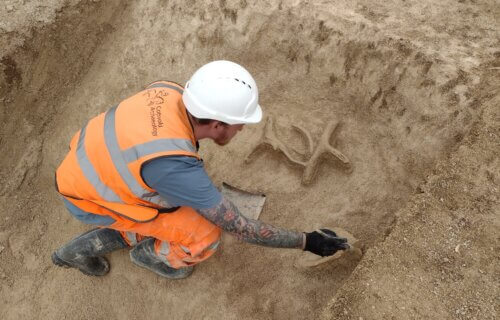
man wearing orange safety vest and white hard had digs up artifacts in large dirt hole.
A new development located off Netherhampton Road in Harnham has uncovered some fascinating findings during the archaeological works. (credit: Vistry Group)

HARNHAM, United Kingdom — The mysteries of Stonehenge may be the tip of the archaeological iceberg in this region of the United Kingdom. Researchers have made another remarkable discovery just miles from the world-famous site.
While preparing for a new housing development in Harnham, just eight miles south of Stonehenge, workers unearthed items that may date all the way back to 10,000 BC. The findings include ancient pottery, knives, and even red deer antler, which was often used for making tools and weapons in prehistoric times, according to archaeologists.

Cotswold Archaeology
Screenshot_20230923_151942_Chrome.webp
partnered with Vistry Group, the property developers, on this excavation project

The abundance of water has inevitably attracted human occupation from the Mesolithic onwards (10,000 BC – 4000 BC), which has led to some interesting findings,” says Richard Greatorex, principal fieldwork manager at Cotswold Archaeology, in a statement.

Among the most intriguing discoveries are five Bronze Age barrows — ancient burial mounds — dating from around 2400 BC to 700 BC. Archaeologists also found 10 burials and numerous pits and postholes from the Neolithic and Late Bronze Age. These pits and postholes seem to suggest that this area was used for agriculture long ago.

The site has uncovered some brilliant archaeology and has been an amazing opportunity for our archaeologists to excavate and better understand how this area fits into a wider landscape of settlement,” adds Steve Bush, Cotswold Archaeology’s onsite project leader.

Another point of interest is the discovery of Iron Age lynchets — terraced land created by ancient farming methods — as well as Anglo-Saxon pottery and knives that could shed light on life in that period

The artifacts are currently undergoing further analysis. They will eventually be donated to Salisbury Museum, ensuring that they are accessible to the public for years to come.

“It has been fascinating to see what has been discovered in Harnham, as it enables us to understand the land and our heritage better as a result,” says Emma Colin, Vistry Western’s managing director.

 
I dont understand how we don't find more rare objects in the world if we are always digging up for new houses , buildings , Graves , etc .... If this world was so active before our time , where the fuck did everything go ?
Most people making the finds do so by accident and have no idea the significance of what they found. The find goes unreported and more often than not probably gets tossed in the trash. I mean if you found a tiny fragment of broken glass or a bead, which was the only remains of an ancient civilization, you wouldn't know and probably just assume it is modern trash.
 
I dont understand how we don't find more rare objects in the world if we are always digging up for new houses , buildings , Graves , etc .... If this world was so active before our time , where the fuck did everything go ?
Turned into paste during the Great Flood and then turned into solid rock. And buried under the mountains. That "culture" used glass and plasma like we use electrons and copper. ALL that glass (scooped out from the face of the Moon) now exists as the world's sandy beaches.
 
Back
Top