


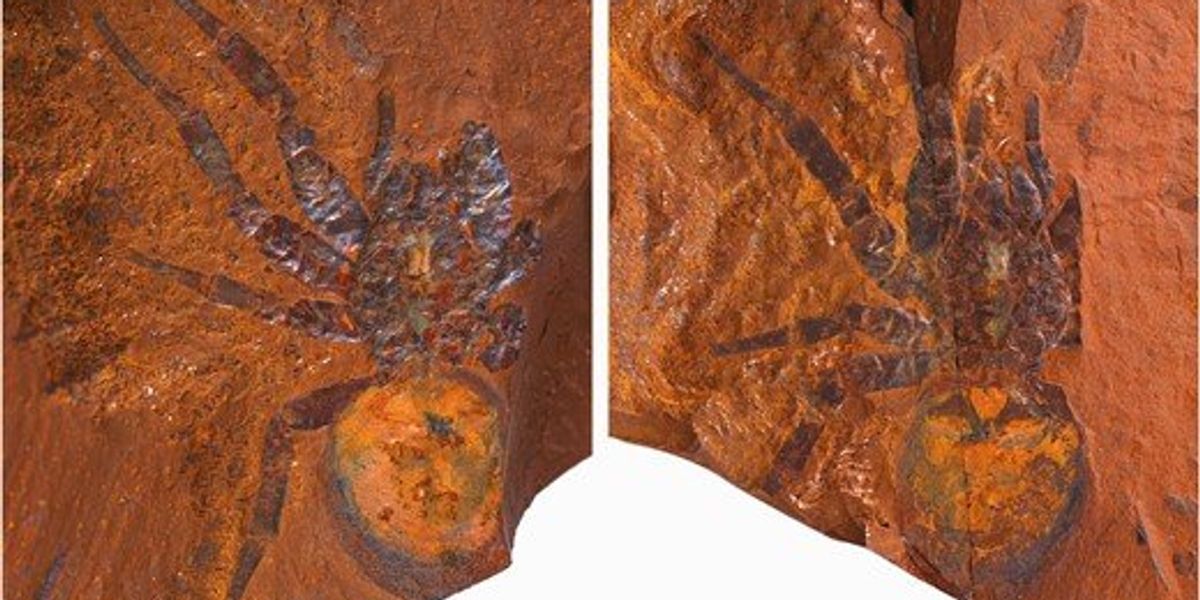
Scientists have found a fossilised giant trapdoor spider in New South Wales, only the fourth specimen of its kind to be found in Australia.
The creature would have roamed and hunted in the surrounding areas which were once a lush rainforest, researchers said in a recently filed report.
Last year, scientists unearthed fossils of the rainforest area from millions of years ago, teeming with specimens including plants, trapdoor spiders, giant cicadas and wasps.
Now the area is a grassland region known as McGraths Flat.
Researchers have named the spider fossil ‘Megamonodontium mccluskyi’. It would have lived in the Miocene period 11m to 16m years ago.
Only four spider fossils have ever been found throughout the whole continent, which has made it difficult for scientists to understand their evolutionary history,” said palaeontologist Matthew McCurry of the University of New South Wales and the Australian Museum.
“That is why this discovery is so significant, it reveals new information about the extinction of spiders and fills a gap in our understanding of the past.
The closest living relative of this fossil now lives in wet forests in Singapore through to Papua New Guinea.
“This suggests that the group once occupied similar environments in mainland Australia but have subsequently gone extinct as Australia became more arid.”
The spider was found among many other Miocene fossils. In some of them, the fossils were so well preserved that subcellular structures could be made out.
Scanning electron microscopy allowed us to study minute details of the claws and setae on the spider's pedipalps, legs and the main body,” said virologist Michael Frese of the University of Canberra.
The details meant scientists could confidently place it near the modern Monodontium, or trapdoor spider.
However, it is five times larger than its modern day relatives. Megamonodontium mccluskyi's body is 23.31 millimetres long – that is just over an inch
The discovery of the species also tells us something of the past climate of Australia, the report added.
The fact that it was found in a layer of rainforest sediment means the region was once much wetter than it is now.
That could, in turn, help scientists understand how a warming climate has already altered the country’s life forms – and how it might change them again.
"Not only is it the largest fossilized spider to be found in Australia but it is the first fossil of the family Barychelidae that has been found worldwide," said arachnologist Robert Raven of Queensland Museum.
"There are around 300 species of brush-footed trapdoor spiders alive today, but they don't seem to become fossils very often.
This could be because they spend so much time inside burrows and so aren't in the right environment to be fossilized."

 www.indy100.com
The creature would have roamed and hunted in the surrounding areas which were once a lush rainforest, researchers said in a recently filed report.
Last year, scientists unearthed fossils of the rainforest area from millions of years ago, teeming with specimens including plants, trapdoor spiders, giant cicadas and wasps.
Now the area is a grassland region known as McGraths Flat.
Researchers have named the spider fossil ‘Megamonodontium mccluskyi’. It would have lived in the Miocene period 11m to 16m years ago.
Only four spider fossils have ever been found throughout the whole continent, which has made it difficult for scientists to understand their evolutionary history,” said palaeontologist Matthew McCurry of the University of New South Wales and the Australian Museum.
“That is why this discovery is so significant, it reveals new information about the extinction of spiders and fills a gap in our understanding of the past.
The closest living relative of this fossil now lives in wet forests in Singapore through to Papua New Guinea.
“This suggests that the group once occupied similar environments in mainland Australia but have subsequently gone extinct as Australia became more arid.”
The spider was found among many other Miocene fossils. In some of them, the fossils were so well preserved that subcellular structures could be made out.
Scanning electron microscopy allowed us to study minute details of the claws and setae on the spider's pedipalps, legs and the main body,” said virologist Michael Frese of the University of Canberra.
The details meant scientists could confidently place it near the modern Monodontium, or trapdoor spider.
However, it is five times larger than its modern day relatives. Megamonodontium mccluskyi's body is 23.31 millimetres long – that is just over an inch
The discovery of the species also tells us something of the past climate of Australia, the report added.
The fact that it was found in a layer of rainforest sediment means the region was once much wetter than it is now.
That could, in turn, help scientists understand how a warming climate has already altered the country’s life forms – and how it might change them again.
"Not only is it the largest fossilized spider to be found in Australia but it is the first fossil of the family Barychelidae that has been found worldwide," said arachnologist Robert Raven of Queensland Museum.
"There are around 300 species of brush-footed trapdoor spiders alive today, but they don't seem to become fossils very often.
This could be because they spend so much time inside burrows and so aren't in the right environment to be fossilized."
Scientists find 'giant' dinosaur spider fossil in Australia
If you thought Australia’s spiders were scary, wait until you see the prehistoric version.Scientists have found a fossilised giant trapdoor spider in New South Wales, only the fourth specimen of its kind to be found in Australia.The creature would have roamed and hunted in the surrounding areas...
www.indy100.com





 🕷️🕸️
🕷️🕸️