


Supermassive black hole Sagittarius A* is spinning nearly as fast as it can, dragging the very fabric of space-time with it and shaping the heart of the Milky Way.
The supermassive black hole at the heart of our galaxy isn't just spinning — it's doing so at almost maximum speed, dragging anything near it along for the ride.
TRENDING
When you purchase through links on our site, we may earn an affiliate commission. Here’s how it works.
By Robert Lea
published 1 day ago
Supermassive black hole Sagittarius A* is spinning nearly as fast as it can, dragging the very fabric of space-time with it and shaping the heart of the Milky Way.

An image of the supermassive black hole at the heart of the Milky Way, which scientists think is spinning as fast as it can. (Image credit: EHT Collaboration)
The supermassive black hole at the heart of our galaxy isn't just spinning — it's doing so at almost maximum speed, dragging anything near it along for the ride.
Advertisement
ADVERTISEMENT
SCROLL TO CONTINUE READING
Physicists calculated the rotational speed of the Milky Way's supermassive black hole, called Sagittarius A* (Sgr A*), by using NASA's Chandra X-ray Observatory to view the X-rays and radio waves emanating from outflows of material.
The spin speed of a black hole is defined as "a" and given a value from 0 to 1, with 1 being the maximum rotational speed to a particular black hole, which is a significant fraction of the speed of light. Ruth A. Daly, a physicist at Penn State, and colleagues found that the rotational speed of Sgr A* is between 0.84 and 0.96 — close to the top limit defined by a black hole's width. The team described Sgr A*'s blistering speed in a study published Oct. 21 in the journal Monthly Notices of the Royal Astronomical Society.
Discovering that Sgr A* is rotating at its maximum speed has far-reaching implications for our understanding of black hole formation and the astrophysical processes associated with these fascinating cosmic objects," Xavier Calmet, a theoretical physicist at the University of Sussex who was not involved in the research, told Live Science in an email.
The supermassive black hole at the heart of our galaxy isn't just spinning — it's doing so at almost maximum speed, dragging anything near it along for the ride.
TRENDING
- Roman coins mystery
- Strange sea monsters
- Black hole photo
- Ancient temples
- PlayStation VR 2 review
- Review
When you purchase through links on our site, we may earn an affiliate commission. Here’s how it works.
Supermassive black hole at the heart of the Milky Way is approaching the cosmic speed limit, dragging space-time along with it
NewsBy Robert Lea
published 1 day ago
Supermassive black hole Sagittarius A* is spinning nearly as fast as it can, dragging the very fabric of space-time with it and shaping the heart of the Milky Way.
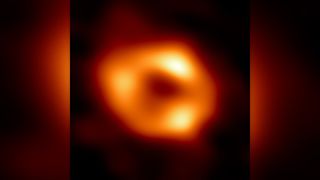
An image of the supermassive black hole at the heart of the Milky Way, which scientists think is spinning as fast as it can. (Image credit: EHT Collaboration)
The supermassive black hole at the heart of our galaxy isn't just spinning — it's doing so at almost maximum speed, dragging anything near it along for the ride.
Advertisement
ADVERTISEMENT
SCROLL TO CONTINUE READING
Physicists calculated the rotational speed of the Milky Way's supermassive black hole, called Sagittarius A* (Sgr A*), by using NASA's Chandra X-ray Observatory to view the X-rays and radio waves emanating from outflows of material.
The spin speed of a black hole is defined as "a" and given a value from 0 to 1, with 1 being the maximum rotational speed to a particular black hole, which is a significant fraction of the speed of light. Ruth A. Daly, a physicist at Penn State, and colleagues found that the rotational speed of Sgr A* is between 0.84 and 0.96 — close to the top limit defined by a black hole's width. The team described Sgr A*'s blistering speed in a study published Oct. 21 in the journal Monthly Notices of the Royal Astronomical Society.
Discovering that Sgr A* is rotating at its maximum speed has far-reaching implications for our understanding of black hole formation and the astrophysical processes associated with these fascinating cosmic objects," Xavier Calmet, a theoretical physicist at the University of Sussex who was not involved in the research, told Live Science in an email.