• Adults Only Website 18+

    If you are under 18 you are not permitted to submit personal information to us or use this website. If discovered you will be banned.

    We will ban and report anyone posting illegal content.

    We will ban any forum user who breaks our terms.

    Freedom of speech should be wide open as long as it doesn't incite violence.

    We have a 15 year old thriving community here with 400,000+ members and hundreds of people online at any given moment, we encourage you to join!, there are 1000's of topics to discuss. Please be aware before registering and read our terms of service and privacy policy.

    By dismissing this notice and proceeding, you agree to the above.

THE SPREE KILLER THREAD

spreeeee.webp

I'll start off with Martin Bryant and the Port Arthur Maccascre:

Martin Bryant

Suddenly One Sunday


For the owners of the numerous shops and caf�s at the Port Arthur Historical site in Tasmania, fine weather usually meant good crowds and Sunday April 28, 1996 was no exception. Once the site of one of Australia's most brutal penal settlements, Port Arthur had become the premiere tourist attraction in Tasmania. By 1.00 pm, over five hundred visitors were at the site, enjoying the many attractions that the area had to offer.

1a.jpg

Broad Arrow Cafe

By 1.30 pm the pace at the 'Broad Arrow' caf� had slowed after the busy lunchtime period but at least sixty people still remained, finishing meals or browsing through the gift shop. No one seems to recall seeing the young man with long blond hair enter the caf� and order a meal, but they do remember his comment when he sat down on the front balcony area to eat his lunch. "There's a lot of wasps about today," he said to no one in particular and began to eat his meal. A few minutes later, he made another remark about the lack of Japanese tourists.
He made no further comments as he finished his meal and picked up his bags and went back into the caf�. Moving towards the back of the room, he lifted a long, blue sports bag onto a vacant table and placed a video camera beside it. For several minutes he stood staring at a group of diners at an adjoining table before turning his attention to an Asian couple that were sitting near him. Before anyone had realized what was happening, he unzipped the larger bag and produced an AR15 semi-automatic rifle and shot the Asian man, Moh Yee Ng, in the neck, killing him instantly. Swinging the rifle from the hip he pointed it towards Soo Leng Chung, the man's companion, and shot her through the head. Turning his attention back to the first group he lifted the rifle to his shoulder and fired a shot at Mick Sargent, grazing his scalp and knocking him to the floor. Before Mick could shout a warning, the gunman fired a fourth shot that hit Mick's girlfriend in the back of the head. In a matter of seconds, the young man had claimed three victims.
The fusillade continued as the gunman selected new targets, the acrid smell of gun smoke hanging in the air as his helpless victims dodged for cover. One man at the front of the room who bravely stood to shout a belated warning, died when a bullet tore through his neck. Husbands were killed as they tried to protect their wives and families, one man receiving massive head injuries when a bullet that had passed through a previous victim hit him. Some were killed instantly but many others lay bleeding from their wounds.
Walking towards the front entrance of the caf�, the gunman fired methodically, shooting left and right as the terrified crowd scrambled for cover. Fifteen seconds later, a total of twenty people lay dead with fifteen more wounded, many of them seriously. Leaving the Broad Arrow, the gunman walked out into the parking lot where over a hundred people were milling about in confusion. Many, hearing the shots, had started walking in the general direction of the caf� in the mistaken belief that a re-enactment was in progress. Others, who had been close enough to observe the carnage, ran for cover, screaming warnings to anyone they came in contact with.
Seeing the crowd gathered in the car park, the gunman opened fire. Several tourists fell as the rest, finally aware of what was happening, screamed and ran. Walking towards a tour bus parked nearby, the gunman shot the driver and three passengers. As the latest fusillade echoed across the parking lot, several tourists who were waiting to board the bus crawled under it for safety but the gunman saw them and calmly squatted down and shot them before walking back to his car, a yellow Volvo 244GL sedan with a surfboard strapped to the roof.
The gunman then drove three hundred yards down the road, to where a young woman and her two children were walking beside the road. Pulling to a stop, he fired two quick shots killing the woman and the child she was carrying. When the older child ran away to take refuge behind a tree, the gunman followed her and killed her with one shot. Returning to his vehicle, the gunman then drove a further two hundred yards towards the entrance gate where a gold coloured BMW was parked. Three shots were fired in rapid succession and the car's three male occupants lay dead. After dragging the bodies from the car, the gunman transferred his firearms into the BMW and drove away.
A short distance up the road he saw a couple sitting in a white Toyota and stopped beside them. The female driver froze as the man approached holding a gun and ordered her male companion to get out of the car. The man obeyed, pleading with the gunman not to shoot, but the gunman ignored him and instead, ordered the man to climb into the open trunk of the BMW. The gunman then slammed the lid and returned to the front of the car and fired two shots through the driver's window killing the young woman instantly. With the man still locked in the trunk, the gunman sped away towards a local guesthouse called the Seascape Cottage where the final chapter of the deadly saga would eventually unfold.

1b.jpg

Seascape Cottage

As he drove towards the entrance to Seascape Cottage, the gunman saw another vehicle approaching and opened fire, but his bullets missed their target. Turning his attention to the next vehicle, a four-wheel-drive jeep driven by a holidaying couple from Melbourne, the young man fired two shots, one of which tore into the bonnet, the other smashing the windscreen. A second volley of shots ripped through the side windows showering the occupants with glass and hitting the female driver in the forearm. Realizing the driver was hit; the male passenger leaned over and attempted to drive the vehicle to safety but was unable to do so as the throttle cable had been severed by one of the bullets.
Seconds later, a Ford sedan with two married couples on board, drove towards the cottage and were hit by a hail of bullets that penetrated the windshield, wounding the driver. Bleeding profusely from his wounds, the driver of the Ford continued on to where the jeep was parked and managed to rescue the occupants before speeding away to the Fox and Hounds, another guesthouse further down the road. Another vehicle, approaching along the Arthur Highway, saw the man standing on the road with a gun and rapidly changed direction.
After the Ford drove away, the gunman walked back to the BMW and drove down the entrance road and parked in front of the cottage. He then removed his guns from the car before releasing the man from the trunk. After taking him inside the house and handcuffing him to a stair rail, the gunman returned to the BMW, poured petrol over it and set it alight.
Only minutes after the shooting began at Port Arthur, the first police were summoned to the scene. Hearing the emergency radio call, two young constables, Paul Hyland and Garry Whittle, drove rapidly towards the area. As Constable Hyland approached Seascape Cottage, he saw the damaged vehicles on the side of the road and stopped to investigate. Seeing smoke billowing from the car parked in front of the cottage, he drove back down the highway to set up a roadblock. By this time Constable Whittle had arrived and he also parked his vehicle across the highway on the other side of the entrance to seal off the area.
Soon after two other police arrived, the BMW exploded sending them diving for cover. As they maneuvered their vehicles into safer positions, shots were fired in their direction from the cottage. The police held their positions until members of the Special Operations Group relieved them shortly after dark. As they took up flanking positions around the guesthouse, more shots were fired from within the cottage. The operation was further hampered by poor radio reception making it almost impossible for the police to confirm each other's positions.

1c.jpg

Martin Bryant

As the hours ticked away, information about the gunman began to seep through. The lone gunman was believed to be Martin Bryant, a twenty-eight-year-old resident of New Town, a suburb of Hobart. Bryant was described as being tall with long blond hair and pale skin, almost albino in appearance and "a little slow." Another piece of information that filtered through caused greater concern. In addition to the AR15 and FN semi-automatic rifles that Bryant was known to be carrying, he had access to several more firearms that belonged to David and Sally Martin, the owners of Seascape Cottage. Given the additional weapons, at least three hostages and the lack of suitable cover around the cottage, a direct assault was ruled out and a specialist negotiation team was summoned.
Off and on for the next six hours, the senior police negotiator, Sergeant Terry McCarthy spoke to Bryant over the phone. During the course of the negotiations, Bryant's only demand was that he be given a "ride" in an army helicopter. Eventually, contact with the cottage was lost when the batteries went flat on the cordless phone that Bryant was using. As the vigil continued, police reinforcements from as far away as Victoria and New South Wales arrived at the scene creating the largest single police action in Australia's history.

1d.jpg

The charred ruins

The next morning, Monday, April 29, senior police met to decide the next course of action. Shortly after, smoke was seen billowing from the cottage and at 8.25 am, Martin Bryant ran from the building, his clothing ablaze. As police rushed forward to make the arrest, Bryant tore his clothes from his body and gave himself up. Later, as ambulance officers smothered his skin with ointment, Bryant asked them if it was petrol they were using. He was later conveyed to the same hospital where many of his victims were fighting for their lives. After the fire was put out, more bodies were found inside the cottage. Included in the dead were the Seascape's owners, David and Sally Martin and Glenn Pears, the man that had been locked in the car. Police would later establish that Pears had been murdered sometime during the negotiations and Bryant killed the Martins prior to his arrival at Port Arthur. In a period of just over nineteen hours, Martin Bryant, a man described by locals as being "a quiet lad and a bit of a loner," had killed thirty-five men, women and children and wounded another eighteen making him the most notorious spree killer of all time.
A Killer in Profile


From an early age, Martin Bryant was an unusual child. His mother, Carleen, often told family and friends that she was concerned about young Martin's temperament. His father Maurice would eventually take early retirement from his job as a dockworker to look after Martin. By the time he started school, his erratic behavior distanced him from the other children. It wasn't until he reached primary school that he was found to have a below average I.Q. and put into special classes. One of his teachers at New Town High remembers him as "totally isolated in his own little world." In fact, he was more isolated than several deaf children who were in the same class. What was more intriguing was that Martin seemed to prefer it that way and was at his happiest when he didn't have to interact with anybody.
As he got older his "strange detachment," became more apparent, even when confronted with traumatic and sometimes dangerous situations. On one occasion, when he and a girlfriend were marooned in a dinghy in heavy seas off Bass Strait, Martin showed "a complete lack of emotion" when the couple were rescued by a fisherman. He showed a similar detachment when his father supposedly committed suicide by drowning himself in a dam on the family's property. When he was asked to help find his father's body, Martin seemed to be enjoying himself immensely and showed no sign of concern over his father's death. According to an ambulance officer at the scene, Martin knew more about the death of his father than he was telling. Although Maurice Bryant was found in the bottom of a dam with a weighted diver's belt wrapped tightly around his throat, police treated the matter as a suicide when they found a suicide note and an amount ofcash in a car on the property.
Because of his strange behavior, Martin was often bullied and on one occasion was almost drowned by a group of children he was tormenting. As he grew, Martin's behavior became more cruel and bizarre. In one incident, while skin diving with a friend, Martin jabbed a hand spear into the head of his companion while he was surfacing. Neighbors describe how, as a child, Martin would constantly torment them by throwing rocks at their children, cutting down trees, untying boats from their moorings and destroying fruit trees and vegetable gardens.

2a.jpg

"A quiet lad and a bit of a loner."

After leaving school, Martin did not need to look for work as he qualified for a pension because his I.Q. was twenty to thirty points below average. Sometime later however, he took a job that would change his life forever. Helen Harvey, the rich, middle-aged eccentric heiress to the Tattersalls Lottery fortune, asked Martin to work for her as a handyman. From that time on, Martin formed a bond with Harvey that was seen by many as more than a working relationship. Harvey lavished attention on Martin and often took him on shopping expeditions, sometimes spending thousands of dollars on him at a time. She was known in the area for weaving strange tales about her life and for squandering large amounts of money needlessly. During one particular year, she purchased a new car every month but never drove any of them. Jewelry was also a passion but she never wore any. Eventually, Martin moved in to her mansion which was around the corner from his parent's home. The house was a menagerie with scores of dogs, cats and birds living in and around the house. On one occasion, the living conditions in the home had become so squalid that the RSPCA animal welfare association forced Harvey to clean up the property to comply with health regulations. After the job was completed, seven dumpsters full of rubbish were taken from inside the house alone. Later, when the bins were emptied, apart from rubbish, they were found to contain several television sets in working order, cash and other valuables. Eventually, Bryant and Harvey moved to the country.
After moving to the small rural town of Copping, Martin's behavior became increasingly erratic. When he was kicked off a bus for harassing a young schoolgirl, he hailed a cab and chased the bus to abuse the driver. Not long after moving to the new area, his neighbors began to complain about Martin prowling around their properties late at night. He was later reported for threatening a neighbor with a rifle and became increasingly obsessed with firearms. One family friend remembers him constantly "showing off" with his guns and bragging about taking "pot shots" at the tourists who stopped at the apple stand near the property's front gate.
Regardless of the numerous complaints about his behavior, Martin spent some of the happiest years of his life in Harvey's company. This was all to come to a tragic end when Harvey was killed in a traffic accident, which some believed was caused by Martin tugging at the steering wheel while Harvey was driving, a dangerous prank that Bryant was known for. The police later investigated the matter but cleared him of any involvement. With the two most influential figures in his life dead, Martin was left largely on his own. Named as the sole beneficiary of Harvey's estate, Martin now had a mansion in Hobart and cash in excess of $500,000 to spend any way he wanted.
Following Harvey's funeral, Martin moved back to the house in Hobart but became restless. With a virtually endless stream of income, he was free to choose any lifestyle he wanted. He soon discovered overseas travel and made thirty trips within a three-year period. During this time he made few friends, his only social contacts were whoever sat beside him on the aircraft and shop owners and caf� proprietors, many of whom remember him for the many outrageous outfits he wore. His relationships with women were just as bizarre with Bryant making approaches to any female regardless of age, often making lewd comments about their appearance and his sexual preferences, which seemed to include bestiality. Unable to build a normal relationship, Bryant indulged his physical needs by hiring prostitutes to come to his house. Several who visited him at the mansion refused to go back as they found him and his surroundings "creepy."
In the months before the massacre, Martin visited Port Arthur several times. During this time, he bought a new sports bag. The shopkeeper who sold it to him, remembers him measuring several before deciding on which one to purchase. Although many psychologists believe that Martin Bryant's actions on that fateful day stemmed from impulsive behavior, the sports bag incident and the fact that he had visited the site numerous times in the weeks preceding the attack, suggests that the killings were planned in advance and carried out with cold, calculating precision.
Aftermath
While Martin Bryant recovered in Royal Hobart hospital under heavy guard, the families and friends of the victims attempted to come to terms with the tragedy. After the police completed their reconstruction of the massacre, they estimated that, from the time Bryant had started shooting until the time he left the historic site, only eight minutes had elapsed. In just eight short minutes, Martin Bryant had taken the lives of 11 Tasmanians, 12 Victorians, 1 South Australian, 4 from New South Wales, 4 from Great Britain, 2 Malaysians and another man from South-East Asia. Of the injured, 15 were Australians, two others a Canadian and an American.
When police later released the information that Bryant had purchased the "military style" weapons used in the attack, from a Hobart gun dealer without any form of licensing, it resulted in an uproar. Virtually overnight, large numbers of private citizens called newspapers, television stations and talk-back radio shows demanding that Australia's disparate gun laws be urgently reappraised. Within days, many politicians added their support and met to discuss a new set of national gun laws including a total ban on all semi-automatic weapons.
In response, representatives of several prominent pro-gun lobby groups protested against the sweeping changes, citing that the laws would only serve to place restrictions on decent, law-abiding citizens and not the "lunatic fringe" that procured their firearms illegally.
Although much of the blame for Port Arthur was centered on the availability of guns used in violent crimes, Australia's homicide statistics prove otherwise. Tasmania, Martin Bryant's home state, has the lowest murder rate in the country with just 0.85 murders per 100,000 population, a rate far lower than Japan which has some of the strictest gun laws in the world. According to the Australian Institute of Criminology, fists, knives and blunt instruments are the most frequently used weapons in homicides, with guns accounting for just 25%.
Despite numerous protests, Prime Minister John Howard later implemented sweeping reforms regarding gun ownership in Australia which included bans on the importation and sale of most "military style" semi-automatic weapons.

No Laughing Matter

In the weeks and months following the massacre, Bryant was subjected to four major psychological examinations but, despite theories that he may be suffering from schizophrenia and a personality disorder called Asperger Syndrome which resulted in "inappropriate mannerisms and actions," Martin Bryant was declared legally sane and fit to stand trial.
In an earlier police interview, when asked the reasons for his actions, a smiling Bryant said, "I'd really love to help you out, but I can't."
The trial began on November 7, where evidence was heard relating to the slaughter. Some of the most disturbing being when eye witnesses related the hideous injuries inflicted upon their friends and families by Bryant who was described as a "laughing, maniacal fool" during the shootings. During the entire trial, including the screening of an amateur video of part of the shooting frenzy, Bryant continued to smile and, on more than one occasion, laughed openly. He continued to smile several days later when the jury handed down a guilty verdict after which he was sentenced to life imprisonment with no possibility of parole.

3a.jpg

Bryant's cell.

Martin Bryant is now housed in Hobart's Risdon prison under protective custody. His mother who, apart from his defense counsel, was Martin's only visitor during the trial, later told interviewers that she wished her son had died along with his victims. When asked how Martin was adapting to life in prison, she answered, "He's his usual self, he's smiling and laughing.

In Memoriam

In a case such as this, it is all too easy to focus on the person responsible and neglect the most important element of any crime, the victim. The following is a list of the thirty-five men, women and children that Martin Bryant senselessly murdered on April 28, 1996. May they rest in peace.
WINIFRED APLIN * WALTER BENNETT * NICOLE BURGESS * CHUNG SOO LENG * ELVA GAYLARD * ZOE HALL * MERVYN HOWARD * ELIZABETH HOWARD * RON JARY * TONY KISTEN * DENNIS LEVER * SARAH LOUGHTON * DAVID MARTIN * SALLY MARTIN * PAULINE MASTERS * NANETTE MIKAC * ALANNAH MIKAC * MADELINE MIKAC * ANDREW MILLS * GWENDA NEANDER * PETER NASH * NG MOH YEE WILLIAM * ANTHONY NIGHTINGALE * MARY NIXON * GLEN PEARS * JIM POLLARD * JANET QUINN * KATE SCOTT * HELENE SALZMAN * ROBERT SALZMAN * RAYMOND SHARP * KEVIN SHARP * ROYCE THOMPSON * JASON WINTER *


http://www.documentingreality.com/forum/f166/horrific-port-arthur-massacre-footage-84312/

Unable to link the videos from DR. Anyone?
Also anyone with more victim photos before and after, actual footage, etc., plz post.

 
MICHAEL RYAN AND THE HUNGERFORD MASSACRE

An only child, Michael Robert Ryan was born on 18 May 1960 in the Savernake hospital, Hungerford. His father, Alfred Henry Ryan, a government building inspector, was known for being a perfectionist and was 55 when Ryan was born.

His mother, Dorothy Ryan, was over 20 years younger than her husband and was 34 when she had her only son. She was a respected and popular member of the community and used to work as a dinner lady at the Hungerford Primary School before becoming a part-time waitress at the Elcot Park Hotel, where she worked for 12 years, until her death.

Ryan grew up in South View, Hungerford and relatives remembered him as a quiet, mostly sullen and quite self-centred boy. His favourite toy was Action Man, the commando-type plastic doll, kitted out with uniforms and weapons. Short for his age, Ryan was often teased and bullied but never retaliated and consequently avoided other children. At age 11, he moved from the local primary school opposite his home, to the John O’Gaunt Secondary School, where he underachieved academically and would often play truant. He had a few friends but always shied away from any sporting or social events at school.

At age 16, he left John O’Gaunt School to attend a technical college, the Newbury College of Further Education, intending to learn to become a building contractor. Although he tried hard, it soon became apparent that Ryan showed no flair for this trade and soon dropped out of college. He found low-paid work as a caretaker at a girls’ school. Continuing to live with his parents, his doting and indulgent mother would pay for anything he could not afford, including cars, petrol, insurance, and even his first gun, an air rifle.

When Ryan was old enough, he purchased a shotgun and began to collect other weapons, which he proudly displayed in a glass cabinet in his bedroom. It seemed that the guns gave Ryan the feeling of power and control that he had always lacked. He would also brag to people about things he had not done, in a string of lies that made him seem far more capable and experienced than he actually was. He told people he had served in the Second Parachute Regiment of the British armed forces, that he was getting married, and that he owned a gun shop. He would become extremely angry if people did not believe him and his mother would often confirm these lies to people, in a desperate effort to help her son feel better.

Besotted with the military, Ryan bought army jackets, survival gear and masks. He even persuaded the police to grant him a licence to own more powerful firearms. They were unable to refuse him as he had no record of mental instability and no criminal record. However, they stipulated that Ryan install a suitable Chubb steel cabinet in which to safely lock his weapons. He subscribed to magazines on survival skills and guns, including ‘Soldiers of Fortune’, and was a fan of violent films such as ‘Rambo: First Blood’ (1982).

Ryan was 25 when his father died of cancer in 1985. The loss affected him profoundly and he became increasingly withdrawn, often going off alone to the shooting range, or working on cars. It was during this time that he lost his caretaker job. People later commented that his mental instability became increasingly apparent following the death of his father.


The Crimes

Market DayIt was market day in Hungerford, a balmy Wednesday, 19 August 1987. The popular weekly market attracted many people and was an event enjoyed by locals and visitors alike. People came to buy goods, eat in the restaurants and stay at the inns. This Wednesday was no different, with the schools on holiday, many people were taking advantage of the good weather. However, the jovial atmosphere was soon to be shattered and people’s lives changed forever.

Savernake Forest, a popular recreational area seven miles from Hungerford, was a favourite haunt of Ryan’s, where he would spend great deals of time pretending to be on army manoeuvres. He liked to think of himself as a soldier, skilled at surveillance without being seen himself. Wearing camouflage outfits, he enjoyed sneaking up on picnickers and watching them without their knowledge, before disappearing again.

First Victim
Just after midday, on 19 August 1987, the 27-year-old unemployed Ryan entered a secluded area of Savernake Forest. Here he found Susan Godfrey, 33, an attractive, auburn-haired mother, with her children, Hannah, 4, and James, 2. He spied on them as they ate their picnic lunch, before playing a while. Preparing to leave for her grandmother’s 95th birthday, Godfrey was packing away the picnic when a grim looking Ryan approached, dressed all in black and pointing a 9mm Beretta pistol at her.

He ordered her to put her children in the car, which she did immediately, strapping them in and telling them to wait there for her, that she would be back soon. Ryan picked up the picnic groundsheet and ordered Susan to walk with him into the woods. Here he shot her 13 times, dropped the groundsheet and returned to parking area. Godfrey’s children watched as he climbed into his car, which was parked next to theirs, and drive away without a word to them. They had heard the sounds of the shots being fired and were terrified.

After some time, young Hannah unbuckled their seatbelts, so they could go in search of their mother. A fellow park visitor, Myra Rose, found the children wandering around and they told her their mother had been shot. The woman did not believe them at first but agreed to help them find her. Meanwhile, a police officer had noticed Godfrey’s empty car with open doors and had gone to investigate. In the neighbouring forest he found Godfrey’s body, about 250 feet from her car.

She was fully clothed but riddled with bullets. Near her body were two groups of German-made 9mm spent cartridges. It wasn’t long before investigators discovered, via ballistics analysis, that her death was connected to those that happened subsequently in Hungerford that afternoon. This had been Ryan’s first victim.

Ryan then went to Froxtield petrol station, where he was watched by Mrs Kakoub Dean, wife of the owner, as he filled up his metallic silver Vauxhall Astra GTE, as well as a five-litre can. She recognised him as a regular customer at the petrol station, but not a chatty or friendly one. Also, he had never before bought so much petrol at one time, making Dean suspicious, so she kept an eye on him.

Whilst Dean served another customer, Ian George, Ryan went to the boot of his car and brought out a semi-automatic rifle. By the time Dean looked back at him, he had assumed a shooting position, with the rifle aimed directly at her. She ducked below her counter just as a bullet pierced the safety glass above it and ricocheted through the small shop behind her. George sped off on his motorcycle.

Ryan stormed into the shop and again aimed his rifle at Dean. Terrified, crying and huddled against the wall, she begged him not to kill her. He took no heed of her pleas and pulled the trigger, but nothing happened. He tried pulling the trigger twice more, but both times the rifle failed to fire.

Dean reported later that when she looked Ryan in the face, it seemed as if he was not even aware of her and was looking right through her. Having failed to kill Dean, Ryan quickly returned to his car and drove off towards Hungerford. Dean called both her husband and the 999 emergency services. The police had already received a report, from George, of an armed robbery in progress at the petrol station and were en route to her.

Resupplying
At around 12:45pm, Ryan arrived at his next destination, 4 South View, a dead-end street in Hungerford, where he lived with his widowed mother. Watched by neighbours, he went into the house and muffled shots were heard. It later transpired that he had shot the family dog, a black Labrador.

Emerging from the house, dressed in a headband and sleeveless flak jacket, Ryan carried a bag filled with food and other supplies. He tried starting his car but to no avail. Angrily, Ryan climbed out of the car and shot five bullets into the boot. He then went back into the house, used the five-litre can of petrol to soak everything he could, and set the house on fire.

Into his car, Ryan had packed military clothing, a large amount of ammunition and a first aid kit. He also had several different firearms: a Beretta 9 mm semi-automatic pistol; an M1 carbine semi-automatic assault rifle; and a Kalashnikov AK-47 rifle loaded with armour-piercing bullets. He took the firearms, packed the pockets of his flak jacket with ammunition and marched off down the road.

Seeing two of his neighbours, Roland and Sheila Mason, in their back garden, he shot Roland six times and Sheila once, in the head. Both died instantly. Ryan spotted another shocked neighbour, Marjorie Jackson, peering through the window at the dead bodies and shot her as well. She was wounded but managed to call her husband, Ivor Jackson, who worked close by. Whilst she waited for help to arrive, she watched Ryan jog up and down the road, shooting at anything that moved. Another witness reported that Ryan warned several children to get off the street and go inside. It seemed that whilst he was in the midst of a murderous rampage, he still felt the need to protect children.

An elderly neighbour, Dorothy Smith, 77 years old and deaf in one ear, had come out into the street to see what all the noise was about. She shouted at him, saying, “Is that you making that noise? You are frightening everybody to death. Stop it, you stupid bugger!”. Ryan looked at her with extremely vacant eyes and a strange grin, before moving off eastwards along a footpath leading to Hungerford Common. She was inordinately lucky not to have been shot by him.

Manhunt
Lisa Mildenhall, 14, was shot and wounded by Ryan, who had smiled at her whilst she crouched on the ground at her front door, and then shot her four times in the legs and stomach. She scrambled into her house, where she collapsed and her mother immediately called an ambulance. Mildenhall survived the shooting.

Kenneth Clements was walking along the footpath with his family, towards South View, when Ryan appeared and shot him once, killing him instantly. Robert, his frightened son, escaped by jumping over a fence into the neighbouring school, whilst the rest of the family literally ran for their lives.

The Hungerford police were already undertaking a manhunt for the killer and a police helicopter spotted Ryan. They warned ground units to set up a roadblock around South View, to stop any drivers entering the area, although they had no idea what Ryan would do next. In an unfortunate turn of events, the police at the roadblock actually sent some drivers directly towards Ryan.

Police Constable Roger Brereton rushed to the danger area of South View and Ryan shot at his patrol car 23 times. Brereton was hit by four of the bullets and died in his car. The smiling Ryan shot 11 rounds from his semi-automatic at another car that drove into the street. Its occupants, Linda Chapman and her daughter, Alison Chapman, whilst wounded, both survived. Linda was hit in the shoulder and Alison in the right thigh. Unfortunately, the bullet travelled up into Alison’s lower back, leaving her permanently disabled.

Moving up Fairview Road, Ryan found neighbour, Abdul Khan, 84, a retired restaurateur, mowing the lawn in his back garden. Ryan approached, looked at him and shot him three times. Kahn died later of his wounds. Ryan immediately turned to Alan Lepetit, a coalman who had helped install the Chubb steel cabinet for Ryan’s firearm collection. Lepetit had heard about shooting in his neighbourhood and was hurrying home to check on his family. Ryan shot Lepetit twice in the arm and once in the back as he fled. He survived the attack.

Danger Zone
Ryan then shot at an ambulance, shattering its windscreen, as it was trying to reach some of the victims in a narrow lane. Ambulance-woman Hazel Haslett was injured in the arm and the leg by broken glass. Driver, Linda Bright, immediately put the ambulance into reverse and retreated. Access was blocked for the fire engine called to deal with the fire Ryan had started in his own home and which had already spread to three neighbouring properties. Residents of the area were becoming increasingly worried as they continued to call for emergency help and none arrived. The fact was that they were prevented from entering the danger zone, for fear of being shot themselves. Meanwhile, police were busy getting some people to safety and preventing others from going where they thought Ryan might move to next.

People were frantic to get to their families to see if they were safe and unharmed. Ivor Jackson’s wife, Marjorie, had called him whilst Ryan was aiming a gun at her. Now, as his colleague, quantity surveyor George White, drove him home to check on his wife, they came across Ryan. He sprayed their car with 11 bullets, Ivor Jackson was shot three times in the chest and once in the head and White was shot too, dying as their car smashed into the police car Ryan had shot at earlier. Jackson played dead and survived the shooting.

He heard what happened next, as Dorothy Ryan, returning home from some shopping, arrived at the scene in her car. She parked behind White’s car and opening the door and looking in, said, “Oh Ivor…” and then hurried up the road. What she found was houses on fire, people lying dead in their gardens and smashed cars lining the street. Dorothy then saw her son with a gun in his hand and called to him, saying, “Stop Michael. Why are you doing this?”. Without replying, Ryan shot his mother twice in the stomach and once in the leg. He walked up to where she lay in the road and, with the gun only four inches from her, shot her twice in the back, killing her.

Despite the police helicopter hovering above him and telling him to lay down his weapons, Ryan merely walked away. The police officers at the scene did not apprehend him at this point, as they were unarmed. At 1.30 pm specially trained officers from the Tactical Firearms Unit were brought in and local police officers assembled closer to town. After killing his mother, Ryan walked across the school playing field, firing randomly.

Betty Tolladay, 71, had heard loud bangs, and thinking it was children playing with firecrackers, had come out into her back garden to shout at them to keep the noise down. Instead she found Ryan, who shot her once. The bullet entered her groin, smashed the top of her hip, part of her pelvis and the sciatic nerve, before exiting via her back. She managed to drag herself into her house and survived.

Ryan’s next victim was Francis Butler, a 26-year-old accounts clerk, out walking his dog in the Hungerford Memorial Gardens. He was shot three times in the groin and the leg with the AK-47 rifle and died where he fell. Ryan walked past a young boy, Dean Lavisher, without seeming to notice him, but fired at another boy riding past on his bicycle, Dean Cadle, thankfully missing him. Ryan then abandoned his M1 carbine in the Memorial Gardens.

10th victim
Popular cab driver, Marcus Bernard, 30, was en route to visit his wife and newborn son in the local hospital. When he slowed down to see what was happening, Ryan shot him in the head with the AK-47 and he died instantly. Bernard was the tenth fatality on that bloody Wednesday. Witnesses report that at this point, Ryan seemed disgusted with the rifle and threw it onto the ground. Changing his mind, he retrieved it and carried on walking, away from town.

Along the way, Ryan shot and wounded a man, who was pulled to safety as Ryan moved closer in order to shoot him again. A car drove towards Ryan and he shot both occupants. The man, Douglas Wainwright, hit twice in the chest and once in the head, died instantly but his wounded wife, Kathleen Wainwright survived. It transpired that they were the parents of the police officer who had run all the checks on Ryan when he had applied for a modified licence, to own more powerful firearms.

Yet another vehicle drove into the area and once again, Ryan shot at it, hitting the driver, shattering his jaw, bursting his tongue and missing his spinal cord by two millimetres. He was John Storms, 49, a washing machine engineer who had been called out to Hungerford Park Farm on business. Bob Barclay, a local builder and nearby resident, risking his own life, bravely ran out and dragged Storms from his car, managing to half crouch and half run with Storms into the safety of his garden. Storms survived the shooting.

Prime Minister
By this stage, the press had heard of the killing spree and arrived in the area, taking photographs of the dead and wounded, and unethically gaining access to some of the victims’ houses, by saying they were crime scene personnel. Their pictures were a grim account of the trail of destruction and death that Ryan had left in his wake. It was calculated that during the most intense period of Ryan’s rampage, he had killed an average of one person per minute. The Prime Minister, Margaret Thatcher, who was on holiday in Cornwall at the time, was notified of the events and kept informed via a special phone line from Downing Street. The press helicopters were in the way of police trying to track Ryan and this allowed him to get away again.

Paying no attention to the police or the press, Ryan seemed oblivious to anything other than his hell-bent mission to kill everyone in his path. Eric Vardy, a carpenter and van driver for Norland Nursery College, was on his way with passenger, Steven Ball, to a builders’ supplier. As they drove up Tarrants Hill, their windscreen was shattered by a spray of bullets and Vardy was hit twice, under the chin and in the torso. He later died of shock and haemorrhage from the bullet wound to his neck.

Ryan then walked into Priory Road, where he found Sandra Hill, 22, driving her red Renault 5, with the window down and the music blaring. He took aim and killed her with a single bullet to the chest. Crossing the street, shooting as he went, Ryan strode towards 60 Priory Road, the home of Victor and Myrtle Gibbs and blasted open the front door with his semi-automatic rifle. The wheelchair-bound Myrtle was totally vulnerable and Victor threw himself across her to protect her from the crazed gunman. Ryan fired at them and Victor died instantly, whilst Myrtle died later in hospital. Having created a ‘fort’ for himself in the Gibbs’ home, Ryan fired at neighbouring houses, injuring a man at number 62 and a woman at number 67 Priory Road.

Ian Playle, a 34-year-old clerk to the Justices at Newbury Magistrates Court, had brought his wife, Elizabeth, and their two young children, Richard and Sarah, to Hungerford on a shopping trip. As they drove down Priory Road, Ryan shot at their car and Playle died from a single bullet wound to the neck from the Beretta. His wife and children were unhurt. George Noon, 67, was standing in the garden of his son’s house, 109 Priory Road, when Ryan shot him in the shoulder and the eye, but he survived.

O’Gaunt Secondary School
Shortly before 2pm, Bert Whatley, a Priory Road resident, watched as Ryan, walking slowly, with his head down, entered the John O’Gaunt Secondary School, which was closed for the summer holidays. It was the same school he had attended more than a decade before.

Chief Inspector Lambert had sent Sergeant Paul Brightwell and his team of eight officers from the Tactical Firearms Unit to investigate the school, unaware that this was indeed the exact location of the killer. They were armed with .38 Smith and Wessons, which were no match for Ryan’s arsenal.

Four and three quarter hours after the police had first been informed of Ryan, he was finally spotted at one of the school’s third floor classroom windows at 5.26 pm. He threw his Kalashnikov out of the window, leaving him with only his 9mm Beretta and ammunition. Brightwell immediately informed his superior and Hungerford was declared safe for the waiting ambulances and fire engines to move in to the former danger zone. Police surrounded the school building and Brightwell worked to establish communication with Ryan and ultimately to persuade him to surrender.

Negotiation
During the next 90 minutes, Brightwell and Ryan held a long and detailed conversation, during which Ryan seemed quite lucid, calm and easy to talk to. At one point, he claimed to have an Israeli fragmentation type hand grenade, which seriously worried the police. He continually asked about his mother and how she was. Brightwell answered that he did not know at the time but was attempting to find out, and continued to persuade him to drop his weapons and come outside. Ryan said he would not exit the building until he had news of his mother’s condition.

Some of the things Ryan shouted out the window to Brightwell were, “Hungerford must be a bit of a mess”; “If only the police car hadn’t turned up. If only my car had started”. He also wanted to know if his dog had been found and if they had located his M1 carbine and its magazine, as he didn’t want the children to find it and hurt themselves. At another point, close to the end, he said, “I wish I had stayed in bed”.

Suicide
At 6.45 pm he said, “It’s funny, I killed all those people but I haven’t got the guts to blow my own brains out”. He then asked the time and was silent for a while. At 6.52 pm, Brightwell heard a single muffled shot from the classroom. The police were not certain if Ryan had shot himself or just fired off a round. They flew the police helicopter past the window, but could not see in to the classroom. One of the Tactical Firearms Unit climbed onto the school roof and with a mirror on a long pole, managed to see into the classroom at last. Ryan was lying slumped in the corner, near a window, apparently dead.

The rest of the unit entered the room and checked that he was not wired with explosives as a booby trap. In his right hand, tied to his wrist with a bootlace, was his Beretta pistol. It was confirmed that Michael Robert Ryan had fatally shot himself at 6.52 pm on Wednesday, 19 August 1987, with a single gunshot to the head. The bullet had passed through his skull and shattered his brain. The horrific Hungerford Massacre was finally over. Ryan had killed 16 people, including his mother, and wounded 15 others.

The Aftermath

Victims were taken to the Princess Margaret Hospital in Swindon. Although situated 15 miles from Hungerford, it was the nearest hospital with an Accident and Emergency department equipped to deal with the numerous casualties with high-velocity gunshot wounds. Routine admissions were cancelled, the X-ray department and the blood bank were put on alert, extra doctors and support staff was made available and the victims started pouring in.

At around 4 pm, the Royal Air Force hospital in nearby Wroughton contacted the Princess Margaret Hospital to inform them that they could take the next two serious and six minor casualties. The Housing Department of Newbury District Council made accommodation available for those residents of South View who found themselves homeless after the fires Ryan had started.

Life savers
Lance Corporal Carl Harries, 21, a young off-duty soldier and veteran of the Falklands War, was on his way into town, to pick up a radiator hose, when he walked into the midst of the massacre. Not able to stand by and idly watch people suffer, he had repeatedly risked his life to help a number of victims, giving first aid where he could and solace to those having lost loved ones. Harries later received the Queen’s Commendation for Brave Conduct.

Amongst others also later commended for their bravery were ambulance-women Hazel Haslett and Linda Bright, who had been shot at by Ryan but who had continued working selflessly late into the night to help other victims.

It was reported in the tabloid newspapers that following the public announcement of Ryan’s death, the people of Hungerford reacted with relieved delight. People were said to have run into the streets chanting, “The bastard’s dead, the bastard’s dead”, whilst children cycled around on their bikes, yelling “Good riddance”, and people in pubs toasted his death. Whether or not these were completely accurate accounts, they certainly encapsulated the emotion of relief foremost in people’s minds immediately after the massacre that the carnage was finally over.

Ron Tarry, Hungerford’s Mayor, claimed that the locals were in shock and speaking in hushed tones and that it was the press and others who had flocked to the scene who were doing the drinking in pubs. Either way, the mourning period for an entire town was still to be endured.

The Reverend David Salt received countless communications of support and offers of help poured in to the Hungerford vicarage. Flowers began arriving at the town hall, where the flag flew at half-mast. The Hungerford Family Help Unit was hastily established in makeshift offices, co-ordinated by John Smith, to help a community suffering from Post Traumatic Stress Disorder. The Round Table helped by providing funds for taxis, rents, television rentals and other services. Cash and cheques poured in from well-wishers, some even from children, and a Tragedy Fund was established, in collaboration with Lloyds TSB, Barclays and NatWest, the three banks in Hungerford.

The Queen
Her Majesty the Queen’s private secretary sent a letter of condolence from Buckingham Palace to Mayor Tarry and enclosed a personal contribution from the Queen. Prime Minister Mrs Thatcher interrupted her Cornish holiday to visit Hungerford. Close to tears, she toured the streets, met with the relatives and visited victims in hospital.

All over Berkshire, the funerals that followed the massacre were deeply poignant. Many were attended by people who had never known the deceased in life, but wished to show support for their families and the bereaved Hungerford community in general. In contrast, Dorothy Ryan’s funeral service, held at St Mary’s Church in Calne, Wiltshire, was only attended by 40 mourners. Whilst people did recognise that she was a victim, Canon John Reynolds, who conducted the service, selected not to mention her son and only made a brief reference to the Hungerford massacre.

Speculation
Following the massacre, the British press was inundated with stories about Michael Ryan and speculation as to why he had committed so many acts of unprovoked violence. Dr Gregory Moffat, a childhood aggression specialist, claimed that victims of bullying are generally small, weak, lack confidence and are loners. Their inability to defend themselves against their bullies means that shame, guilt, anger, hate and the need for revenge builds inside them. This powerful mix of emotions is often later expressed in an inappropriately violent response. This seemed to fit the profile of Michael Ryan.

The Hungerford Report
The British Home Secretary, Douglas Hurd, travelled to Hungerford on Sunday, 23 August 1987. There he announced that he had commissioned a report on the massacre from the Chief Constable of Thames Valley Police, Colin Smith. The Hungerford Report confirmed that Ryan’s weapons had been legally licenced. It also transpired that there were several unfortunate incidents encumbering the response by the police and other emergency services to the events on 19 August 1987.

The local Hungerford police station was in the process of being renovated and had only two telephone lines working on that day. In addition to this, the local telephone exchange could not handle the amount of 999 calls that were being made, as Ryan wreaked havoc across the suburbs and people desperately tried phoning for help. In a further twist of fate, the local police helicopter was in for repair but police mechanics eventually made it ready for flight and it was deployed at around the time Ryan shot his mother. Adding to the sound of gunfire in the area was the fact that the Thames Valley firearms squad were in training, about 40 miles away.

The Hungerford Report led to the Firearms (Amendment) Act 1988, which banned the ownership of semi-automatic centre-fire rifles and restricted the use of shotguns with a magazine capacity of more than two rounds.

Memorial Service
On 8 October 1987, a memorial and rededication service was held for the town of Hungerford. Mayor Tarry claimed it to be the day on which life in the town could begin once more. The open-air service outside the town hall was attended by over 60 percent of the population of Hungerford and the principal sermon preached by Right Honourable Robert Runcie, Archbishop of Canterbury.

Apart from the numerous local and international newspaper articles written about the Hungerford Massacre and Michael Ryan, there were also several books. These include ‘Lonewolf: True Stories of Spree Killers’ (May 2002) by Pan Pantziarka and ‘The Encyclopedia of Mass Murder’ by Brian Lane and Wilfred Gregg (1993). Ryan has also been documented on internet sites devoted to mass murder. Some more minor details of that fateful day in 1987 vary in the different accounts but all agree that it will remain in memory as one of the worst gun crimes in British history.

Sir Charles Pollard, Chief Constable of Thames Valley Police from 1991 – 2001, commented, “The realisation that this could happen in fun-loving England, where we don’t have guns and the police aren’t armed… it changed policing and it changed society forever.”
 
Derrick Bird

Classification: Spree killer
Characteristics: Local taxi driver - Motive unknown
Number of victims: 12
Date of murders: June 2, 2010
Date of birth: October 8, 1957
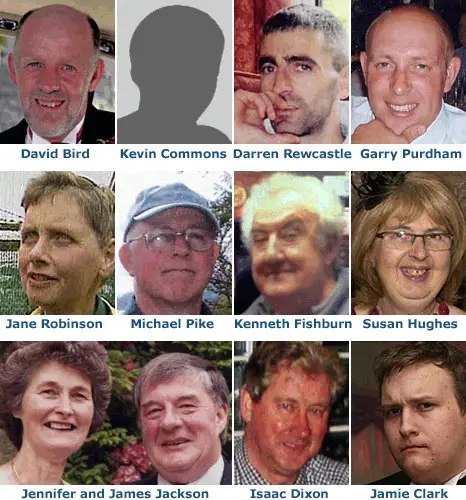
Victim profile: David Bird, 52 / Kevin Commons, 60 / Darren Rewcastle, 43 / Susan Hughes, 57 / Kenneth Fishburn, 71 / Jennifer Jackson, 68 / James Jackson, 67 / Isaac Dixon, 65 /Garry Purdham, 31 / Jamie Clark, 23 / Michael Pike, 64 / Jane Robinson, 66
Method of murder: Shooting
Location: Cumbria, North West England, United Kingdom
Status: Committed suicide by shooting himself the same day


photo gallery


The Cumbria shootings were a killing spree that occurred on 2 June 2010 when a lone gunman, Derrick Bird, killed 12 people and injured 11 others before killing himself in the county of Cumbria, North West England, United Kingdom.
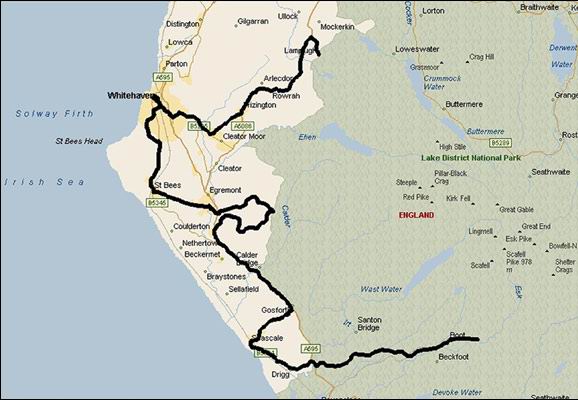
The series of attacks began in mid-morning in Lamplugh and moved to Frizington, Whitehaven, Egremont, Gosforth and Seascale, sparking a major manhunt by Cumbria Constabulary.
Bird, a 52-year-old local taxi driver, was later found dead in a wooded area, having abandoned his vehicle in the village of Boot. Two weapons that appeared to have been used were recovered. There were 30 different crime scenes investigated. Police confirmed it was the worst incident of mass shooting in Britain since the Dunblane massacre of 1996.
The Queen paid tribute to the victims and The Prince of Wales later visited Whitehaven in the wake of the tragedy. The Prime Minister, David Cameron and Home Secretary Theresa May also visited West Cumbria. A memorial fund has been set up to aid victims and affected communities.
Timeline
Targeted shootings
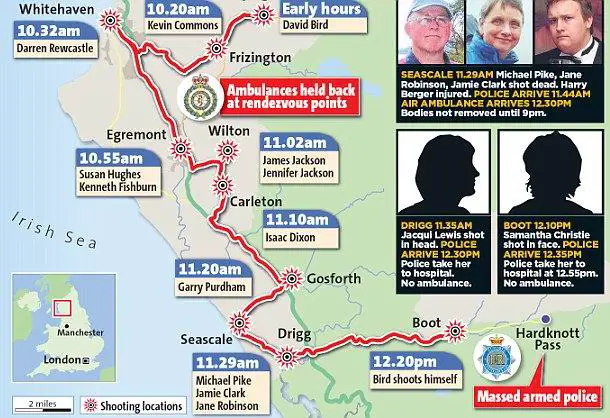
The incident began when Bird, a self-employed taxi driver from Rowrah, first shot dead his twin brother, David Bird, in Lamplugh, then shot dead the family solicitor, Kevin Commons, in Frizington. At 10.20 BST the police were telephoned. Bird then moved on toward Whitehaven. At 10:33, there was a shooting incident close to the taxi rank in Whitehaven. It emerged that the suspect, later identified as Bird, had shot dead a taxi driver who was known to him, and that he had shot several others.
Random shootings
Soon after this, residents in the towns of Whitehaven, Egremont and Seascale were urged to stay indoors after the shots were heard and there were further shooting incidents. He drove through several local towns firing apparently at random. In Egremont, Bird killed a further two people on the streets. A couple were both shot dead in the village of Wilton and a mole-catcher in a field in Carleton was also killed. A former semi-professional rugby league player, Garry Purdham, was shot dead outside the Red Admiral Hotel at Boonhead, near Gosforth. Bird also killed three people in Seascale: two pedestrians and a man driving a car. The motorist died, although it was not clear at first whether he died from gunshot wounds or the resultant car crash.
Search for the suspect
Bird was last seen alive at 12.30; shortly after 12:30 police confirmed that there had been a number of fatalities and that they were searching for a suspect.
Police announced they were searching for the driver of a dark grey Citroën Xsara Picasso, driven by the suspect identified as Bird. Bird reportedly abandoned his car in the village of Boot and continued to evade the police on foot.
At 14:00, Deputy Chief Constable Stuart Hyde announced that a body, believed to be that of Bird, had been found in a wooded area, along with a rifle. Police confirmed shortly afterwards that members of the public who had previously taken shelter during the incident could now resume their normal activities.
During the manhunt, the gates of the nearby Sellafield nuclear reprocessing plant were closed as a precaution, and the afternoon shift was told not to come to work. This was the first lockdown in the history of the plant.
Victims
Targeted killings
1. David Bird, 52, killed at Lamplugh, twin brother of the gunman.
2. Kevin Commons, 60, killed at Frizington, gunman's family solicitor.
3. Darren Rewcastle, 43, killed at Whitehaven, fellow taxi driver known to the gunman.
Random killings
4. Susan Hughes, 57, killed at Egremont.
5. Kenneth Fishburn, 71, killed at Egremont.
6. Jennifer Jackson, 68, killed at Wilton, wife of James Jackson.
7. James Jackson, 67, killed at Wilton, husband of Jennifer Jackson.
8. Isaac Dixon, 65, killed at Carleton.
9. Garry Purdham, 31, killed at Gosforth, brother of England rugby league captain Rob Purdham.
10. Jamie Clark, 23, killed at Seascale.
11. Michael Pike, 64, killed at Seascale.
12. Jane Robinson, 66, killed at Seascale.
Perpetrator
13. Derrick Bird, 52, suicide at Boot
Aftermath
At 15:00, Prime Minister David Cameron, taking his first session of Prime Minister's Questions, announced that "at least five" people had died, including the gunman. Later that evening, a police press conference in Whitehaven announced that 12 people had been killed, that a further 11 people were injured, and that the suspect had killed himself. They also confirmed that two weapons had been used by the suspect in the attacks and that thirty different crime scenes were being investigated.
Over the next few hours, Bird's shooting of his brother and solicitor was revealed. The police stated that the shootings took place along a 15-mile (24 km) stretch of the Cumbrian coastline. Helicopters from neighbouring police forces were used in the manhunt, while those from the RAF Search and Rescue Force and the Yorkshire Air Ambulance responded to casualties. A major incident was declared by North Cumbria University Hospitals NHS Trust at West Cumberland Hospital, Whitehaven, with the accident and emergency department at the Cumberland Infirmary, Carlisle, on full incident stand-by.
Bird had been a licensed firearms holder and the incident sparked debate about further gun control in the United Kingdom; the previous Dunblane and Hungerford shootings had led to increased firearms controls.
Perpetrator
Derrick Bird was a son of Joseph (7 September 1916 – 31 October 1998) and Mary Bird, who is terminally ill. He had a twin brother, David (1957–2010) and an older brother. He lived alone in Rowrah, and had two sons with a woman from whom he separated in the mid 1990s. He became a grandfather on 22 May 2010, and was variously described as a popular and quiet man who worked as a self-employed taxi driver in Whitehaven. There are unconfirmed reports that he had previously sought help from a local hospital due to his fragile mental state. Bird had a shotgun certificate from 1995 onwards, and a firearms certificate for a rifle from 2005 onwards. He was being investigated by HM Revenue and Customs. The body of Bird was formally identified at Furness General Hospital in Barrow-in-Furness, and he was cremated at a private service on 18 June 2010
Possible motives
There has been speculation that Bird may have had a grudge against people associated with the Sellafield nuclear power plant that he worked for as a joiner, resigning in 1990 due to an allegation of theft of wood from the plant. He was subsequently convicted, and given a 12 month suspended sentence. Three of the dead were former employees although there is no evidence that any were involved with his resignation.
A fellow taxi driver, who described himself as one of Bird's best friends, and was shot in the hand, has claimed that Bird had a relationship with a Thai girl he met on holiday in Pattaya, Thailand. It has been further claimed by another friend of Bird that he had sent £1,000 to the girl, who subsequently ended their relationship via a text message; he added that Bird had been "made a fool out of".
It has also been speculated that Bird had been involved with a family dispute over a will. The speculation was heightened when it was revealed that Bird had targeted both his twin, David, and the family's solicitor, Kevin Commons, in his attacks, killing both.
Police investigating the killings have also found that Bird was the subject of an ongoing tax investigation by HM Revenue and Customs for tax evasion. This suggests that he could have been pressurised by the threat of possible future prosecution and punishment at the time of the killings, suggesting a possible cause of his actions. According to Mark Cooper, a fellow taxi driver who had known him for 15 years, Bird had accumulated £60,000 in a secret bank account and was worried he would be sent to prison for hiding the cash from HM Revenue & Customs.
Reactions
Official responses and visits
Prime Minister, David Cameron was joined by several other MPs in expressing the House of Commons members' shock and horror at the events during Prime Minister's Questions.
On the evening of 2 June, the Queen said she was "deeply shocked" by the shootings and shared the nation's "grief and horror".
The Home Secretary, Theresa May MP expressed her regret at the deaths and paid tribute to the response of the emergency services. The Cabinet met to discuss the shootings and May later made a statement on the Cumbria incident to the House of Commons on 3 June 2010. Cameron and May visited the affected region on 4 June 2010 to meet victims, officials and local people.
Jamie Reed, the local Member of Parliament for Copeland, called the incident the "blackest day in our community's history".
Prince Charles visited Whitehaven on 11 June 2010 to meet members of the community affected by the tragedy.
Media
BBC One altered their programming to broadcast two BBC News Specials about the shootings, at 14:15 and 19:30 on the same day. The ITV continuing drama, Coronation Street was cancelled on 2, 3 and 4 June as it contained a storyline involving a death in the Lake District and a violent storyline featuring a gun siege in a factory. The episodes were rescheduled to run the following week due to the Cumbria massacre. An episode of the Channel 4 panel gameYou Have Been Watching, which was due to be broadcast on 3 June 2010, was postponed because it was a crime special.
In addition, pop singer Lady Gaga came under criticism after performing a murder scene at her concert in Manchester – as part of her Monster Ball Tour – just hours after the massacre. Comedian Frankie Boyle also attracted criticism for referring to the Cumbria tragedy on the day after the massacre. The Times journalist Giles Coren suggested Derrick Bird should read a copy of his book on anger management. He later apologised. Both Coren's initial remark and subsequent apology were made on his Twitter feed.
Memorials
On 9 June 2010, a week after the incident, memorial services were held in the West Cumbria towns affected by the shootings followed by a minute's silence at midday. The minute's silence for the Cumbria victims was also marked prior to David Cameron's second Prime Minister's Questions in Parliament. The funerals of the majority of Bird's victims were held at various churches in West Cumbria.
Wikipedia.org
Profile: Cumbria gunman Derrick Bird
BBC.co.uk
November 2, 2010
Taxi driver Derrick Bird sparked a massive police manhunt when he went on the rampage in west Cumbria in June, shooting dead 12 people and injuring 11 others.
His catastrophic and violent actions caused universal disbelief in the area, where he was known by many.
Bird, 52, of Rowrah - known as "Birdy" - was divorced with two grown-up sons and had become a grandfather in the weeks before the shootings on 2 June.
All accounts from friends, family, neighbours and colleagues, have described him as "quiet", "popular" and "a laugh".
And yet something made him shoot dead his own twin brother, David, then others known to him, such as the family solicitor and a colleague. He went on to kill and maim again and again, apparently at random, before taking his own life.
'You won't see me again'
Reports have circulated of a possible feud within his family or at work. But no-one has yet spoken of a man who showed any sign of being capable of mass murder, and police have said he had no history of mental illness.
His elderly mother, Mary Bird, was said to be "stunned" after learning the news that her son had murdered his twin and 11 others - Bird's brother's daughters have denied reports of any family feud.
A friend of Bird's, Peter Leder, told CNN that he was "an outgoing, well-known guy, who everyone liked".
But he said when they spoke, Bird told him: "You won't see me again."
Glenda Pears, manager at L&G Taxis in Whitehaven, said both Bird and one his victims - Darren Rewcastle - had been self-employed drivers and friends.
Ms Pears said Bird had been a taxi driver for 23 years and was a "real nice man".
She said one of her drivers witnessed the aftermath of the shooting in Whitehaven.
"The lad that's been killed [Darren Rewcastle] was friends with him. They used to stand together having a craic on the rank. He was friends with everybody and used to stand and joke on Duke Street."
One Whitehaven taxi driver - who did not want to be named - said he had known Bird for 10 years. He said he believed he had lived in the Whitehaven area all his life but that he rarely spoke of his family.
The man said Bird enjoyed foreign holidays, travelling to Thailand each year with friends. Others said he loved "tinkering" with his car and was a fan of motor sports and scuba diving.
He had not been aware of Bird owning a gun, or being a member of any gun club, he said. A neighbour also said he had never seen Bird carrying a gun but added that game shooting was not uncommon in the area.
The driver added: "He was a nice guy. He was quiet but we used to have a laugh. He was quite a friendly person."
Although some appeared to be unaware of his gun ownership, it later emerged that Bird obtained a shotgun licence back in 1995, and a firearms licence for a .22 rifle in 2007.
Police trawling through Bird's history said they now knew he had been dismissed from his job as a joiner at the Sellafield nuclear plant in Cumbria in 1990 after being convicted of stealing from his employer.
He received a 12-month suspended sentence, which - in accordance with the law and Home Office guidance - did not prohibit him from getting the gun licences.
A review published on 2 November concluded that Cumbria Police acted properly when it issued the licences, and existing gun licensing laws could not have prevented the tragedy.
The independent review, by Adrian Whiting of the Association of Chief Police Offiers, also said that Bird's actions could not have been predicted.
A similar view was held in the aftermath of the killings by friends unable to fathom his behaviour.
Michelle Haigh, the landlady of Bird's local pub, the Hound Inn in Frizington, described him as a "normal bloke".
He would often stop off at the pub, which is about three-quarters of a mile from his home, she said.
"He was a nice guy, nothing out of the ordinary. He would come into the pub, have a couple of pints, have a chat with his friend and go home.
"This is not in character with the Derrick Bird we know."
The landlady, 41, said no-one she had spoken to could think of any trigger for the fatal events.
A neighbour told the BBC Bird had lived on Rowrah Road for about 20 years and had never caused any problems, adding: "I know him, he's all right".
'Normal person'
Whitehaven councillor John Kane told the BBC Bird had always appeared to be "very placid... a very quiet man... kept himself to himself".
He added that "Something must have pushed him over the edge."
Sue Matthews, a telephonist at A2B Taxis in Whitehaven, said the gunman lived alone, adding that he was a "quiet fellow".
"I would say he was fairly popular. I would see him once a week out and about," she said.
In his home village of Rowrah, near Frizington, shocked neighbours were still coming to terms with what had happened.
Neighbour Ryan Dempsey, 26 - who lives next door but one - said Mr Bird was "very approachable" and would often sit on his front step, drinking tea and talking to passers-by.
He said he had never seen him angry or losing his temper.
"Nobody could have a bad word to say against him, as far as I know," he said.
However he said other neighbours had remarked that on Wednesday morning he had not been his usual friendly self, and had "looked straight through people", he said.
Derrick Bird's stunned neighbours describe 'placid and happy man'
Locals in disbelief over gunman's rampage, saying he was easygoing and friendly, and had recently become a grandfather
By Severin Carrell - Guardian.co.uk
June 2, 2010
Neighbours and passing friends remember Derrick Bird as a friendly, even-tempered man; the kind of neighbour with a ready smile, who would also stop for a chat. Their shock at his unprovoked shooting spree is resounding.
Ryan Dempsey, a neighbour, had known Bird since he was 10. "He was a very easygoing sort of fellow; never walked past without saying hello. The last time I saw him was last night or the night before, and he was just as happy as before. He waved through the window, nodded and smiled, and the next thing I hear is this tragedy."
Bird had a very good reason to be an apparently happy man: he had just become a grandfather. Last week, his son Graeme and his wife, Victoria, who lived only a few miles from Bird's ill-kempt and shabby cottage, had a son.
But today, the curtains in their home were tightly drawn. On the sitting room window sill was a row of greetings cards crammed tightly together. Their neighbours, alerted to the day's shocking events, were unwilling to talk. "I have no information," said a young woman next door.
The couple had retreated to Graeme's mother's home in the bucolic village of Lamplugh, just a few miles away, which is a rambling collection of farms, pubs and idyllic country homes surrounded by pastures and hedgerows plump with spring flowers. Lamplugh is also home to Bird's brothers, David and Bryan.
At the gate of the housing association home where Bird's former partner, Linda Mills, lives, a young police woman stood guard. She politely told reporters that no one inside was prepared to talk to the media. A family liaison officer was on their way.
While his son's and ex-partner's homes are smart, carefully tended and welcoming family homes, Bird's own cottage in the village of Rowrah has the air of neglect and loneliness. Rowrah is a small place, one of a string of hamlets and villages, mostly home to people who commute to Sellafield nuclear reprocessing plant down the coast or to Whitehaven and Workington.
Bird's home is one of 13 small two-up-two-down pebble-dashed cottages in a tight row opening out onto the street. Its paint and plasterwork are peeling and stained; a dusty upstairs bedroom window is paint-splattered. A rusting satellite dish leans upwards from under the eaves. The downstairs curtains were tightly drawn, but on the window sill were lawyers' letters and one from the Criminal Injuries Compensation board.
There were strong rumours reported in Whitehaven that Bird, known to locals as "Birdy" had had feuds with other taxi drivers and was known to the police. But for many who knew him, Bird was "very placid" and well known on the Whitehaven taxi ranks.
One man who knew him told BBC Radio 4 he appeared to be a mild-mannered, content individual: "I can't see how this piece [the murder spree] fits into his jigsaw. It's just completely out of place."
Dempsey, 26, who works for a power company, had first met Bird when Dempsey's parents bought their cottage two doors away 15 years ago. He knew him as a child and six months ago had taken over the property.
Dempsey never saw Bird – a man reputed locally to be keen on railways – with guns or heard him talk about an interest in shooting or any membership of a shooting club. "I wasn't aware of it; I didn't see him with a firearm," he said.
But in this rural area with its gamekeepers and farmers, he said, shotgun ownership was common. He had heard that Bird had used a shotgun on his victims. But then many gun owners tend to keep their firearms out of sight.
"I can't remember seeing him with a firearm, no. Like I say, my dad is a gamekeeper and my dad doesn't like people openly seeing him with a firearm. It just puts people off".


Derrick BIRD


bird_001.jpg


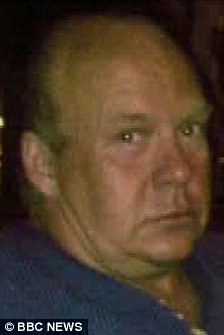
Derrick Bird


bird_011.jpg

Derrick Bird


Derrick Bird


bird_013.jpg

Derrick Bird


bird_014.jpg

Derrick Bird enjoyed scuba-diving holidays, but those who accompanied him
said that he was known as a 'lech' and dubbed 'the dog'.


bird_015.jpg

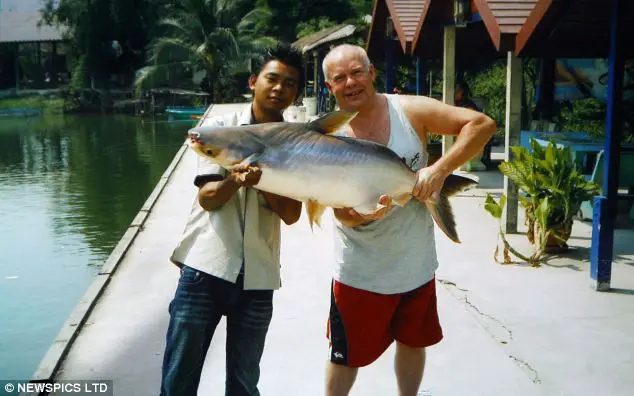
Bird and a fish he caught during one of his Thai trips.


Derrick Bird at his local sub-aqua club.


bird_017.jpg

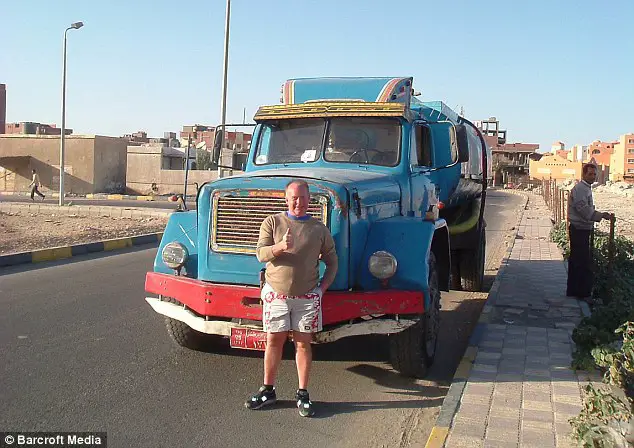
Bird in Sharm-El-Sheikh, Egypt, in 2008.


bird_018.jpg

Derrick Bird


bird_020.jpg

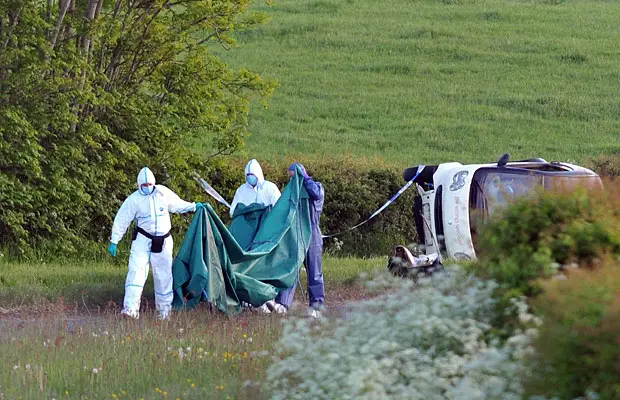
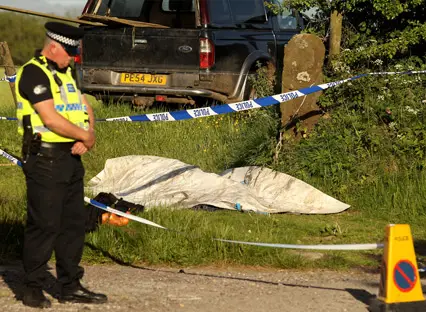
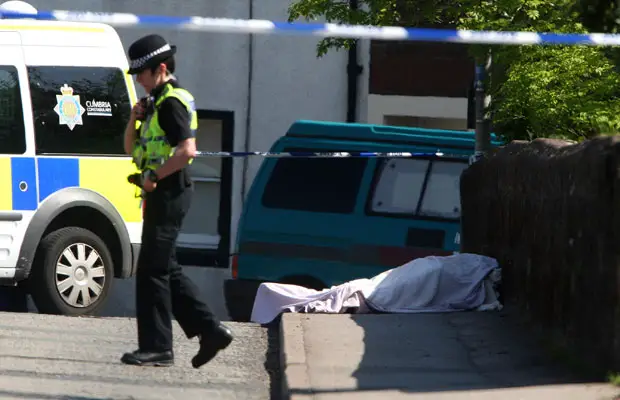
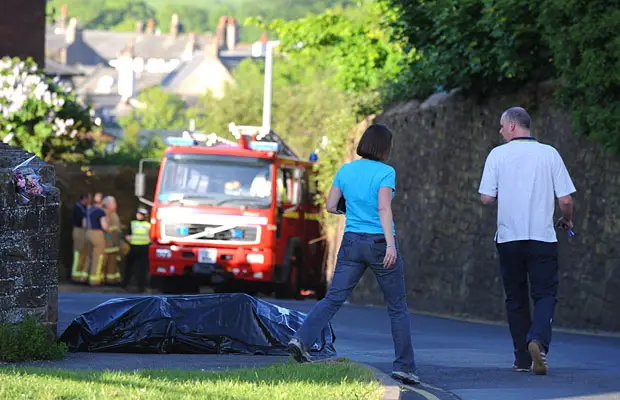
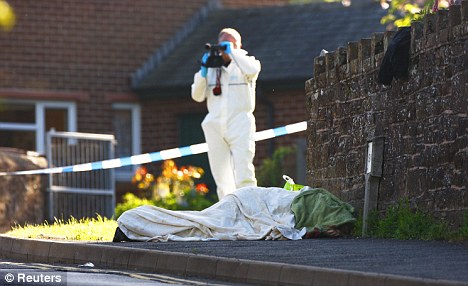
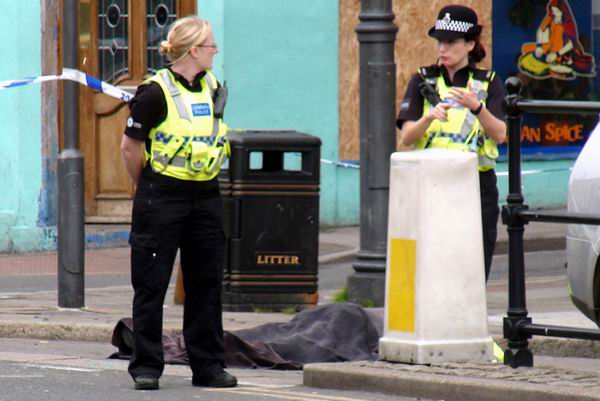
Police forensic officers examine a car containing a body near Seascale, Cumbria after taxi driver
Derrick Bird went on a shooting rampage.


bird_021.jpg


bird_022.jpg


bird_023.jpg


bird_024.jpg


bird_025.jpg


bird_in_mourning.jpg

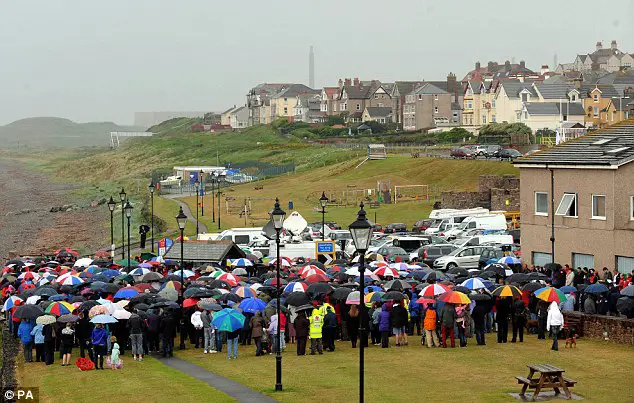
In mourning: Seascale stopped as hundreds stopped for the ceremony.


bird_brother.jpg

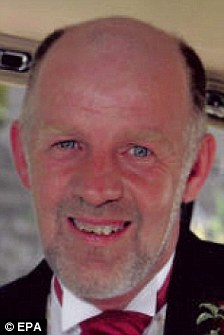
Derrick Bird's twin brother David, 52, who was found dead at his house on High Trees Farm, Lamplugh.


bird_victims.jpg

The victims


bird_injured.jpg

Whitehaven taxi driver Don Reed who was shot and injured by Derrick Bird.


bird_map_1.jpg


bird_map_2.jpg
 
Lulz I dug up this 2010 article on the Port Arthur massacre. Supposedly Martin's old lady has written a book about the incident.

http://www.themercury.com.au/article/2010/12/05/191085_tasmania-news.html

"There might be one or two (people interested), but they'd be warped people themselves. It's not a Christmas present I'd get."

I laughed at this statement from one of the victim's family members being somewhat interested myself.
 
Quote Melbourne man Wally Nash, whose son Peter, 32, was killed by Bryant, questioned her motives.

"Why do it? Why stir it up now? I wouldn't buy it and if I never read it, I'd never care," he said.


Cash maybe you tard?
 
Aramoana massacre
aara2.webp

schitzophrenic shooter David Malcolm Gray


From Wikipedia, the free encyclopedia
Aramoana massacre
Special Tactics Group officers crouch on Muri Street (right), before storming Gray's beach house (left)
Location Aramoana, New Zealand
Date 13–14 November 1990
7:30 p.m. – 5:50 p.m.
Attack type Spree killing
Deaths 14 (including the perpetrator)
Injured 4
Perpetrator David Malcolm Gray

The Aramoana massacre was a mass murder that occurred on 13 November 1990 in the small seaside township of Aramoana, New Zealand.[3] Resident David Gray, a 33-year-old unemployed man, began indiscriminately shooting people in the township with a scopedsemi-automatic rifle, after a verbal dispute with his next-door neighbour. He shot neighbours and a family visiting the township,[4] and killed thirteen people, including local police Sergeant Stewart Guthrie, first responder to the reports of a shooting. After a careful house-by-house search the next day, police officers led by the Special Tactics Grouplocated Gray and shot him dead as he came out of a house firing from the hip[1][2] (media reports at the time called the group by the pre-1990 name, the Anti Terrorist Squad). It is the deadliest criminal shooting in New Zealand history.[5]

Initial incident
[edit]
Description

[edit]

The massacre began on 13 November at 7.30 pm when Gray confronted neighbour Garry Holden about one of Holden's daughters wandering onto his property. After the confrontation, Gray went into his house, retrieved a Norinco 84S semi-automatic rifle, walked outside and shot Holden dead.
Nearby were three young girls: Holden's two daughters, Chiquita and Jasmine, and his girlfriend Julie Ann Bryson's adopted daughter, Rewa. The girls ran into Holden's house as Gray walked onto Holden's property. He quickly found Chiquita and shot her through her left arm and chest with a Squires and Bingham .22-calibre semiautomatic sporting rifle, the bullet lodging in her abdomen.[6]
The wounded girl fled past her father's body to Bryson's nearby house, while Gray set the Holden house on fire. Bryson, realising that Rewa and Jasmine were still in the Holden house, drove her van there with Chiquita in an attempt to save the girls. Gray shot at the van as it passed the house, which was by then ablaze.[citation needed]
Gray started shooting indiscriminately, targeting a utility vehicle full of locals who had seen the Holden house burning and stopped to help. He first shot Vanessa Percy as she ran down the street in terror, then killed two young boys, Leo Wilson and Dion Percy. The boys' sister, Stacey, received severe wounds to her abdomen.[7] Ross Percy, the children's father, who had been driving them home after a day fishing when they saw the fire, was the next to die, followed by Aleki Tali, who had also been with them fishing that day. Gray then entered the home of Tim Jamieson, killing him and another elderly local, former Green Island mayor Vic Crimp. The next victim was James Dickson, who was looking for his dog, Patch. Helen Dickson, James' mother, and neighbour Chris Cole went into the road to see what the noise was. Gray shot at both of them, wounding Cole who was in a phone booth calling the police and forcing Helen to dive for cover. Helen, who had recently had a hip replacement and was unable to walk without assistance, pulled herself along on her stomach using her arms and feet in a ditch to get inside and phone for help. She then crawled back to Cole to tell him help was coming.
After waiting for some time, Helen again crawled back to her house and phoned 1-1-1 (emergency telephone number). By this stage it was getting dark and the dispatcher advised her to stay inside. Helen later received the George Medal for bravery.[8] Help arrived too late for Cole, who died in the hospital.
[edit]
First responders

The first police officer to arrive was Sergeant Stewart Guthrie, officer in charge of Port Chalmers police station and an NCO in the Armed Offenders Squad (AOS).[9] He came armed with a Smith & Wesson Model 10 police revolver (at the time of the massacre New Zealand police ordinarily did not carry firearms) and enlisted the help of Constable Russell Anderson, who had arrived a short time earlier with the fire service. He armed Anderson with a rifle belonging to a resident. With darkness approaching, the pair moved through the township to Gray's house, where Guthrie deployed the constable to cover the front while he moved to cover the more dangerous rear of the house. A detective, Paul Knox, and two constables arrived, starting the first step of the "cordon, contain, appeal" standard police strategy for armed offenders.[10] Guthrie observed Gray and relayed his movements inside the house to police headquarters.
After some time he lost sight of the gunman, and advised the detective to warn everyone to be alert. Anderson spotted Gray coming out the front of his property and issued a challenge, at which the gunman retreated quickly, passing through the rear of his property. Taking cover in the sand dunes of a neighbouring crib, Guthrie encountered Gray coming out of the darkness. Yelling at the gunman to surrender, he fired a warning shot. Gray shouted, "Don't shoot!", leading Guthrie to believe he was surrendering. However, Gray suddenly fired several times, one shot striking Guthrie in the head, killing him instantly.[8]
Minutes later the Dunedin branch of the AOS began to arrive and sealed off the township with a roadblock about 250 metres along the only road out of Aramoana, securing it with an armoured car.[5] AOS units from Christchurch, Timaru and Invercargill were called in for support. The situation was considered dangerous as Gray had a scoped rifle, making him potentially accurate at long range. By now the police had ordered that Gray was to be shot on sight - without a warning shot.
[edit]
Special Tactics Group

Armed police search cribs in Aramoana for David Gray, November 14.
Commissioner of Police John Jamieson authorised the Special Tactics Group (STG), the specialist counter terrorist unit, to travel to Dunedin and locate Gray,[11] group members were in Christchurch, Wellington and Auckland. Unable to get transport with the Air Force, the group caught the early morning business flight on the 14th.[12] They took Heckler & Koch MP5submachine guns, encountering some problems taking firearms on a commercial aircraft. Also on the flight were Minister of Police John Banks, the Commissioner, and Julie Holden, who described Aramoana to the STG.[12] A large number of reporters met the flight on arrival at Dunedin. A bus took the STG to Port Chalmers, which was choked with vehicles, where residents from Aramoana briefed the group about the township and Gray.[13]
STG members took a reconnaissance flight over the township in an Air Force Iroquois. The helicopter initially flew high as it had no armour from small arms fire; Gray had shot at a private news helicopter earlier that morning.[14]The crew of the Air Force Iroquois then carried out low, slow passes over areas of bush where Gray was believed to be hiding, carrying armed police and dropping tear gas grenades as it did so, in an attempt to 'flush him out'. The Iroquois crew flew for over eight hours in support of the operation during the day, including positioning police snipers in the surrounding hills. After the initial reconnaissance flight the STG moved out as two squads and met up with the Timaru AOS, who were holding positions. The group received fire orders: "if he has a firearm, he is to be shot".[9] Meanwhile, Gray had entered a crib, eaten a small meal and gone to sleep.
Some Christchurch members of the STG moved into Aramoana at about 6:00 am on 14 November.[15] The STG went first to Gray's house, passing bodies on the street. After clearing neighbouring houses they put a stun grenade into Gray's, blowing out the windows, followed by tear gas. Kicking down the door, they discovered it was empty.[16] The group then worked down the road, checking each house, a squad on either side of the street. The STG called up the AOS, with members from Wanganui, Palmerston North, Napier, and New Plymouth, to their backs. The group discovered Sergeant Guthrie's revolver in a garden, and a woman who had been hiding under a table for more than twenty hours.
The house in Aramoana where David Gray was shot dead on November 14, 1990.
After a long day searching from house to house, the STG checked a crib with a broken window on the north-eastern side of the township. The crib had large hedges on both sides, and a fibrolite shed at the rear. The group spotted Gray briefly at a window, and a battle ensued. Police put a stun grenade through a window, but it bounced off a mattress that Gray had placed as a barricade and landed back near police. Police fired teargas into the crib. Gray began shooting not at police but through the fibrolite shed. The STG opened fire, both sides shooting for two minutes, Gray walking around inside firing randomly.[1] A stray bullet that passed through the crib struck an STG officer in the ankle.[1] As soon as the shooting erupted, the Air Force Iroquois took up position overhead to help ensure Gray could not escape into nearby bushes in the fading light of the approaching second night.
At around 5.50 pm, Gray ran out of the house, shooting from the hip and shouting "Kill me! Fucking kill me you bastards!"[1][2] He took several steps before being struck and knocked down by STG gunfire. Gray was hit five times: in the eye, neck, chest and twice in the groin. Even with these injuries, he struggled fiercely against police, breaking free of plastic handcuffs before being re-handcuffed, while berating police for not having killed him.[2] Ambulance officers treated him at the scene and on the way to Dunedin hospital by providing him oxygen, but the ambulance did not get very far out of Aramoana and at 6:10 Gray died.[17]
Inside the crib police found a .22 Winchester rifle fitted with a silencer, an air rifle, hundreds of rounds of .22 ammunition, and approximately 100 rounds of .223 ammunition. Gray was carrying a .22 Remington rifle as well as the .223 Norinco when he was shot.[2] Police had fired between 50 and 60 shots,[18] and at least 150 police officers were involved in the operation.[19]
Rewa Bryson and Jasmine Holden's charred bodies were found in what remained of the Holden family home. Fourteen people including Gray were dead.
[edit]
Perpetrator

David Malcolm Gray
The perpetrator of the massacre was 33-year-old David Malcolm Gray (20 November 1956 – 14 November 1990), an unemployed resident of Aramoana. Gray was born in Dunedin, New Zealand, and was raised in Port Chalmers.[20] His father, David Francis, worked in a manufacturing company and his mother, Mary Elizabeth, was a machinist. He had two siblings, sister Joan and brother Barry.[20][21]
Gray attended Port Chalmers Primary School, and later enrolled at the Otago Boys' High Schoolfrom 1971 to 1973,[21][22] where he was a mid-stream student.[20] A former classmate stated Gray was quiet and unassuming, and that "there was nothing frightening about him then".[21]Those who knew Gray remembered him as having been a loner since primary school. He had worked occasionally as a farmhand but had been unemployed for a few years before 1990.[20][23]
Both Gray's parents predeceased him — his father in 1978,[20][24] and his mother in 1985.[25]His sister said the death of their mother deeply affected David, and prompted him to move fromPort Chalmers to the Gray family holiday home in Aramoana.[21][26]
Gray was a regular customer at Galaxy Books and Records in Lower Stuart Street, Dunedin. Bill Brosnan, the store owner, knew him for seven years and said he was a fan of military books and Soldier of Fortune magazine.[20][23] In January 1990, Gray threatened an assistant of the bookshop with what appeared to be a shotgun in a cardboard box, and Brosnan served him with a trespass notice in February.[23]
His sister said he was an animal lover; locals said this was a source of conflict with his next-door neighbour Garry Holden, whose pets kept dying.[21]
[edit]
Casualties

[edit]
Killed

  • Rewa Ariki Bryson, 11, friend of Jasmine
  • Simon Christopher "Chris" Cole, 62
  • Victor James "Vic" Crimp, 71
  • James Alexander "Jim" Dickson, 45
  • Sergeant Stewart Graeme "Stu" Guthrie, 41, Port Chalmers police officer
  • Garry John Holden, 38
  • Jasmine Amber Holden, 11, daughter of Garry Holden
  • Magnus "Tim" Jamieson, 69
  • Ross James Percy, 42
  • Vanessa Grace Percy, 26, wife of Ross Percy
  • Dion Raymond Jack Percy, 6, son of Ross and Vanessa Percy
  • Aleki Tali, 41
  • Leo Wilson, 6
[edit]
Wounded

  • Stacey Percy, 4, daughter of Ross and Vanessa Percy
  • Chiquita Holden, 9, daughter of Garry Holden
  • Stephen Vaughan, Wellington police officer
  • An unidentified member of the STG (referred to as "Gamma" in Bill O'Brien's account of the tragedy to maintain anonymity)
[edit]
Causes

Gray's mental and physical state worsened in the months leading up to the attack. There was some evidence of a progressive decline in his mental state before the shootings, as he alienated the few friends he had. On the morning of 13 November he travelled into Dunedin city, and visited a bank where he objected angrily to a NZ$2.00 bank fee for a cheque.[27] He then went to Elio's Gun Shop in King Edward Street, South Dunedin, placing a $100 deposit on a gun he intended to collect the next week. At the Continental Coffee Bar he was served a cold pie, and became confrontational. After being asked to leave, he threatened the owners saying: "I'll be back, I'm going to get you. I'll blow you away."[28]
[edit]
Aftermath

The memorial at Aramoana, listing those killed.
Three days after the incident Gray's house at 27 Muri Street in Aramoana was deliberately set on fire and burnt to the ground.[29] The Port Chalmers Fire Brigade attended and doused surrounding vegetation to prevent the fire spreading; around fifty residents watched it burn and reportedly laughed mockingly as it did so. Gray's relatives asked that any investigation of arson be stopped, when contacted by police.[30]
The massacre is the most deadly criminal shooting rampage in New Zealand's history. It sparked lengthy debate about gun control, as Gray's primary weapon was a semi-automaticrifle, with a similar appearance to and internal mechanism based on the Russian AK-47. The incident directly resulted in an amendment to New Zealand's firearms regulations in 1992, tightening gun control and the creation of the military-style semi-automatic category of firearms. The government was led to believe that Gray had shot all his victims with an AK-477.62x39mm assault rifle. It was subsequently proven that Gray used several firearms, none of which were an AK-47 assault rifle. Four of the Aramoana victims were proven to have been shot with a Norinco 84s .223semiautomatic sporting rifle.
Many of the officers involved received gallantry awards, Sergeant Guthrie receiving a posthumous George Cross.[8] A memorial to the victims was erected in the township.
[edit]
Cultural influence

[edit]
Books

At least two non-fiction books have been written about the shootings: Tragedy at Aramoana by journalist Paul Bensemann,[31] andAramoana: Twenty-two hours of terror by police officer Bill O'Brien.[32] There are chapters devoted to the shootings in Gordon Johnston's history of the settlement, Journey to Aramoana - His Story,[33] and Confessions from the front line by STG leader Murray Forbes.[34]
[edit]
Film and television

A movie based on the massacre, Out of the Blue, directed by Robert Sarkies, premiered at the Toronto International Film Festival on 12 September 2006.
The production faced some opposition from some citizens in Aramoana. However, eventually the community allowed some scenes to be shot in the township. They agreed to the making of the movie only if the title was not "Aramoana" and if they were to see the movie beforehand.
[edit]
Music

The massacre was an inspiration for The Mutton Birds' song "A Thing Well Made" on their self-titled debut album.[35] The song is narrated by a man who owns a sporting goods store in Christchurch. As the song closes he describes his work for the day, which involves sending "one of those AK-47s for some collector down the line." Dunedin band The Chills more directly address the Aramoana incident in the song "Strange Case" from the 1992 album Soft Bomb. Newly formed Wellington band Goatrider were inspired to write the song "David Gray", which subsequently appeared on their 1992 limited edition cassette release "FTS".
[edit]
See also

[edit]
References

[edit]
Citations

  1. ^ a b c d e (Forbes 1997, p. 206)
  2. ^ a b c d e Spencer, Leigh (16 November 1990). "Gunman called 'Kill me' as he rushed police". Otago Daily Times. p. 1.
  3. ^ Staff Reporters (14 November 1990). "GUNMAN ON RAMPAGE". Otago Daily Times. p. 1.
  4. ^ Benson, Nigel (15 November 1990). "Day's outing for Port family turns to tragedy". Otago Daily Times. p. 2.
  5. ^ a b Staff Reporters (15 November 1990). "HOURS OF TERROR END". Otago Daily Times. p. 1.
  6. ^ Jones, Lea (5 November 2005). "Return to Aramoana". New Zealand Herald. Retrieved 2008-10-18.
  7. ^ "'Don't shoot me' wounded four-year-olds plea". Otago Daily Times. 16 November 1990. p. 2.
  8. ^ a b c The London Gazette: (Supplement) no. 52837. pp. 2783–2784. 17 February 1992. Retrieved 2008-01-10.
  9. ^ a b (Forbes 1997, p. 203)
  10. ^ "Armed Offenders Squads". New Zealand Police.Archived from the original on 17 October 2008. Retrieved 2008-10-18.
  11. ^ (Forbes 1997, p. 199)
  12. ^ a b (Forbes 1997, p. 200)
  13. ^ (Forbes 1997, p. 201)
  14. ^ (Forbes 1997, p. 202)
  15. ^ http://tvnz.co.nz/national-news/tvnz-wins-high-court-appeal-over-aramoana-story-4486488/video
  16. ^ (Forbes 1997, p. 204)
  17. ^ Police Complaints Authority. Report of Police Complaints Authority on tragedy at Aramoana, 19 December 1990.
  18. ^ (Forbes 1997, p. 207)
  19. ^ "Sobering sights as Banks, Jamieson visit". Otago Daily Times. 15 November 1990. p. 2.
  20. ^ a b c d e f Gibb, John (18 November 1990). "Gray made few contacts". Otago Daily Times. p. 1.
  21. ^ a b c d e Gibb, John and the NZPA (17 November 1990). "Sister shocked Gray could be crazed killer". Otago Daily Times. p. 1.
  22. ^ "Class List". Otago Boys’ High School Foundation. Retrieved 2008-10-18.
  23. ^ a b c Someville, Philip (15 November 1990). "Police 'warned' of Gray's mental state". Otago Daily Times. p. 1.
  24. ^ "Cemetery Details". Dunedin City Council. Retrieved 2010-02-07.
  25. ^ "Cemetery Details". Dunedin City Council. Retrieved 2010-02-07.
  26. ^ Gibb, John (17 November 1990). "Profile of a mass murderer". Otago Daily Times. p. 19.
  27. ^ (O'Brien 1991, p. 60)
  28. ^ (O'Brien 1991, p. 62)
  29. ^ Matthews, Philip (October 2006). "The spirit of Aramoana". The Listener. Retrieved 2008-10-29.
  30. ^ Spencer, Leigh (19 November 1990). "Gray house razed, inquiry called off". Otago Daily Times.
  31. ^ (Bensemann 1991)
  32. ^ (O'Brien 1991)
  33. ^ (Johnston 1992, pp. 137–145)
  34. ^ (Forbes 1997, pp. 199–208)
  35. ^ "Touching the Green, Green Grass of Home - Music in New Zealand journal (2000)"
[edit]
Sources

  • O'Brien, Bill (1991). Aramoana : Twenty-two hours of terror. Auckland: Penguin. ISBN 0-14-016819-2
  • Forbes, Murray J. (1997). Confessions from the front line. Sandringham, Auckland: Howling at the Moon Productions. ISBN 0-9583568-5-8
  • Johnston, J. Gordon (1993). Journey to Aramoana : His story. Dunedin: Johnston. ISBN 0-473-01683-4
  • Bensemann, Paul (1991). Tragedy at Aramoana. Lower Hutt: Imprint. ISBN 0-908561-32-6
[edit]
External links

Aramoana Beach :shrug:(not much in the way of pics available for this case :D )
images


Po-lice outside Grays ramshackle residence
aara3.webp

Amorana Memorial
aara4.webp


model of scoped auto rifle used by Gray in the shooting
aara1.webp


First 15 mins of "Out of the Blue", the 2006 movie based on the massacre
 
Back
Top