
Follow along with the video below to see how to install our site as a web app on your home screen.
Note: This feature may not be available in some browsers.
-
Adults Only Website 18+
If you are under 18 you are not permitted to submit personal information to us or use this website. If discovered you will be banned.
We will ban and report anyone posting illegal content.
We will ban any forum user who breaks our terms.
Freedom of speech should be wide open as long as it doesn't incite violence.
We have a 15 year old thriving community here with 400,000+ members and hundreds of people online at any given moment, we encourage you to join!, there are 1000's of topics to discuss. Please be aware before registering and read our terms of service and privacy policy.
By dismissing this notice and proceeding, you agree to the above.
You should upgrade or use an alternative browser.


well done people

Wednesday, 16 November 2011
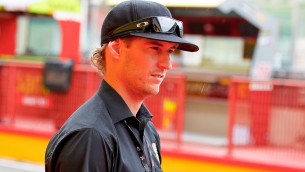
The team will enter as a CRT in the premier class with the Australian rider in 2012.
The Speed Master team has confirmed its entry as a CRT in the MotoGP category for the 2012 season, with Anthony West its chosen rider for the step up to the premier class.
Australian rider West has previous MotoGP experience, most recently in 2008, and has been riding in the Moto2 class for the past two seasons with MZ Racing.
The 30 year-old’s crew chief on the Speed Master team will be Tommaso Raponi, and the team has announced it will run with an Aprilia engine with a chassis yet to be confirmed.
West’s first season in the premier class was on board a Honda 500cc in 2001, and he rode the majority of the 2007 campaign and the entire 2008 season in the MotoGP category for Kawasaki.
Suzuki Motor Corporation suspends GP racing
Friday, 18 November 2011
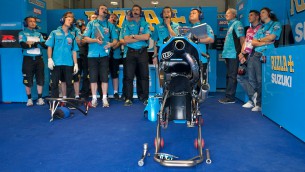
Suzuki Motor Corporation has decided to suspend temporarily its participation in FIM Road Racing Grand Prix MotoGP from 2012.
This suspension is to cope with tough circumstances mainly caused by the prolonged recession in developed countries, a historical depreciation of Japanese Yen and repeated natural disasters.
Having an eye to returning to MotoGP in 2014, Suzuki will now focus on developing a competitive new racing machine for that class.
Suzuki will continue motocross racing activity and support of road racing activities using mass-produced motorcycles, by obtaining FIM homologation and co-operation with the supplier of its development racing kit parts.
Suzuki Motor Corporation press release


Wednesday, 23 November 2011
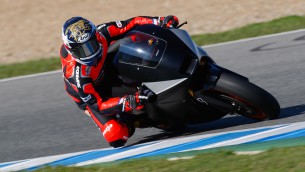
An action filled first day of private testing at the Jerez circuit featured Colin Edwards debuting the Suter-BMW CRT.
Over a dozen riders gathered at the Andalusian track in a three-day test that featured MotoGP, CRT and Moto2 bikes on track together. Despite prevalent rain earlier in the week, the first day of testing was held under sun and clear skies, encouraging the riders to squeeze all they could from the eight hours of work (from 10am to 6:00pm) allotted to them each test day.
Colin Edwards wrapped up his first experience aboard CRT machinery today riding the BMW powered Suter CRT bike of his new team for 2012, NGM Forward Racing. The experienced Texan posted a best time of 1'43.9 during his 39 laps, in his first day of track action since getting injured in the tragic accident that also claimed the life of Marco Simoncelli at Sepang. The American was absent for both the Grand Prix of Valencia and end of season Official Test held directly after at the Ricardo Tormo Circuit.
Sharing the track was Yonny Hernandez, who took to the controls of the Kawasaki motor driven BQR FTR motorcycle to turn out a best lap of 1.45.7, and Ivan Silva, who was crowned the Stock Extreme Champion in the Spanish Championship CEV on Sunday, who rode the prototype Inmotec machine to register an unofficial time of 1'45.5 within 40 laps.
Also present was Ducati Team, though without their official riders. Instead the GP12 was put through its paces in the hands of World Superbike champion Carlos Checa and regular Ducati test rider Franco Battaini. The two riders lapped aboard the 2012 1000cc Desmosedici sporting an aluminum frame, although their times were not disclosed.
Several teams from the Moto2 class were present to give their new riders time aboard their new machinery, among them the Aspar Team with riders Nico Terol and former Moto2 World Champion, Toni Elías. The two focused primarilyu on bike geometry and set-up, with Elías putting in a remarkable 104 laps aboard the 600cc bike.
Scott Redding and Mika Kallio of Marc VDS Racing Team continued to familiarize themselves with the Kalex Moto2 that the team will run next year. Redding had a crash early in the day but was unhurt. Also taking a fall in the morning was Pol Espargaró of the Pons Racing team, the Catalan rider was also uninjured and was able to continue the day's testing along side team mate Esteve Rabat.
Unofficial times - Day one
MotoGP
Colin Edwards (NGM Forward Racing) 1.43.9 (39 laps)
Iván Silva (Inmotec) 1.45.5 (40 laps)
Yonni Hernández (BQR-FTR Kawasaki) 1.45.7 (28 laps)
Moto2
Scott Redding(Marc VDS Racing Team) 1.42.9 (52 laps)
Pol Espargaró (Pons Racing) 1.43.3 (45 laps)
Esteve Rabat (Pons Racing) 1.43.3 (57 laps)
Mika Kallio (Marc VDS Racing Team) 1.43.9 (50 laps)
Gino Rea (Gresini Team) 1.43.9 (57 laps)
Bradley Smith Tech 3) 1.44.0 (60 laps)
Toni Elías (Aspar Team) 1.44.2 (104 laps)
Axel Pons (Pons Racing) 1.44.7 (50 laps)
Alex De Angelis (Forward Racing) 1.44.9
Yuki Takahashi (Forward Racing) 1.44.9 (42 laps)
Xavier Simeon (Tech 3) 1.45.2 (67 laps)
Nico Terol (Aspar Team) 1.45.6 (63 laps)
By Loz Blain
15:25 November 23, 2011
A formula one car, at 640 kg (1,411 lbs) and about 800 horsepower, has a power-to-weight ratio around 1.25 horsepower per kilogram (2.2 lbs). The new 1199 Panigale, with 195 horsepower and 164 kg (361.5 lbs), has a ratio of 1.19 horsepower per kilogram. Granted, that figure changes significantly if you add my porky badonkadonk and a full tank to the equation ... but regardless, this roaring L-twin beast is not only the new power-to-weight champion of the production motorcycle world, it's a ground-up reinvention of the Ducati superbike that has reportedly been in development since the venerable 1098 first hit showroom floors in 2007. Even without factory support, the 1198 won this year's World Superbike championship ... and absolutely everything about the Panigale looks significantly better, including Troy Bayliss' lap times. Let's take a closer look at what is easily the most desirable supersports bike of 2012.


A tough launch
Ducati hasn't exactly had the best lead-up to the Panigale's debut - the pressure's really on. The Italian company dropped factory support for its World Superbike team this year to focus on its MotoGP effort, having signed the highest-wattage star in the motorcycle universe, Valentino Rossi.
Of course, things haven't gone to plan. While Carlos Checa romped to WSBK championship victory aboard the Althea Racing Ducati 1198, Rossi has very publicly struggled to get his head around the Desmosedici GP11. Rossi's miserable 7th place championship finish in 2011 was a blight on an otherwise near perfect career - his previous worst results being two third places in 2007 and 2010. Everything else has been championships and a few second places all the way back to 1997.
It was the worst advertising Ducati could have hoped for - with the man many believe to be the world's greatest racer on board, the problem wasn't the rider - it was the bike. And specifically, it was the carbon-fiber monocoque frame.
At extreme lean angles, a motorcycle's suspension system becomes more or less useless. At an elbow-dragging 60 degrees, a fork or shock's plane of compression is so far from vertical that it's just not effective at soaking up vertical bumps to keep a tire planted to the ground.
This is where frame flex comes in - most MotoGP bikes have an aluminum twin-spar or double wishbone frame that allows a certain degree of sideways flex. At full lean, the bike can twist to help it deal with bumps. But the Ducati GP11 was a different beast. In search of an edge in airflow, weight distribution and chassis tuning, Ducati ran with a monocoque design that more or less did away with the frame altogether. The headstock connected to the front engine cylinders via a small carbon fiber unit, and the swingarm and seat unit came off the back of the engine, too. Carbon fiber's incredibly light weight, strength and almost limitless flex tuning ability were expected to deliver big results.

Great in theory, but in reality the carbon-framed Ducatis proved more or less unrideable to anyone but Australia's Casey Stoner. Outside Stoner's garage, the carbon-framed bikes became a graveyard of champions, more or less ending the GP career of Marco Melandri, relegating ex-champ Nicky Hayden to the back of the pack, and completely stumping Rossi to the point where it looks like Ducati is going to try redesigning the Desmosedici around an aluminum frame just to give its big star a chance in 2012. Here's a much more in-depth look at the GP11 and its carbon frame, if you're interested.
Why is this relevant? Because Ducati had bigger plans for the monocoque "frameless" chassis design. Plans that start with the 1199 Panigale that has just debuted at EICMA. That's right: Ducati's new flagship consumer sportsbike is going to market with an aluminum version of the monocoque frame that made Valentino Rossi look like he couldn't ride.
You couldn't script a worse marketing coup - Rossi has certainly cost the factory megabucks to hire, and Ducati has thrown the kitchen sink at the GP11 and 11.1 trying to spend their way to the pointy end of the field, but instead of a cupboard full of silverware, they're left with a bike and a frame concept that's reputedly unrideable, and no doubt a great deal of regret that they didn't hang on to Stoner while they had the chance.
So, with this bit of history in mind, as well as the runaway success of the previous model - the 1198 - let's examine the new 1199 Panigale and see if it can rise above such a difficult birth.

Ducati 1199 Panigale - Superquadrata engine
The new Panigale (named for the western quarter of Bologna where the Ducati factory is located) may be impressive to look at, but its spec sheet is where the pulse really starts racing.
For starters, 195 horsepower is an incredibly impressive number for a high-revving 4-cylinder bike, let alone the big fat pistons of a V-Twin. The Superquadro engine hits this huge figure at just 9000 rpm, where by comparison the BMW S1000RR is spinning at a crazy 14,200 rpm to make its peak of 193 horses.
The 1199's power output is a stunning 25 ponies stronger than the magnificent Ducati 1198 it replaces. That's a huge jump.
They've done it by pretty much redefining the concept of "oversquare" (or "Superquadro" in Italian) with a massive cylinder bore of 112 mm and an ultra-short stroke of 60.8 mm. A shorter stroke means quicker revving, and the larger bore allows significantly larger diameter valves in the cylinder head. There has been almost no torque penalty from the reduced stroke; the Panigale pounds out 98.1 lb-ft of torque, just 1 lb-ft less than the 1198.
The higher redline of the 1199 Panigale makes Ducati's famous gear-activated desmodromic valve actuation more important than ever - it opens and closes the valves extremely precisely through mechanical actuation instead of waiting for springs to effect the closure.

Ducati wasn't prepared to take the reliability risk of using a cam belt to run the desmo system, however, so the Panigale runs a cam chain and gear-drive setup like the Desmosedici GP racers, complete with +/- calibration options on the intake and outlet camshafts to allow precise adjustment.
One major visual change to the engine is the lack of the twin underseat exhausts that have graced every Ducati superbike since the famous 916. The Panigale's exhaust is almost integrated into the fairings, exiting just in front of the rear wheel and looking just about as if there's no pipe at all, if it wasn't for the rear cylinder's exhaust tubing winding around beneath the shock unit. No doubt it's heavy in stock form, but the exhaust system looks fantastic.

The much-maligned monocoque chassis
The famous Ducati L-Twin engine configuration is looking more like a V-Twin than ever before; the cylinders are still 90 degrees apart, but the L shape has been tilted back a further 6 degrees, so it's now 21 degrees from horizontal.
That has allowed the whole engine to move 32 mm forward in the bike - which reaps benefits in rear wheel suspension action, as you can extend the swingarm - but it also puts the front cylinder head nice and close to the headstock. The tiny, aluminum monocoque frame simply joins the headstock to the front cylinder head, and then back to the rear cylinder head in a triangle arrangement. The swingarm pivot point mounts off the crankcase and rear cylinder, making the engine a fully stressed member in the frame. It's a rare and very progressive chassis configuration that's closer to the remarkable Britten V1000 than to any sportsbike on the market.
Check out some technical drawings showing how the Ducati 1199 Panigale frame attaches to the engine.
The new engine location helps to keep weight over the front wheel to improve handling, but it also shortens the bike from a rider's perspective, with some 3 cm (1.18 in) shorter reach to the handlebars. The swingarm has been extended by nearly 4 cm (1.57 in), to the point that the 1199 Panigale will actually run a 7.6 mm longer wheelbase than the 1198, despite the fact that the rest of the bike is much more compact.
The elimination of a traditional trellis frame has helped Ducati shave a whopping 10 kg (22 lbs) off the total weight of the bike - and its predecessor was already the lightest bike in its category. Fully fueled with 17 liters (4.5 US gallons) of premium and ready to roll, the Panigale's claimed weight is just 188 kg (414.5 lbs). The BMW S1000RR, by comparison, weighs in at 204 kg (450 lbs) wet, and the Honda CBR600RR supersports bike weighs 187 kg (412 lbs). Extraordinary.

Panigale Electronics
I've been banging on about Ducati's dashes for some time - the dash from the 1098/1198 and now the Multistrada is absolutely fantastic, having been developed from the dash used on the Desmosedici GP bikes. It's been the best dash on the market in my opinion for some years now - but it's gone straight out the window on the Panigale, which pushes the concept of a motorcycle dash forward by a long margin.
The new dash is a full color, high resolution TFT display. It's moving toward computer screen territory, which seems appropriate given the abundance of electronics this bike packs in. Check out a video of the dash for more information.
Sports ABS and The Ducati Traction Control (DTS) systems are just the beginning here - through the dash you can also fully adjust your suspension settings (presumably only on S models) via the Ducati Electronic Suspension (DES) system, as well as your Ducati Quick Shift (DQS) setup, choose your engine mapping and power output characteristics, and even adjust the amount of engine braking on a trailing throttle with Engine Braking Control (EBC). The engine braking system makes use of the Panigale's fly-by-wire motorized throttle system to feed a little air into the throttle bodies under deceleration, reducing compression braking and effectively making the 1199 feel even more like a freewheeling race bike on corner entry. Oh, and that's in addition to the slipper clutch fitted to the brand new gearbox.
All these settings are manageable individually, or you can trust the Ducati engineers by going with one of three preset riding modes - Race, Sport and Wet. As usual, the key metric here is the power curve - in Wet mode you get 120 horsepower and a gentle throttle map, in Sport mode you get the full 195 horsepower but with a softish throttle response, and race mode goes all out with full power on a hair trigger, quarter turn throttle.
Further information about this wealth of electronica will emerge as time goes by, but with an unrivaled list of electronic adjustment opportunities, the Panigale goes straight to the head of the class as the most electronically advanced sportsbike on the planet ... for now!

Braking and Suspension
The Panigale makes use of the very latest Brembo 4-piston monobloc radial brakes, gripping 320 mm discs at the front. With a wider fork spacing than usual, the discs get more airflow than ever before to keep them cool under extreme conditions at the racetrack.
ABS will be a welcome addition to the 1199 - while Brembo's road gear is generally quite progressive, it's also massively powerful. One ham-fisted panic grab on cold tires can easily lock up the front wheel - or flip you over the handlebars if the tire is up to temperature.
ABS appears to be standard on all 1199 Panigale models - and while all we know about it is that it is a brand new sports ABS system, it's likely to include some sort of stoppie management system as well as simple prevention of wheel lockups. Whether it's a full fledged race-ready system like the one on the BMW S1000RR is yet to be seen, but either way you're able to turn it off and tune it at will.
The rear wheel apparently has a brake too ... but this is a sportsbike, folks. Who needs it?
As for suspension, the S and S Tricolore models will wear the very latest electronically adjustable units from Ohlins, where the standard model will make do with the typical Marzocchi 50 mm fork and Sachs rear shock setup.
The new bike's geometry and thick single-sided swingarm necessitate an odd-looking shock placement at an angle slightly past horizontal. It may look strange, bit it's certainly going to be easier to adjust than some more vertical shock placements.
That slightly elevated shock position gives a progressive action on the rear shock - handy for the road. But if you want a flatter and more linear shock response for racetrack riding, you can quickly change a couple of bolts on the shock mount to reposition it. It'll be interesting to see how much that changes the suspension feel.

Cornering and Handling
Reduced weight, extended swingarm, underslung exhausts and all the electrickery in Christendom combine to make the Panigale a cornering beast - but this is aided by the new, more front-heavy geometry, the riding position and a wider set of handlebars to give extra leverage on changes of direction.
Any fear that the monocoque chassis might make it unrideable at extreme angles were dispelled by a single tweet from Ducati's legendary retired SBK champion and now test rider Troy Bayliss, who took the Panigale to Mugello and immediately went half a second faster on it than any bike he's ever ridden before. That was in superbike spec - and as Bayliss put it, "in street form, nothing will come close."
From the looks of things, folks, the 1199 Panigale seems like a good bet to smash the superbike class apart in the same way the BMW S1000RR did on its release a couple of years ago. It's lost so much weight, gained so much power, and packed in so many new technical innovations that it simply looks unrivaled in the class - I mean, it's got the horsepower to destroy most of its inline 4 competition at the racetrack, but combined with a lethal v-twin torque assault and some 15 kilos (33 lbs) less weight.

Power to weight is sky high, the onboard electronics are as advanced as they get on any motorcycle anywhere, and in early development models it's already proving itself on the racetrack. Every few years, a motorcycle totally redefines the sportsbike market. The 1992 Honda CBR900RR Fireblade. The 1998 Yamaha YZF-R1. The 2005 Suzuki GSX-R1000. The 2009 BMW S1000RR. Now, it looks like it's Ducati's turn. The king is dead. Long live the king.
http://www.gizmag.com/ducati-1199-p...aign=dc2926a337-UA-2235360-4&utm_medium=email
Friday, 25 November 2011
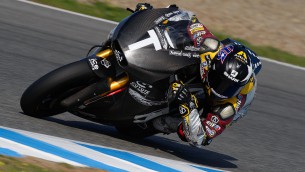
With Edwards and Checa completing their tests on Thursday, four riders remained to work on the premier class machines, while Scott Redding again posted the top time in the Moto2 category in the last day of private testing at Jerez.
The third and final day of the private three day test held at the Jerez circuit concluded under perfect weather conditions, although this final day saw fewer participants as several teams completed their work at the conclusion of the day on Thursday.
Yonny Hernandez and Iván Silva returned to the track, taking turns at the controls of the Kawasaki powered BQR FTR prototype. Silva took the morning slot, finishing his session by signing a best lap of 1'44.2 but not improving on his best time from yesterday, a 1'43 .6. Hernandez rode in the afternoon, to post a best time 1'44.0, four tenths quicker than his time from Thursday.
That left Colin Edwards holding the fastest time of the CRT bikes, who posted a 1’42.6 aboard the Suter-BMW of NGM Forward Racing team on Thursday.
Randy De Puniet continued with his tests on the Aprilia powered Aspar Team CRT, putting in 70 laps today. Also joining the big bikes was Ducati test rider Franco Battaini aboard the GP12. The Italian was the only Ducati rider as Carlos Checa completed his testing on Thurday.
Among the representatives of the Moto2 class, Scott Redding (Marc VDS Racing Team) again paced fastest for the third day running. The Briton recorded a best lap of 1’43.3 today, four tenths off his time of 1’42.9 which put him at the head the timesheets on both Wednesday and Thursday. British rider Gino Rea (Gresini Racing) had the only fall of the day, having a minor crash in the afternoon but suffering no consequences. Toni Elias returned to the track, and like his first day of testing, put in a remarkable number of laps, no less than 90 aboard the Suter of the Aspar Team.
Unofficial times - Day three
MotoGP
Yonny Hernández (BQR-FTR Kawasaki) 1.44.0 (23 laps)
Iván Silva (BQR-FTR Kawasaki) 1.44.2 (37 laps)
Carlos Checa (Ducati Test Team) did not participate
Franco Battaini (Ducati Test Team) not provided
Randy De Puniet (Aspar Team) not provided (70 laps)
Moto2
Scott Redding (Marc VDS Racing Team) 1.43.0 (54 laps)
Bradley Smith (Tech 3) 1.43.1 (57 laps)
Mika Kallio (Marc VDS Racing Team) 1.43.4 (69 laps)
Gino Rea (Gresini Team) 1.43.8 (58 laps)
Xavier Simeon (Tech 3) 1.43.9 (80 laps)
Toni Elías (Aspar Team) 1.44.6 (90 laps
Nico Terol (Aspar Team) 1.44.7 (73 laps)
Colin Edwards talks CRT bikes
Friday, 25 November 2011
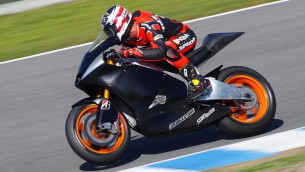
Experienced MotoGP veteran Colin Edwards talks about his first experience aboard the NGM Forward Racing team’s BMW powered Suter CRT bike, his new ride for 2012.
After two days of private testing at the Jerez circuit, the experienced Texan spoke to motogp.com about his first impressions of the CRT machine, one of the new generation of MotoGP bikes that will join the grid in 2012. This was Edwards' first ride on the BMW-Suter after missing the post- Valencia Official Test while recovering from shoulder surgery.
The veteran expected that there would be work to do before next season, though his first impression of the bike was higher than he originally expected. “Overall, it is better than I thought it would be, the potential is there. I think we are at about 65 percent right now,” he said.
The electronics package the team will use is new to MotoGP, and Edwards said the remaining 35 percent of bike development will come from improvements with those electronics. “The chassis is set up, but the main thing is the electronics and getting the whole package to come together. With the electronics, every time we make a little change and make it better, everything just gets a little smoother and easier.”
Speaking further of the overall impression of the new bike, the Texan said: “The bike reminds me a lot of 2003 when I went to Aprilia. It's got a screamer engine, lots of torque, somebody built the chassis, someone put an engine it, and it came a long way through the year. It was one of the first bikes with ride by wire and all the electronics. It reminds me a lot of that. But I know what I need, I know what I am looking for, I know what want, I know how to make the bike go faster, so the main thing now is just don’t lose focus and keep going down the right path.”
The team spent most of the two days on Bridgestones from 2011, though they did get a chance to test a new rear tire, which created challenges but Edwards is sure are fixable. “We got a little more chatter...once we get the electronics fixed I know that will go away, I am sure it will.”
As for the bike’s lap times, of which the unofficial best time on Wednesday was a 1'43.9 and Thursday was a 1’42.6 (as compared to Edwards’ best time of 1’40.188 in the Spanish GP at Jerez in March), Edwards was unconcerned. “I came here and I would have been happy with just yesterday's times, being injured and all, but I did a ‘42.6 today, which is a little better than a second faster. I’m reasonably happy with that.”
The test was also the first time the American worked with his new crew chief for 2012, Kor Veldman. “I've never worked with him before, but he has a lot of knowledge and experience and we get along great. Just spending a couple days with me I can see he knows what he is talking about, and that’s a plus, you know, when you can find someone you can communicate with and get things done. So I'm really happy with him.”
Two days of putting the bike through its paces was enough to learn what the team needs to do next according to the veteran. “We didn't set the world on fire, but like I said we are at 65 percent, we have to work to find the rest of it,” he said.
The team will have two months to complete that work before the next time the bike will hit the pavement at the Official Test at Sepang in 2012.
Newsflash, 30 November 2011
After two winter test sessions in Spain, at Aragon and more recently Valencia, KRT riders Tom Sykes and Joan Lascorz enter the enforced winter break in good spirits after posting strong performances.

Overhead conditions on the first day at Valencia started out cloudy but the afternoon and the final two days provided good track conditions, allowing both Sykes and Lascorz to make improvements that saw them set consistently strong lap times, whether on fresh race rubber or nearing the end of a long run.
There were many developments to the race-winning Ninja ZX-10R for both riders to test, including suspension, linkages, electronics, chassis geometry and the latest ride-by-wire system.
With more direct control of the entire KRT Superbike World Championship project once more evident at these tests, there were several Japanese engineers in the pit garages as all the team-members refined their working methods and strategies.
After the test ban is lifted in mid January the team will take to the track once more in Spain, at Almeria, to make further steps down the road toward the start of the new WSBK season. The 14-round/28-race campaign commences at Phillip Island in Australia on 26 February 2012.
Tom Sykes: “The tests went well and we ended up doing a 1’33.1 lap time on a race tyre. We have worked through a lot of different things, we are working well in the garage and I am relaxed. It is no secret that when I’m relaxed I work my best. We have had some good weather - consistent weather - in Valencia and that made it better to work through all we needed to do. We have a new electronics package and found a better overall machine balance for me. We also went well at Aragon even though we only really had half a good day there, because of weather and some car tyre rubber laid on the track surface. Once the conditions improved it took us only four outings of four laps each to beat the kind of lap times I set at the race last summer. Right now we are on a package that we have not changed so much between the two tests. We have a fairly good base setting that works for race distance and, when we put new tyres in, for a fast lap time as well. I think we have come a long way even since the post-season Portimao test. The bike tells me what it is doing quite a lot better than before, and the improved feedback tells me when I am arriving at the limit.”
Joan Lascorz: “I am very happy the way the test went because I set good lap times and I was very happy with the performance of the bike and the team. We made a lot of changes to the bike, changed a lot of general settings and worked on the suspension. Some are now much different from last year. All the staff worked well together again. I think I learned most from this test in terms of finding out more about our latest machine settings and then finding a more consistent good pace. These things should allow us to challenge closer to the top in 2012. Tom was very fast and we both worked well with race tyres.”
have we seen this one yet?
here Abba have a laugh
by dean adams (1994)

It happens, oh, once or twice a year: the phone will ring at Kenny Roberts' house in Modesto and on the other end of the line will be a determined individual who through perseverance, good intentions or connections has obtained the King's private number.
"They'll say, 'Yeah, I have your old race bike.' Roberts explains, "It'll be an old dirt tracker or one of the many Yamaha roadracers. I'll ask them some specific questions, was the frame broken and re-welded many times by the swing arm pivot? Inevitably, after a few questions it becomes apparent that they don't have the bike I raced." Roberts and friends own most of the significant bikes he piloted. Save one.
So, it was with a callused cynicism that Roberts heard through the grapevine that someone out there had one of his old bikes. But not just any old bike. He claimed to have in his possession Kenny's famed Yamaha TZ750 dirt track machine, the bike that he won the Indy mile with in 1975, a bike that tried very hard to maim Roberts on several occasions. Ahhh, that bike.
For those readers without a degree in motorcycle racing history—or simply weren't born in '75—this is the encapsulated story: In 1975 Kenny Roberts was having a bear of a time trying to retain his number one plate because of a charge by a likable man by the name of Gary Scott and his potent factory Harley Davidson. In previous attempts at the championship, Roberts utilized the standard Yamaha four-stroke twin to run down the booming XR Harley. Run them down he did, winning multiple Grand National championships when the series contained both roadrace and dirt track events. However, that success was not carrying on into 1975, the tired design of the Yamaha (helped along by flowbench masters Jerry Branch and Tim Witham) began to show cords, and even The King in his early prime could not stop the advances of Scott and Harley. Bad luck followed Roberts as well that season, clutches that were once infallible roasted, chains snapped, wires loosened and fell off. It was obvious to all at Yamaha that it was time for a new machine.
Roberts, his personal craftsman Kel Carruthers and key personnel at Yamaha scoured the corners of their imagination to find something that would give them an edge. What they needed was horsepower, big power. Hence, a scheme was hatched: Roberts wanted horsepower let's give it to em'. Although none of them realized it at the time they would prepare a machine that would put the fear of God into the King and add an illustrious chapter to racing history.
Although there were grave reservations on many fronts when the details of the Kel Carruthers-built Yamaha became known, hesitance did not stop the principles from assembling one Doug Schwerma designed Champion dirt track frame, a leaned on Yamaha TZ700/750 engine (the very same one Roberts had won Laguna with previously that year) billowing one hundred plus horsepower on the dyno and one set of Goodyear dirt track tires. With these menacing ingredients they threw in the best fabrication skills of Kel Carruthers and flipped the puree switch on the blender. Interestingly, with the aforementioned parts in front of him, Carruthers assembled the machine in just five days.
Carruthers and company were not the first to see the potential of a Japanese multi-cylinder cradled in a dirt track frame.
(Although it is not generally known in present day, other riders had Yamaha TZ trackers before The King, including Rick Hocking, Steve Baker, Randy Cleek and the elder Skip Aksland, but these men were not Roberts neither were they assisted by Kel Carruthers so the results were marginal. Moreover, Erv Kanemoto built Kawasaki triple-powered machines for his riders: Gary Nixon, Don Castro and Scott Brelsford; Kanemoto Kawasakis were fairly successful, although not at the National level. The wound-tight Kawasaki, at least when compared with the brute force Yamaha, had a touch softer power curve and less horsepower. Too, it was time-consuming, Kanemoto recalls; the Kanemoto Racing triple shook so badly that Kanemoto made plenty of foot-trips to the track to find parts that had shaken off. He'd retrieve air filters and anything else not nailed on.)
Oh, la-de-dah, isn't life grand at the front of the pack Jay? Yes, dear Corky, dreadful about our chum Roberts having such a bear of a time on that contraption ... say, what's that frightful noise?
The assumptions of this being a monster unleashed were confirmed once Carruthers stepped back from it in his shop. They realized that the Champion Yamaha was, in essence, over-kill, so much so that in the final races of the '75 season Carruthers affixed a kill-switch to the number three cylinder on the Yamaha. Roberts would push the switch on the entrance to corners, killing the spark to that cylinder in order to tame the wickedness of the machine.
In a late-night, pre-Indy phone call Carruthers asked Roberts how fast he wanted to go at Indy. "About one thirty should be enough," he estimated. Carruthers geared appropriately.
Roberts went to Indy without ever seeing the completed bike. Once he arrived the crew sat him on the seat and adjusted levers and the handlebars.
Before the bike took to the track many thought it too powerful and would not be able to obtain any traction. Roberts might have been one of these persons, but he won the first semi-final, putting his name on the grid sheet for the National and from there, the rest is history.
Harley teammates Jay Springsteen (then a just rookie) and Korky Keener initially led the twenty-five mile main event quite easily, playing grab-ass and spraying each other with dirt as the laps ran down to the black and white.
Oh, la-de-dah, isn't life grand at the front of the pack Jay? Yes, dear Corky, dreadful about our chum Roberts having such a bear of a time on that contraption ... say, what's that frightful noise?
Sensing a threat, Keener looked back—very late in the race—and saw Roberts doing his patented water through a screendoor drive through the pack. The shriek of the Roberts TZ750 struck a chord deep within Keener, he signaled Springsteen with a single index finger that Kenny, like death with a black robe and scythe, was coming for them.
Grab-ass time was officially over.
Current Team Roberts manager Chuck Aksland, then a lad of eleven, had begged his grandfather to bring him back east for this event as he knew it would be a scorcher. He was not disappointed, "I still remember seeing hay scattering in the air as Kenny came out of turn four. I still think it was among the best races I have ever seen, top three easy," he says today (1993)
Roberts used the high line to make his charge, essentially bouncing off the bales in making the corner transitions, shaping a crude rectangle out of the oval. With all that Carruthers horsepower he came for Springer and Keener; and on the last lap all three held throttles WFO down the straight, in a flash Roberts clawed by the Harley boys and onto the podium, his margin of victory about two feet at the line.
There are those that say this is the bike and the race that made Kenny Roberts an icon. From nearly a dead last start, Kenny had spun and slid his way to the win. On a bike some thought unridable.
To put this machine's horsepower into perspective for a younger enthusiast, piloting this it would not be unlike racing a modern big bore Suzuki fitted with nitrous-oxide injection—in six inches of water.
The Champion Yamaha 750 is and was considered the definitive unbridled motorcycle, so much so that Roberts, when he got off the bike after narrowly winning at Indy, spewed the immortal Roberts quote: "They don't pay me enough to ride that thing," he said.
Win yes, but live with it? For a season? No thanks. With the King in its saddle the Champion Yamaha never really tracked straight, spinning and hopping on the straights. It tried very hard to toss Roberts over the top and Roberts, truth be known, hated the bike with a passion he would only again have for Freddie Spencer. He raced it twice more after winning Indy, with less than spectacular results,
The AMA, with the help of level-headed Kel Carruthers, quicly moved to ban the bike and the formula that brought it into existence. The argument that if the machine was allowed to breed it would eventually kill someone won the sanctioning body over.
Back to Roberts, modern day, phone in hand. All obvious signs of suspicion on his part disappeared upon learning that the person who claimed to have his bike was none other than Stephen Wright.
In the realm of motorcycle restoration experts there are only a few true craftsmen, among them, Mike Pariti and Wright are the considered among the best, Wright's expertise in the area of board track racers from the early 1900s is unequaled. He is a celebrated author as well, writing both of the American Racer books, volumes that are considered the pinnacle historical record of motorcycle racing from its infancy. If that pedigree wasn't enough, Wright worked as the late racer and part-time actor Steve McQueen's personal motorcycle restorer for six years, assembling McQueen's vast collection of motorcycles to show quality. Therefore, when Wright says he's got a bike you used to race, you don't doubt him.
Even if the bike was put into the crusher. Yes, the crusher.
Once the AMA banned the bike from competition several persons wanted to get their hands on it for historical purposes, (including Carruthers whom as builder probably had more claim to ownership than anyone save Roberts).
From there the engine was removed from the chassis, the wheels sent back to the roadracing shop and the bike compressed to a neat little cube where it couldn't hurt anyone.
Or, so the story goes.
But Yamaha America would have nothing to do with it and sent the bike to Europe for a promotional campaign. It was seen in late 1976 at a dealer show and one brave soul actually rode it at an English Speedway event, but the machine failed to bite that man, former world champion Peter Collins, as he was not able to shift beyond second on a very slick track.
From there the engine was removed from the chassis, the wheels sent back to the roadracing shop and the bike compressed to a neat little cube where it couldn't hurt anyone. Or so the story goes. A little chicanery occurred in this period as the bike never really went to its intended execution. Perhaps another bike tagged as this one went in its place or someone mistakenly checked the bike off the roster, but the machine never went to its demise. For a long while it sat in the back of the Amsterdam race shop with other racebikes put out to pasture. With most of its cosmetics removed save the tank, it looked like just another R&D exercise gone horribly wrong. Which really it was. It sat in that condition for a number of years until former Yamaha manager Kenny Clark, looking through the cadavers of this graveyard, began to study this particular machine. Although it was faded by constant exposure to the elements and sun, the phrase, Prepared by Kel Carruthers, El Cajon in Seventies hippie script on the fuel tank, raised the hairs on the back of his neck.
It didn't take a rocket scientist to determine this was not a machine that belonged in a graveyard but in a museum. He packed the bike up and sent it back to the States where he intended to restore it himself. Upon leaving Yamaha, Clark sold the machine in its dilapidated condition to Wright.
Determined, he set out to make the machine right again. Much damage had been done though. The ground up restoration would be the relatively easy part of the process. The difficulties lay in finding the correct parts, considering Champion only made five kits before the AMA banned the machine and this machine, being a factory built and developed racer, was in some ways very different from the kitted bikes.
Wright spent a good deal of time searching through the attics and garages of racers of the era, trying to find correct decals and other bits. With time and the help of many individuals —such as former Roberts mechanic, Merrill Vanderslice—Wright collected the correct pieces and finished the machine just prior to 1994 and started work.
Flash to the 1994 USGP, behind the Marlboro Roberts garage. Wright brought the bike to Laguna Seca and showed it to Robeerts. Roberts was obviously surprised and somewhat shaken by seeing this old steed in the flesh. He kept repeating, "I can't believe it, just can't believe it." For Roberts, a man who has done and seen plenty, the sight of this old machine unnerved him. He laughed nervously and spoke in broken sentences as the memories, both good and bad, rushed back.
Roberts wanted to own the machine. Wright wasn't ready to part with the noble racing steed just yet, but when that day came, said he would sell it.
The man most responsible for the machine's existence, Kel Carruthers, wearing a blood red Cagiva uniform, walked over and took a long lookat the bike. He examined many of the pieces individually: the foot peg and brake arm where Roberts hadn't been able to pull the machine back from the edge and it smashed into a wall at San Jose, along with the resulting welds where Ken Maley put the pieces back together again. He looked at the TZ700/750 pipes and the unique mounting system he had built to enable the exhaust to tuck in tighter than the kit allowed; the places he relocated the engine later that season. He said to no-one and everyone, "It's the bike," and walked back to Doug Chandler's V585, yet another in a line of machines he would help create but would never own.
There was talk of Roberts doing a lap of honor on the machine at Laguna, someone mentioned that they thought Roberts might fit into Luca Cadalora's or Beattie's leathers.
However, after a few moments' consideration, most thought it a bad idea.
He escaped with his wits intact twenty years ago, let's not push the issue.


Maybe


Similar threads


- Replies
- 9
- Views
- 2K

- Replies
- 2
- Views
- 1K


