• Adults Only Website 18+

    If you are under 18 you are not permitted to submit personal information to us or use this website. If discovered you will be banned.

    We will ban and report anyone posting illegal content.

    We will ban any forum user who breaks our terms.

    Freedom of speech should be wide open as long as it doesn't incite violence.

    We have a 15 year old thriving community here with 400,000+ members and hundreds of people online at any given moment, we encourage you to join!, there are 1000's of topics to discuss. Please be aware before registering and read our terms of service and privacy policy.

    By dismissing this notice and proceeding, you agree to the above.

Two Wheels

Le Mans: Four winners from four races?


Le Mans: Rossi's turn to shine?
Monday, 13 May 2013
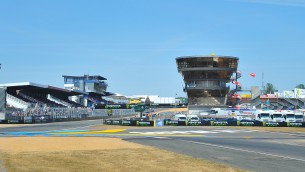
The start of the 2013 MotoGP™ season has witnessed three different winning riders in as many races, with Jorge Lorenzo, Marc Marquez and Dani Pedrosa having celebrated victory at Losail, Circuit of the Americas and Jerez. Can another name now make it a quartet of victors as the fraternity heads to historic Le Mans?
It’s been five years since the first four Grands Prix witnessed as many different victors. Back in 2008, the fourth was Valentino Rossi as he took his Yamaha to success in China. Shanghai may no longer feature on the calendar, but Rossi is certainly still in attendance and striving for his first win since returning to the Japanese marque. Judging by the form so far this season, the seven-time premier class champion certainly seems the man most likely should the winner be different again.
Heading to France, it is Marquez who heads the standings as the youngest ever man to have become the sole leader of the championship. Repsol Honda Team are now first and second (61 points to Pedrosa’s 58), whereas reigning title holder and Rossi’s teammate Lorenzo (Yamaha Factory Racing) is a further point behind and only four off the top spot. Many saw his reaction to the Jerez collision with Marquez as a positive example of sporting behavior, although one can be sure that the on-track battles will be only more tension-filled following that memorable last-corner dive.
A key factor for the upcoming French event - for both keeping dry in the grandstands and winning a motorcycle race - will be the Maine weather. As the 2012 race proved only too well, conditions can be changeable to say the least, although it certainly made for an unpredictable afternoon of racing; Lorenzo won, Rossi finished second on an underperforming Ducati and the now retired Casey Stoner came home third. To the credit of the whole field, only three riders failed to make the finish.
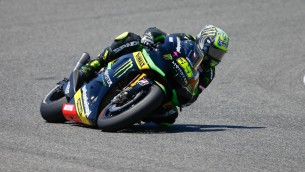
For the sake of those in battle, let us hope that the forthcoming drama does not come in the way of accidents. As those around him were caught out by the boiling temperatures of Jerez, Lorenzo was practically the only front-runner who did not fall during the weekend (if you don’t count the final corner clash, that is). As for Monster Yamaha Tech 3’s Cal Crutchlow, who had two heavy shunts in Spain, a clean weekend is the priority.
At Ducati Team, Le Mans is a highly important meeting. Following the positive debut of the GP13 Lab chassis in the hands of Michele Pirro last time out, regular riders Nicky Hayden and Andrea Dovizioso had their turn in the Jerez post-race test; a further two-day outing on the current GP13 came at Mugello, but included more GP13 Lab development by test rider Franco Battaini. For Le Mans, Pirro covers for the injured Ben Spies at Ignite Pramac Racing.
Performances are also on the up amongst the CRT runners, not least as they have now sampled the first significant ECU software upgrade - delivered by Magneti Marelli and improved based on requests from the teams themselves. The ECU in question is being used by all CRT runners except those on ART machinery (Power Electronics pairing Aleix Espargaro and Randy de Puniet plus PBM’s Yonny Hernandez).
Opening practice for the 2013 Monster Energy Grand Prix de France begins at 9am local time on Friday, whereas Sunday’s race gets underway at 2pm (GMT +2).

I did prefer the other circut they used in the 500cc days to the one they use now Paul Richard had that fast strait.

Facts and Figures: Le Mans


Wednesday, 15 May 2013
The Le Mans circuit holds one of the longest traditions of Grand Prix racing on the current MotoGP™ schedule. Read on to hopefully learn something new…
- Le Mans has hosted a Grand Prix event on 25 previous occasions, including the Grand Prix ‘Vitesse du Mans’ in 1991, which was the only year in which two Grand Prix events have been held in France during a single season.
- Le Mans was first used for a Grand Prix event in 1969, when the 500 race was won by Giacomo Agostini who lapped all other riders in the race on his MV Agusta.
- The Le Mans circuit has been used for the MotoGP event for the last 13 years in succession, starting in 2000.
- Since the introduction of the four-stroke MotoGP formula in 2002, both Honda and Yamaha have had five victories at Le Mans. The other win went to Suzuki in 2007 with Chris Vermeulen – Suzuki’s only GP victory in the four-stroke MotoGP era.
- Jorge Lorenzo, with three wins in the MotoGP class and a single win in the 250 class, is the rider who has had most Grand prix victories at the Le Mans circuit.
- There have been five GP wins at Le Mans for French riders: Jean Aureal won the 125 race in 1969, Guy Bertin the 125 race in 1979, Patrick Fernandez the 350 race in 1979, Mike di Meglio the 125 race in 2008 and Louis Rossi the Moto3™ race last year.
- In addition to Le Mans, seven other circuits have hosted the French Grand Prix: Paul Ricard (13 times), Clermont-Ferrand (10), Nogaro (2), Reims (2), Rouen (2), Albi (1) and Magny-Cours (1)
 
Poncharal: "In terms of machinery, Crutchlow is in a good place"


Tuesday, 14 May 2013
Before heading to Le Mans this week, Monster Yamaha Tech 3’s Herve Poncharal takes time out to catch up with motogp.com. The Team Manager discusses his technical collaboration with Yamaha, rumours on the transfer market and more on current riders Cal Crutchlow and Bradley Smith.
It took only three races of the 2012 MotoGP™ season to pass by before tongues started wagging and rumours of rider moves began to swirl around the paddock. Several British publications reported last week that, after meeting with Cal Crutchlow, he revealed that he could be replaced at Tech 3 next year by Pol Espargaro - brother of Aleix and a strong contender for this year’s Moto2™ title.
With the latest headlines in mind, motogp.com believed the time could not have been better to sit down with Poncharal and discuss the Crutchlow situation. If the leading British rider regularly comments that he does not enjoy as many new motorcycle parts as Yamaha Factory Racing’s Jorge Lorenzo and Valentino Rossi, his boss has expressed a very different opinion and stresses the continued efforts of the Japanese company, which has been working with Tech 3 since 1999.
motogp.com: We often hear Cal explaining that he has no new parts to test from Yamaha. What is your opinion from a technical point of view?
Herve Poncharal: Cal now has ultra-competitive machinery, as we have seen from what he managed to achieve in Qatar, Texas and Jerez - and not only in races but also in qualifying. He has had the best lap time on several occasions, in comparison with the Yamaha riders. In MotoGP engines are sealed and closed, so you cannot tell exactly what is inside them, but our engine specs are almost identical to the factory engines and we are now into the third development phase of the chassis since the first pre-season test at Sepang. We first tested the chassis in early February. That was followed by an update in late February (for the second Sepang test) and then another one at the post-race test in Jerez last week. I do not think one can say - and, furthermore, I do not think Cal can say - that we don’t have active support and competitive machinery.
I always remember Furusawa (Masao, responsible for the development of the Yamaha M1 between 2004 and 2010) saying that it was never two factory and two satellite bikes for Yamaha, but four official bikes. I believe Cal has a bike that is very, very close to those of the official riders (Lorenzo and Rossi). Would one say it is exactly the same? No, but performances are subjective and especially when it comes to the chassis. For example, Valentino does not always use the same chassis as Jorge; a chassis can be better or worse to handle depending on the individual feelings of each rider. So technically speaking, for me, the situation Cal finds himself in is very good and he is very much considered a factory rider of the Yamaha Motor Corporation.
Rumour has it Pol Espargaro could compete in MotoGP with Tech 3 next year. Has Yamaha spoken with you about such a happening and does this possible new arrival determine your rider line-up for next season?
I am currently in talks with Yamaha to renew the support contract, because the current deal between Tech 3 and Yamaha will expire in late 2013. We’re now talking about extending it to 2014, 2015 or 2016…at least two years, though. We are still discussing terms and so I, obviously, cannot talk with riders just yet. It is still not absolutely sure what machinery will be available for 2014 and 2015. Personally, I have never talked to Espargaro on behalf of Tech 3.
That Yamaha and Espargaro have spoken is a certainty. He is one of the most talented young riders in Moto2. Marc Marquez, Andrea Iannone and Bradley Smith have already made the jump to MotoGP and so that would also be a logical step for him next year. The road to Honda is closed because they have four riders under contract until the end of 2014: two at Repsol Honda, one at Gresini and one at LCR. If Espargaro does want to compete in MotoGP next year, he will obviously have to do it with another marque and so it is obvious that he is in talks with Yamaha. I do not know the depth of those conversations; whether something has been agreed, is almost agreed or whether there is still a lot to sort out. What I do know is that Yamaha has four bikes and, when Cal Crutchlow is the only rider who is contracted only for this year, some think Espargaro could take his place. The current situation is that we are in May, that I have a contract with Cal for 2013 and that Yamaha has opened up some negotiations - nothing more than that. I love Cal and will be keeping him informed of what I know, simply to allow him as much time as possible to remain attractive on the rider market - whether that will be to stay at Yamaha or to go somewhere else.
On the other hand, when we renegotiated in mid-2012, Cal talked to us but was also in discussions with Ducati. He told me Ducati would be his priority if he had the opportunity, just as Andrea (Dovizioso) did, because they both wanted to be full factory riders. Ducati chose Andrea and Cal ended up staying with us, but he had been ready to go in mid-2012 and so only renewed his deal with us for a year in order to maintain the opportunity of being on the rider market for 2013, to try and become a factory rider which would be a dream for him. Had he signed for two years, he would not be in this situation now. For him, Tech 3 might be Plan B, but each rider manages his own situation and it is true that Cal is a bit boisterous. There is a market out there, though, and Yamaha are free to make their own choices.
And what about the contracts between Tech 3 and its two current riders?
Right now I have two riders: Cal Crutchlow and Bradley Smith. We are still in the first part of the 2013 season and are focusing on it 100%. I have sponsors who have invested in my team to get results and benefit from them in 2013. That is also my goal and is what is most on my mind at this point, more than asking me if somebody will go one way and somebody else somewhere else, or whether I should be bringing such and such rider into the team.
We are now into the run-up for the French Grand Prix, which is a highly important one to us and not just because we are French - because, after all, we do not have a French rider in the team. It’s also important because this race is backed by Monster Energy, which happens to be our title sponsor, plus the fact that France is a big market for the likes of Black & Decker, Stanley and DeWalt, as well as Motul and Yamaha Motor France. Bearing all of that in mind, we are focussing on this race. The media love to talk about future contracts, but this race is our priority at the moment.
 
Magneti Marelli assesses ECU progress


Cecchinelli on Magneti Marelli progress at Le Mans
Tuesday, 21 May 2013
MotoGP™ Director of Technology Corrado Cecchinelli caught up with motogp.com to give his view on the Magneti Marelli ECU at the Le Mans race, ahead of which the first software upgrade was introduced at the Jerez post-race test. Teams running the software include NGM Mobile Forward Racing, Came IodaRacing Project and Avintia Blusens, as well as the in-house PBM chassis (not the PBM ART machine).
Cecchinelli commented: "We are very pleased with the results so far. The system was very good out of the box as Magneti Marelli delivered it, but now we are starting to improve it.
"We did an important test after Jerez, and the results were satisfying. We are using the new software here, which includes a lot of small things. The main things are something that helps wheelie control and on the exit of corners. And all of the riders are happy, so all of them are using it now."
Speaking about the challenges Marelli faced coming into the championship he added: "The one thing nobody sees, is making the ECU work for all the machines. That’s something that nobody really understands, but it’s really a lot of work. The big challenge is to match all our customers’ requirements, which means asking all the teams what they need, and what they would like to have, and try to bring it on track as soon as possible."
With regards to future improvements throughout the season, Cecchinelli spoke of the importance of the appropriate timing for upgrades: "We plan to introduce…let’s say…‘not so small steps’ in the after-race tests, because we do not want to introduce them during a race weekend where it could upset a team’s work. So the plan is more or less to introduce something at any after-race test."
Magneti Marelli will provide the hardware for the entire MotoGP™ grid from 2014, with teams being able to run their own software – with a 21-litre fuel limit – or that of Marelli with a 24-litre fuel limit. Cecchinelli, when prompted about the competitiveness of the package said: "I think it’s the best you can have…I think it will become the best we can have, for a common-purpose software of course. You will never have the same tailor-made software you can have if you work on just one machine.
"We are [confident ahead of 2014]! We see where we are now, and because I trust the people in the project. But as I told you, it will always be a general-purpose software - so it will be, in my opinion, much better than what the independent teams could have by themselves, but not at the level of the top factories."


I like speed but, this razor blade aint for me . . .

Embedded media from this media site is no longer available


De Puniet confirms Suzuki test after home race disappointment


De Puniet poised to head to Motegi for Suzuki test
Sunday, 19 May 2013
Power Electronics Aspar’s Randy de Puniet will travel to Japan tomorrow to test Suzuki’s potential MotoGP™ entry for 2014 following the disappointment of a crash in his home race at Le Mans.
The Frenchman was pushing hard in wet conditions in front of his local crowd, only to suffer another crash in his 2013 campaign. Following the race he was visibly disappointed, but also confirmed that he looks to put the result firmly behind him as he travels to Japan tomorrow to test a Suzuki MotoGP™ machine, which had already been spied and talked about in numerous biking publications and media outlets.
He could not give specific details, but said he hoped this would see him arrive to the next race in Mugello in a fresh frame of mind to help him mount a serious challenge for top CRT spot on his ART machine.
He commented: “Yeah we leave tomorrow to Japan to test with Suzuki in Motegi, and it’s good for me because I will forget very quickly the race from today and I think it will be good for Mugello. I will be ready to be fast immediately. That is a good experience for me how to do a great job and I really hope to come back to Mugello for a good race.”


Bridgestone: 'Lorenzo did not have tyre problem'


Tuesday, 21 May 2013
MotoGP™ tyre supplier Bridgestone has verified that Jorge Lorenzo did not suffer a rear tyre problem in Sunday’s French Grand Prix. The world champion, suffering a lack of rear grip, fell down the field to an eventual seventh position.
From second on the grid, the Yamaha Factory Racing rider held the same position in the opening stages but soon began to lose pace. The result would mark his worst race finishing position – retirements aside – since his debut premier class season in 2008.
Soon after the race had finished in Le Mans on Sunday, word began to circulate in the paddock that Lorenzo had been suffered from a defective rear tyre.
"It was clear during the race that Jorge had an issue, as he couldn’t keep the same pace as the leading group," says Shinji Aoki, Manager of the Tyre Development Department at Bridgestone Motorsport.
"Immediately after the race he had a debrief session with his tyre engineer where he explained his lack of rear grip. As is always the case in these situations, his engineer thoroughly examined Jorge’s race tyres which were found to be in good working condition. In addition, I examined the tyre myself and personally discussed the matter with the Yamaha engineers and we all agreed that Jorge’s lack of rear grip was not attributable to his tyre."
Aoki stresses that the issue was not a faulty tyre, but more setup-related.
"We received many different comments from the riders after the race on the feeling on the track, even though they all used the same specification of wet tyre and endured the same track conditions," he continues. "In these low grip situations, machine setup is critical as the smallest setting change can have a big effect on performance.
"In any case, it was a shame for Jorge as he was so strong in morning Warm-Up and we all expected a better result from him, but he is a champion and I know he will be back to his competitive best at the next race."
Not since Indianapolis 2011 had Lorenzo finished a race, but off the rostrum. He now sits third in the championship and 17 points in arrears of Repsol Honda Team’s Dani Pedrosa.
 
Sykes Wins Both Home Races At Donington!
WSBK, Donington, Europe, 26 May 2013
Tom Sykes (Kawasaki Racing Team) scored his first career double at Donington and in doing so moved to within four points of the championship lead after five rounds.
w409h272_000003400C488EE0.jpg
Having set a new track best in Superpole on Saturday Sykes rode brilliantly and almost faultlessly in each 23-lap race at Donington to score not only his first double win, but take a new lap record in race two, a 1’28.074, set on lap four.

He was a start-to-finish leader on each lap each time around and after a small change to his front suspension settings for race two he went four seconds faster than in race one, despite a rise in track temperatures.

Tom now sits in second place on his own, only four points from the lead and with the third place rider 20 points behind after one third of the season has been completed.

Loris Baz (KRT) had a better first race than second and he achieved his target of a top five finish in the opener, then he went seventh in race two. Most importantly of all, he remains sixth in the championship.

Federico Sandi (Kawasaki Team Pedercini) finished 14th in race two, his team-mate Alex Lundh was 15th, giving each rider a points score on one race. Neither had finished race one, retiring in the pits.

Portimao, in Portugal, on June 9th in the venue for the next round.

Tom Sykes: “I have been in World Superbike for a few years now and I got the first double win on home soil is a fairy tale. One click on the front suspension between races made the difference and we could see that in the second race time, which was better than the first one. The Ninja ZX-10R is working well and it has been all weekend so I feel very motivated. We are racing in a World Championship and these guys are as fast as you like and very competitive, so it is not as easy at it looked. Kawasaki is a very close unit and we have worked hard and everybody has seen how much better we are in the races. I got the circuit record yesterday and I got the new lap record in race two so I have the full set. I really enjoyed the support from the crowd and I hope they enjoyed the show. No better place to do my first double than at Donington Park. A good weekend and we are closer in the championship, just four points from the top. We’re in a strong situation, we have a good base setting and now we are going to some fantastic circuits.”

Loris Baz: “I knew that I had good pace even yesterday. I just did not have a good Superpole qualifying session. But in race one today the good Loris was back! I did not have such a fast start but I wanted to go right to the front quickly but I ran straight on at one corner. I was coming back, coming back, and then overtook without any mistake and finished fifth. In race two I did not have the same feeling as in race one and that meant that I could not push, maybe more me than the bike, and the temperature was a bit different. I was not able to follow Chaz Davies and was waiting to get to the end of the race but I did my best. I am still sixth in the championship and I took some points advantage to Jonathan Rea so that is good.” WSBK results
Donington


Sofuoglu Second In The Race And The Points
WSS, Donington, Europe, 26 May 2013
Kenan Sofuoglu (Kawasaki Mahi Racing Team India) scored a second place in the fifth round of the WSS championship at Donington Park and now sits second overall. Fabien Foret was ninth in the race.
w409h272_000003400C4B3116.jpg
Sofuoglu had to settle for second in the 22-lap race at Donington, held in warm and dry conditions, but his 20 points for second place at this round push him to second place overall, 30 points from race winner and championship leader Sam Lowes.

Kenan had to fight hard to get clear of a large group of riders who disputed the early podium positions, but when he did he pulled away to have a largely lonely race. He now has a total of 65 points, after one win, two second places and two no-scores so far.

Kawasaki Mahi Racing Team India rider Fabien Foret posted a ninth place finish and improved on his tenth place qualifying position and in doing so he ended his day third in the points, four behind Sofuoglu.

Florian Marino (Kawasaki Intermoto Ponyexpres) was a strong early starter and looked on for a top five finish but an accidental collision with his team-mate Luca Scassa (Kawasaki Intermoto Ponyexpres) saw Luca go fifth, and Marino crash out without injury, restarting to finish 21st. Luca is now sixth overall, Florian tenth.

Andrea Antonelli (Goeleven Kawasaki) completed his Donington race in eighth place, just ahead of Foret, while Vladimir Ivanov (Kawasaki DMC-Lorenzini Team) was 11th and well inside the points scores. Riccardo Russo (Puccetti Racing Kawasaki) also scored two points for 14th.

Kevin Coghlan (Kawasaki DMC-Lorenzini Team) encountered a technical issue that eventually forced him out of the race when he ran off track.

Kenan Sofuoglu: “Donington is a difficult track to pass on so for some riders it took three or four laps to get ahead of them, but in any case I could not stay with Sam Lowes. I should not be 11 seconds behind, maybe four or five. I lost some feeling at the beginning because I almost crashed when someone hit me and I lost a lot of time then. The final result is OK and not so bad for the championship either. I think Sam was just too fast here and gathering 20-points was good for this weekend. There are nine races to go in which I can be stronger. I am satisfied with second position today.”

Fabien Foret: “That was the most we could do today considering our starting position and some other things. I do not understand how to go really fast on this track, my bike has some small set-up issues and it was not easy but it is not all about that. It is a bit of everything, a bad position on the grid, and I need something extra at this track. The result is as we see it but let’s move on and we have some better circuits coming soon.”
 
MOTOGP » PIC: Production RCV completes Motegi test
27 May 2013

"The test results showed more than what we had expected, in particular, with its running performance" - Shuhei Nakamoto (HRC).

Honda has announced that its new 'Production' MotoGP machine, based on the factory's RC213V prototype and available for use by privateers next season, has completed its debut test at Motegi.

Development of the model is currently slightly behind schedule, but Honda Racing Corporation (HRC) and the unnamed test rider (the #37 suggests MotoGP test rider Takumi Takahashi) took to the Japanese Grand Prix venue on May 23-24.

“The test results showed more than what we had expected, in particular, with its running performance,” said Shuhei Nakamoto, Executive Vice President of HRC. “We are very pleased at this stage and we will announce more in the not too distant future.”

As a non-factory entry, the new bike will be allowed a maximum of twelve engines changes per season (instead of five) and an extra four-litres of fuel per race.

The machine will run the full standard ECU system, while the factory machines will continue to use their own software. Other notable differences relative to the RC213V will be the lack of pneumatic valves or a seamless shift gearbox.

In addition to the full motorcycles being offered for sale by Honda, rival Yamaha is to lease M1 engines/a> to privateers next year.

Honda now intends to 'finalise the development and to announce the introduction of the model by the end of this year'.
 
:facepalm:

sadly we have the first casualty. Of TT week.


Statement issued on behalf of the ACU:

ACU Events Ltd regrets to announce that Japanese rider Yoshinari Matsushita, 43, was killed during the qualifying session at the 2013 Isle of Man TT Races in an incident at Ballacrye in the North of the Island. The session was immediately red flagged following the accident.

Yoshinari, from Saitama in Japan was an experienced racer who first competed at the TT Races in 2009. As well as competing regularly in the Superstock and Superbike classes he also finished 5th in the 2011 TT Zero for electric bikes. He was also 2008 Motegi Endurance race winner.

The ACU wishes to pass on their deepest sympathy to Yoshinari’s family and friends.

Gary Thompson, MBE, Clerk of the Course, ACU, commented:

“Yoshi was a really popular competitor who had a large number of friends in the TT Races paddock. He was a genuine and friendly character who always had time for everyone. He will be sorely missed.”

The Coroner of Inquests has been informed and an investigation into the circumstances of the accident is underway.

http://44ma2.com/
 
SoupTest: Ducati's New 1199 Panigale R
Italy's Fastest Twin Receives A Titanium Treatment And More Adjustability
by dan coe
Tuesday, May 28, 2013
The best part of our job - Testing exceptional motorcycles like Ducati's fresh new Panigale R at places like COTA. The latest "R" is slim, trim and wicked-fast, a perfect match for America's newest competition- based asphalt
image thanks, Ducati


SuperbikePlanet reunited this year with Ducati's latest 1199 Panigale, the official "R" version, during an event held at the model's world-press introduction at the Circuit Of The Americas in Austin, Texas. The COTA invitation was our true chance to ride the successor to the kitted 1199S we only sampled last year, and what we experienced in mid-March was nothing short of spectacular: Ducati's latest R and America's latest F1 circuit are a combination almost beyond belief.

The last time Soup officially tested Ducati's Panigale, we were circulating Yas Marina in Abu Dhabi. It was there that we actually rode our first Panigale, an "S" model with non-active, but electronically controlled, Ohlins suspension. Also while there, Soup was given a single session aboard a kitted 1199S, complete with race mapping, performance exhaust, taller windscreen, and just over 200 peak horsepower. That amazing experience left us with a lasting impression of the new superbike, one that still remains today as perhaps the most exhilarating and memorable Ducati we've ever ridden.

And, while Soup's past impressions of the 2012 production Panigale "S" remain impressive and Soup's Yas Marina ride aboard the kitted 1199 still stands out as being particularly special, at COTA, we were once again invited to experience Ducati's latest development in superbike hardware, the 2013 1199R Panigale, this in another near-perfect motorcycling environment.

1199R

Ducati's new "R" high and mighty on COTA's lofty 133' tall T1. Poised here without mirrors, we expect it and Ducati's future ahead will be clear--without the need to look back.
image thanks, Ducati Corse

The creation of Ducati's fastest new Panigale, an "R"-spec version for this year, was driven in part by the FIM's current WSBK racing homologation requirements, namely that a twin-cylinder motorcycle destined for competition must retain identical engine components with those fit on their street-going counterpart, at least as current rules pertain to "twin-cylinder" motorcycles. Yes, it would seem a penalty of sorts, as this same set of rules still permit all four-cylinder production machines to substitute key parts like connecting rods with exotic materials like titanium, whereas this same allowance is not permitted with twins unless the like components arrive as "stock" equipment in production trim on, or within, the machine. As a result, Ducati enthusiasts will now be purchasing the same base Panigale R motorcycle that the factory fields in the WSBK championship.
Some other related facts, with additional weight penalties and intake restrictions also imposed on the current Ducati in WSBK competition, Ducati revealed that last year's 1199S had two significant deficits when compared to their top competition; one being the absence of 20 horsepower, the other being down in top speed, some cases as much as 9 miles per hour (14 km/h) below the factory Aprilia four. This year, at the opening WSBK round in Australia, the newest 1199 Panigale R did show more promise, as the factory Panigale closed the RSV speed gap to 5 miles per hour (8.3 km/h), while Mr. Checa still displayed the Ducati's prowess by earning his 10th career WSBK pole position. In reviewing what, on the outside, appear to be sanctions against the formidable twins, perhaps the FIM should instead be targeting Bologna's selected riders past and present, as riders like Fogarty, Bayliss, Checa, and others made, and continue to make, the red twin-cylinder motorcycles shine above their competition.

Detailing The New "R" Chassis

Seen here taxing our front Pirelli Supercorsa while starting the drive from one of COTA's hairpins. The 1199 easily transfers it's weight on wheels by merely using its ultra responsive throttle.
image thanks, Ducati Corse


For 2013, Cristian Gasparri's unique and multi-functional chassis design that is the Panigale remains almost unchanged for this year with one major exception. For 2013, the cast-aluminum monocoque chassis with its single-sided swingarm adapts a new four-position adjustable swingarm pivot, the first such adjustability for a production Ducati. Now, with the use of a special Ducati tool, the Panigale rider can select between a 2mm higher pivot position (increasing the arm's angle) for less squat and greater cornering agility, the other three options being to remain in Ducati's neutral position with zero offset, or choose between the two remaining lower positions (-2mm or -4mm), which each lessen arm angle and improve rear grip should less favorable surface conditions warrant the change. Aside from this added adjustability, the only other chassis changes for '13 are almost minor by comparison, including a taller windscreen; substitute machined mirror-removal plates; an assortment of true carbon fiber bits, fenders, and swingarm covers; a re-textured seat; and additional heat shielding between its exhaust headers and the rider's OE components.

Not that the information above is indicative of all the Panigale's adjustability because, in addition to its newly added alternative pivot positioning, this motorcycle continues to offer its rider the 52%/48% weight bias, while the previous chassis tuning options, including two choices in the rear suspension's rising rates (progressive or flat), choices still offered via the linkage position. Two different options remain available for rear height changes, as well. The Ohlins TTX 36 shock is adjustable for length, in addition to the rear suspension's link arm. On the surface, having all of this adjustability might seem excessive, but any changes in final drive gearing or even chain adjustment will reposition the eccentric rear axle and alter rear height, while having the capability of making small or large rear-height corrections quickly and returning to desired setup numbers following changes in external gearing and tire choice are critical, especially in the demanding environs of racing. As for on-road applications, this adjustability would also be of use to discerning street riders.

Up front, as well as in the rear, the "R" continues the use of fully electronic damping control selection through the Panigale's compact TFT dash display. The 43mm Ohlins NIX fork with TiN Titanium-coated steel sliders offers 31 positions for rebound adjustment and 32 choices for compression. Selecting a lower number when using the e-suspension selection mode increases damping rates, the opposite being true for reducing damping forces when moving to higher numbers. Front or rear spring preload changes still require spanners. For overall travel, the NIX 43 Ohlins has 120mm (4.72") of travel, the rear TTX36 Ohlins will bottom at 130mm, or once 5.1 inches of travel has been used.

Attached to the Ohlins suspension, the Panigale continues its non-compromising mantra using the best rolling components and most powerful braking hardware available today. Forged Marchesini three (triple-spoke) 3.50" and 6.00" wheels and ABS-controlled Brembo M50 radial-mount calipers are matched with floating Brembo 330mm discs in front. Rear braking control features a dual-piston Brembo caliper working a fixed 245mm rotor and all ABS modes are available, including linked-rear ABS in sport mode, non-linked ABS in race mode, or "ABS off" entirely.

Panigale R Electronics: Three Ride Modes, DES, DTC, DDA, DQS, EBC, ABS, CBS, RbW, and TFT

COTA's track map, here showing F1 top speeds. At the recent MotoGP, those honors went to one D. Pedrosa. Before braking he posted an amazing 339K or 210.64mph. As with all unknown tracks we attempted to use this map for pre-ride homework--not much help. Elevation changes are everywhere! Domenicali liked T6, we loved T-10!
image thanks, Ducati Corse


Electronics obviously play a huge role in performance, especially with the Panigale, which is still the most electronically advanced production superbike on the market today. This year, the "R" gains GPS, previously only included on last year's Tri-Color 1199S, with all acquired data representing another line on Ducati's DDA downloadable data program, this for auto lap times and circuit mapping. Well-concealed, the GPS receiver has been flush-mounted behind the lowermost frontal point of the windscreen. Now, the only missing parts needed to complete a full-blown onboard data analysis capability system with this Ducati is the fitment of suspension movement potentiometers, these readily available and, as per Ducati, also compatible with the 1199R's DDA program.

GPS, however, is only the start of the Panigale's impressive E-package. Three riding modes (Race, Sport, and Wet), each with specific preprogrammed and pre-selected settings, are key to the Panigale's power outputs and electronic capabilities. DTC (Ducati Traction Control), DES (Ducati Electronic Suspension), EBC (Engine Braking Control), DQS (Ducati Quick Shifter), and ABS with selectable linked CBS (Combined Braking) are all present on the 1199R and accessible through the TFT variable-display dashboard. Quickly accessing the DDA's information for downloads is simply done by retrieving the USB located under the seat.

The Latest 1199 Superquadro R

Moving to the hard parts, Ducati has directed the majority of its latest updates at the Superquadro, its internals, electronics, and exhausts. Engine design, of course, remains Ducati's proven 90 degree L-twin with liquid cooling, Desmodromic valve operation, and 67.5mm elliptical throttle bodies supplied by Mitsubishi's dual fuel injectors. Ducati claims that the newest mill produces the same terminal output as last year—195 horsepower at 10,750 rpm through 98.1 lb. ft. of peak torque, this delivered at 9,000 rpm. What's new and makes this output now more accessible starts at the twist grip, where the electronic RbW and TPS control receive updated mapping resulting in a new movement ratio for a more direct throttle response at low and midrange engine speeds. The change has the greatest effect between 3,000 rpm and 7,000 rpm, with this same RbW update mapping also being retroactive and applicable on all previous 2012 Panigale models. The new throttle curve increases actual throttle openings at what would previously be the '12's same amount of rotational twist grip movement, the result improving torque output in relation to smaller throttle openings. The change now increases engine response starting at very low engine speeds by adding initial grunt at partial throttle openings.

The 1199's compact Desmo design. Chain-driven cam gears on the right, while on the cam's left shows the tick-over compression release system that allows low compression resistance at staring rpms, permitting an ultra small starter motor and battery combination, exclusive to the 1199's.
The oversquare mill displaces 1198cc through forged 112mm slipper pistons (4.41") and a 60.8mm (2.39") stroke, the combination producing a stroke ratio of 46.736mm (1.84"). As with the previous 1199, the Panigale's top-end features aluminum cylinder sleeves with Nikasil plating, the cylinders stabilized from heat with 360 degree grooved circumferential water passages that serve as wet liners quenched by its coolant bath. Also improving heat dissipation and bore dimension stability, the Superquadro's cylinders are trapped by directly contacting the crankcase below for improved pressure sealing and heat transfer.
The Superquadro does retain its current and very large valve sizing, the titanium intakes measuring 48mm (1.84") and the steel exhausts are 38.2mm (1.5"). Cam timing and the engine's 12.5:1 compression ratio also remain unchanged, but new differences found in the top-end include a low-friction DLC treatment on the rockers while, just below, the biggest updates were made with a new set of titanium connecting rods and a corresponding rebalance of the crankshaft, which mandated lighter flywheels. All told, the weight savings here are critical, dropping an impressive 630 grams (22.5 ounces) from the rods and another 700 grams (25 ounces) from the crankshaft flywheels. The substantial removal of this weight allows the engine to easily spin another 500 rpm at peak and safely raises the engine's ceiling to 12,000 rpm. With the increase in peak rpms, Ducati could also shorten the final drive ratio, so the "R's" gearing moves lower, from last year's 15/39 now to 15/41. As a result, the "R's" higher-rpm ceiling helps generate greater terminal speeds yet, with shorter gearing, the combination of lighter reciprocal internals and lower overall gear ratios help to improve engine performance and acceleration everywhere. Graphed measurement charts provided by Ducati also support this claim and indicate a 10% increase in torque output in the lower gears while, at full throttle, as much as 18% more torque at the rear tire is produced when WFO in the Panigale's final gear.

Also helping to keep the 1199R's weight down to its amazing 364-pound dry weight, Ducati continues the use of composite techno-polymer driving gears for its water and dual oil pump arrangements. In the lower-end, oiling and lubrication joins one conventional and one vacuum-scavenging pump, with the vacuum also minimizing power losses associated with crankcase pressures by reducing pumping resistance generated when the very large pistons move in their downward stroke. The secondary pump also assists oil returning to the engine's deep magnesium sump and, again, through the Superquadro's dual oil pumps.

The engine's lightweight pumps, driving gears, perforated shift drum, minimalistic electric starter, cast-magnesium covers over the valves, timing chains, clutch, and extended oil sump are all designed to keep engine weight to a minimum.

Cut away shows new servo-assisted wet clutch and super lightweight poly gears that drive both the water and dual oil pump gears. The lightweight gears don't retain heat and help both acceleration and deceleration factors. They also help with the R's incredible 364lb dry weight.
image thanks, Dan Coe


Remaining engine parts that carry over from the previous 1199 are the hydraulically operated and self-servo-assisted full oil-bathed slipper clutch and the Panigale's special decompression system that allows for the engine's very compact starter motor, this paired with a much smaller 12-volt battery. Now, all Panigale models start with minimal resistance even with their huge 12.5:1 compression-ratio pistons, this due to an ancillary mechanical arrangement on the top-end affixed to each exhaust cam that slightly opens exhaust valves, but only at the extremely low engine starting speeds generated by the small starter. At very low rotational engine speeds, a centrifugal tick-over system engages and momentarily opens both exhaust valves, reducing compression and easily cycling the huge twin. By adopting the entire automatic compression release system, Ducati was able to save 7.3 pounds from the battery and starting system alone. And, perhaps long-forgotten but also absent on all of the Panigale models are Ducati's iconic belt-driven cams, which are replaced with chain-and-gear driven operation on the Superquadro. Extended service intervals are now set at 15,000 miles, and with far fewer external parts and pieces. On a related note and another consideration, while the Superquadro's service intervals have been increased, Soup understands that the expense of each service has also been increased. But, by what percentage, we don't know.

Two Exhaust Systems, Plus A Third New Option

Top of COTA's fast esses, cresting T8. Shown here, the R's optional open exhaust and ample ground clearance. What you hear in the attached video, the amazing sound that follows this motorcycle.
image thanks, Ducati Corse

When the first Panigale was introduced last year, the sum of its hydrocarbon and carbon monoxide emission levels was also increased. These gaseous by-products of the 1199's energy generation were then mitigated by incorporating a secondary air bypass system using a one-way reed valve directing clean air into each cylinder head. With the latest 1199R, the same system remains, with the reed introducing air directly from the airbox into the exhaust ports just aft of the exhaust valve when the engine's ECU senses excessive conditions from the exhaust-mounted Lambda probes. The results are higher exhaust temperatures and cleaner burning without the elevation of actual combustion temperatures, while engineers were able to supply the 1199 with an enriched air/fuel ratio for maximum power followed by cleaner-burning residual gasses and fewer overall emissions.
One new difference between the "R" and the standard 1199 is in exhaust systems. The 1199R will come equipped with a standard 64mm-tube OE exhaust, along with a second race-spec full Termignoni system using a "Racing EVO" part designation. The EVO (as we tested), with 70mm tubing and non-catalyzed mufflers, is included with the purchase of each Panigale R, while the factory also makes available a third exhaust option, this called the "Race Pro." The "Pro" features 160mm- (4.10") longer 70mm header sections for both front and rear cylinders. If looking at all three systems on a graphed power output sheet overlay, the EVO system improves things over the smaller-tube OE exhaust starting with power increases early in the rev range and adds about 10 horsepower through the 1199R's entire power curve. The optional "Pro" exhaust system must be purchased through Ducati's Performance Catalog and must be matched with dedicated mapping, the map already loaded onboard in the ECU. The lengthened system clearly produces the best power of the three, however, it starts improving outputs slightly later, from 6,700 rpm, then tails off along with the others once past 11,000 rpm. We suspect that the OE exhaust remains the best solution for the street, if you're in favor of lower sound levels and reduced emissions. However, if you wish to really wake everything up (including your neighbors) and extract a healthy dose more output from the "R," just fit the big-diameter, fully open Termignoni system already in the crate.

Dollars Versus Sense And Bottom Lines

Mr D and his latest baby in the background. No single engineer had more influence on the Panigale project than Domenicali. Here he's briefing the press on Ducati's dominant superbike racing lineage.
image thanks, Ducati Corse

An interesting fact is that, while looking at the present numbers for 2013, the 1199 Panigale R does come at a price, but a glimpse of the past reflects that any of the previous "R" models have always been considered almost prohibitively expensive and aimed primarily at racing, perhaps the most extreme example being the 1098R Bayliss edition that required a $42,000 investment. In retrospect, the latest 1199 Panigale R is tagged with a $29,995 MSRP, the sum indeed an impressive value considering its vast improvements in technologies, top-level performance, minimal weight, and overall reliability, all for only $2K above last year's price.
Still in the 1199 model lineup is the standard Panigale ($17,995) with its lightweight, non-electronic adjusting suspension damping and optional ABS and DDA capabilities. Next, there is the "1199S" ($22,995), offering the same full-electronic options as the pricier "Tri-Color" (27,995). But, looking at the 1199 Panigale R as a $30K investment, this latest Ducati far outweighs its three other siblings in technology and performance. Titanium connecting rods, lighter crankshaft flywheels, two exhaust systems, miscellaneous carbon fiber pieces, the adjustable swingarm pivot placement and enhanced e-capabilities, all tightly packed together and composing the fastest, lightest, and most advanced production motorcycle Ducati has ever made. Hard to imagine the future getting much better, but leave it up to Ducati. We at Soup share the faith!

Experiencing COTA

A special view from atop the track's observation tower, one usually reserved for COTA's dignitaries. Foreground shows the fast esses praised by Rossi, the rise in the pic's center, T9 & 10. At the very top is T11 beginning the long back straight. Our only peeve with COTA, too much paint when viewed at speed can be a distraction initially, but does look spectacular. From this view, the walls could also be a little farther back too.
image thanks, Danny Coe


Soup's test of the new 1199 Panigale R took place at Circuit Of The Americas, the $400 million motorsports facility built on the outskirts of Austin, Texas. As America's newest track and the host for the second round of the FIM's MotoGP World Championship, it was not without coincidence that Ducati elected COTA to intro their latest superbike. What better place or opportunity to expose their factory racers to a new circuit which, up until that point, had only been seen by a handful of other racers, all of which are Ducati's competitors in MotoGP. And, while both Nicky Hayden and Ben Spies were not given the chance to circulate COTA aboard their MotoGP mounts, a full day shaking down the Panigale R test bikes prior to our following day's ride surely wouldn't hurt, especially when those initial Friday-morning sighting laps awaited them for what would be their second time on the track.

Having seen and now ridden COTA, the clockwise-run track is long, wide (at some points 52-feet wide) and, at the full 3.4-mile length, comprises 20 corners. A description of its features includes some pretty dramatic changes in elevation during the first third of each lap, combined totaling a 133-foot variance. What goes up for Turn 1 must go down, and from Turn 2, the track opens up, eventually sweeping into fast esses, then climbing again gradually and culminating through a wide, but slightly off-camber right (Turn 8), this followed up into another left crest at the apex of Turn 9. Here, and with barely enough time for a short up-shift at the exit, a rider sees only the track's surface dropping away and into another blind descending left that's quite quick as you accelerate down the final hill. During a welcome conference, Nicky noted that this section (Turn 10) was his favorite part of the track. For us, also, this was very entertaining, and we agree with the Champ, as when fit together well, this portion of COTA is both fast and seriously fun. Although the remainder of COTA does have more elevation, once past Turn 10, the track opens and changes seem subtle by comparison, ending what we might call "section one."


The beginning of section two enters what proved to be a 200-mph back straight on a MotoGP machine. This straight ends with a hairpin that requires some of the heaviest braking we've experienced anywhere, while from the back straight--Turn 12 to Turn 18--a series of decreasing-radius rights, both long and difficult corners at best, keep the rider busy steering with the throttle well past their apexes. Still, the outside edges of the track arrive quickly, and it may be here that front grip is taxed the most. The remainder of the lap beyond Turn 18 only has two more turns, both very fast lefts. Turn 19's apex is almost blind, as well, appearing only after you start your turn-in. Our best result here (as strange as it might sound) came by letting the apex come to us, as we really couldn't force the Panigale R to turn much harder at the expense of front grip and, once we established a decent reference on the outside for turning, the corner was easier to grasp. The final turn at COTA is a fast left that, for me, required a downshift and light touch of the brakes while still going straight. When we did this correctly, the entry onto the front straight was fast and almost wheelie-free with stronger drives up the front straight. In review, at least for this tester, the first 10 corners took the most time and mental patience to overcome, yet once the first third of the lap was behind us, things begin to straighten out and, eventually, the track really became fun. In that meeting, Nicky warned us that COTA wouldn't be the easiest track we've ever ridden, and he was correct. It is, however, the best track this country now has to offer, and without exception.

In addition, COTA's equally quick blind crests, decreasing-radius turns, and straights concluding in hairpins all present numerous challenges, especially for the unfamiliar rider. Adding to the difficulty, a learning curve for the circuit is continuously straightened by waiting another 3.4 miles before improving on that particular curve or section again, so making big improvements while lapping during each session is more timely. Yes, we realize that it's the rider's job to learn new tracks and get up to competitive speeds quickly but, that being said, COTA might not be an easy task for the unfamiliar.

Aboard The Panigale R


Once we were somewhat familiar with "where" the track went, it was on to reading the Panigale R's performance and new improvements.
Even leaving the pits, the 1199R felt stronger just off idle. Gone was the previous light flywheel effect, almost a lean off-idle feeling we experienced in Abu Dhabi when initially releasing the clutch. The next impression came once into the engine's upper rev range, where the big twin easily ran into its rev limiter without straining. In fact, 12,000 rpm came so easily that, if not for the surrounding red dash lights flashing and the limiter's soft intervention, it was as if the Ducati might spin as high and as long as necessary. Indeed, the "R" has an unencumbered engine, regardless of load, and yes, it's been a while since we'd experienced the 1199 on the track, but our prior memory has not escaped entirely, and this new Ducati does feel stronger than ever.
Engine response and performance aside, the Panigale R's solid chassis and amazing 417-pound fully wet weight made all the difference when lapping COTA. Perhaps this fact was most influential when changing directions through the esses at higher speeds, and, here, the bike never actually felt as if it would let you get behind with steering, limitations that a heavier mount could easily do. Instead, the Panigale R would use most of its suspension while under heavy loading, requiring only a slight pressure on the opposite peg and some decent countersteering to promptly change directions.
The 1199R truly has the feel and handling of a GP machine, but with superbike power. You can lean on T/C and other onboard electronics for everything, or simply switch them off individually if desired. We loved everything on, but set low...T/C, the transparent ABS, and E-assist EBC braking.
image thanks, Ducati Corse

Braking was intuitive, as well, and it would be safe to say that COTA is a heavy braking track, at least when approaching and exiting the back straight. Here, the Panigale R makes the best use of both its ABS (front-only in "Race" mode) and electronic engine braking control (EBS preset at the maximum #1) and always stopped with ease and stability. The only limit we found during our hardest braking was the upper-body strength of the rider, as with your arms at full resistance and thighs firmly clutching the tank, the Panigale R will stop with a tremendous amount of agility and feel. This feedback also allowed us to continuously move our braking points deeper, until the limits proved to be our resistance strength, and not the motorcycle or the adhesion of its tires. We still can't get over how hard the Panigale R will let you brake. Its performance is amazing!
Prior to our test, Ducati had determined that COTA's track surface was still somewhat green. And, due to the fact that grip can be an issue with open-class sportbikes, the Italians worked closely with Pirelli's engineers, deciding a switch to softer SC-2 compound Diablo Supercorsa rubber would be beneficial. For added precaution, our tires were placed on warmers and set warm with 2.1/1.7 BAR (30.5/24.6psi) respectively. The track-compound rubber did a great job helping the big Ducati get its power down, and as can be seen in some of the action photos, the 200/55 rear tire set with lower pressure offered a wide footprint, this especially helpful when driving off corners.
With DTC, the 1199R's Traction Control detects and limits spin, the system actually doing as much for rear traction as it does for our own RCL (Rider's Confidence Level), improving drives by controlling wheel spin. When on and functioning, the trick system relies on predetermined algorithms to first cut spark advance, since ignition is the fastest way to intervene when spin is detected. And, if more control is still needed, fuel is cut next, should retarding spark advance not be enough. For settings, Soup relied on the DTC levels predetermined by Ducati's technicians, in this case number two (of eight possible). During the test, we found that Ducati's DTC corrective function is so transparent when pushing that it was nearly impossible to tell how much DTC was measuring out our traction. Also, while lapping COTA, our attentions were usually focused well ahead, but an occasional glance at the TFT dash saw yellow indicator lights constantly illuminated, meaning that the Panigale R's electronics were busy keeping us safe. Here, a perfect application would be to download and review the DDA's stored data, as this would show how much wheel spin was occurring and where on the track during each lap it was happening. If serious, having this information could help with everything from gear selection and final-drive gearing, to suspension settings, tire choices, engine performance, and much more, all aimed at fine-tuning the Panigale R and, conceivably, lowering lap times.
Another cut-away. Top mount shower style injectors grace both of the 1199's huge throttle bodies. Viewed here and keeping things lightweight, the throttle bodies and surrounding air box are all sealed entirely by the alloy fuel tank. Exclusively Ducati.
image thanks, DDC

Another e-system that we did experiment with was the DQS, or quick shifter system. The last time we rode the Panigale, it was obvious that our left toe spent too much time around the shifter and, as a result, the DQS worked overtime, inadvertently cutting both spark and fuel as programmed. The resulting misfires were not always intended, and the best fix was simply to move further away from the shifter, thus eliminating the problem. But, at this latest intro, we tried the 1199R's DQS again, dedicating an entire session at COTA to testing DQS in the "off" position. Our experience found that it did stop our foot-fumble-induced engine stutter, but also made upshifting under high-rpm engine loading both more difficult and somewhat more time-consuming. For the remainder of our testing, we used DQS and just worked on keeping our foot clear of the shifter when not moving the pedal, giving the best results overall. Still, it's handy that, like all of the Panigale R's e-systems, the rider always has the option of turning off each electronic aid, if desired.
Soup's final impressions ended where the rubber met the road, in the 1199 Panigale R's case with a massive rear footprint thanks to Pirelli's 200/55 series race-compound Diablo Supercorsa rubber. And, even with the large rear tire, the 1199R both turned in and picked back up with amazing ease while, in the fastest corners of the track, the "R's" incredibly light wet weight makes all the difference. All of the Panigales will arrive in dealerships with the same-size Pirellis, but in a standard road compound. This tire choice is best suited for general sporting use, quicker warm ups, and extended numbers of heat cycling.
Conclusions
Soup's tester leaning on the R's superb T/C system and Pirelli's huge 200 series rear Supercorsa rubber in the non-OE SC-2 compounding. Wheelie control onboard - that of our own. Thanks to both Ducati and their partner Pirelli, a great combination.
image thanks, Ducati Corse

From Abu Dhabi's Yas Marina with its sand-covered surface, to Hermann Tilke's 25th and newest track (COTA)--which is a fast and wide masterpiece of pavement-Ducati's new 1199 Panigale R has, again, proven that it couldn't have been be more impressive. Just looking at its specs, the "R" remains about as far from a conventional engineering design, or its competitors, as a road-going superbike can be. A compact, 1198cc, liquid-cooled Desmodromic 90¯ V-twin that produces 205 horsepower, with a 12.5:1 compression ratio, titanium connecting rods and valves, lightweight crankshaft, 67.5mm elliptical throttle bodies fed with twin fuel injectors per cylinder, dual oil pumps, slipper clutch, two different exhaust systems, an unequaled onboard electronics package with three riding modes, traction control, EBC, ABS, C-ABS, DES, DQS, TFT dash, and DDA. The monocoque chassis now adds more tuning capability this year with a four-position swingarm pivot, while other attractive features like the massive single-sided swingarm, dual-ratio rear linkage, aluminum fuel tank, fully adjustable Ohlins suspension and steering damper, Brembo brakes, forged Marchesini wheels, Pirelli rubber, carbon fiber, and more all total to place the 1199 Panigale R in a class of its own. With this motorcycle, you get what you pay for. No wonder the FIM's WSBK series continues to try to penalize Ducati's Panigale R down in speed. It's just that good.
ENDS
 
Racing Numbers: Gran Premio d’Italia TIM


Thursday, 30 May 2013
Valentino Rossi won at Mugello on seven successive occasions between 2002 and 2008. The Italian would love to collect another MotoGP™ victory at home this weekend, but that would not be the only juicy piece of trivia…
83 - Dani Pedrosa has taken 83 points from the first four races of 2013. This is his best ever start to a championship campaign since moving up to the MotoGP class in 2006. His previous best point’s haul from the first four races was 81 in 2008.
60% - Dani Pedrosa has won nine of the last 15 MotoGP races, representing a win rate of 60%. The winners of the other six races during this period were: Jorge Lorenzo – 3, Casey Stoner – 2, Marc Marquez – 1.
26 - Moto3 rider Alexis Masbou celebrates his 26th birthday on race day at the Italian Grand Prix and MotoGP rider Bryan Staring has his 26th birthday on the day of qualifying.
23 years - Xavier Simeon’s third place finish in the Moto2 race at Le Mans was the first podium by a Belgium rider in Grand prix racing since Didier de Radigues finished second in the 250 race at the Belgium Grand Prix in 1990, at the Spa-Francorchamps circuit.
15 years - On the first day of practice at Mugello, it will be exactly 15 years to the day that Alex Criville won the 1998 French Grand Prix to become the first Spanish rider to lead the 500 World Championship.
9 - Nine different nationalities were represented by the top ten riders across the finish line in the Moto2 race at Le Mans. The only country with two riders in the top ten was home nation France.
7th - Jorge Lorenzo’s seventh place at the French Grand Prix was his lowest finishing position since he was eighth at the final race of his rookie season of 2008, in Valencia.
6 - Dani Pedrosa won the MotoGP race in Le Mans from sixth place on the grid. This was the lowest grid position from which a rider had won in the MotoGP class since Valentino Rossi took victory from the same grid spot in Malaysia in 2010.
5 years - Following his win at Le Mans, Dani Pedrosa heads the championship standings for the first time in five years. The last time he was at the top of the championship table was following the Dutch TT at Assen in 2008.
4 years - On the first day of practice at the Italian Grand Prix, it will be exactly four years to the day since Casey Stoner gave Ducati their first and so far only MotoGP win at the Mugello circuit, in 2009.
 
really looking forward to this race, The young fella wont be albe to make mistakes like this.


Marquez breathes sigh of relief after crash


Marc Marquez’s lucky escape at Mugello
Friday, 31 May 2013
Marc Marquez was fortunate to avoid major injury when he lost control of his Repsol Honda Team bike at Mugello on Friday afternoon.
The 20-year-old rookie, who is the only rider yet to finish off the podium this season, first suffered small incident at Turns 4 and 5 during the morning session.
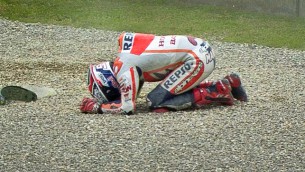
In the afternoon, he posted the fastest speed of the day at 342km/h (212mph). On his next run, the bike become out of shape at 337.9km/h (209.9mph) and seconds later the rider was crawling out of the Turn 1 gravel trap. After being transported to the circuit Medical Centre by ambulance, he was announced as having escaped with no more than a bruised chin.
"Just after the hill on the straight, I grabbed for the brakes but I (lost) the front," he explained later in the afternoon, having missed the usual post-session press call. "I tried to save it but the bike was pulling me towards the wall, so I jumped from the bike to avoid hitting it. I hit my chin hard and strained my neck quite badly; I also have some contusions to my right shoulder, arm and leg, but other than that I'm okay. Thanks to all the medical team that were quickly on the scene to assist me. Now I need to rest and see how I feel later tonight and in the morning."
"Bearing in mind the crash he had, he is okay," Team Principal Livio Suppo told motogp.com. "His chin was very swollen but, considering the speed, he has been very lucky…he jumped off the bike to avoid the wall, but the crash was really big.
"In theory there is nothing broken, so it should be possible, but for sure it is better to wait until tomorrow morning to see how he feels."
Providing the all clear to race is given on Saturday morning, Marquez’s first task will be to move into the top ten of the first three practice sessions in order to head directly to Q2 Qualifying later in the day. Following the opening two periods on Friday, the Spaniard sits 14th and six tenths of a second away from the required tenth place

GRAN PREMIO D'ITALIA TIM

MotoGP Free Practice Nr. 2 Classification 2013
Mugello, Friday, May 31, 2013
Pos.Num.RiderNationTeamBikeKm/hTimeGap 1st/Prev.
1 99 Jorge LORENZO SPA Yamaha Factory Racing Yamaha 341.6 1'48.375
2 46 Valentino ROSSI ITA Yamaha Factory Racing Yamaha 339.4 1'48.409 0.034 / 0.034
3 35 Cal CRUTCHLOW GBR Monster Yamaha Tech 3 Yamaha 337.8 1'48.672 0.297 / 0.263
4 69 Nicky HAYDEN USA Ducati Team Ducati 338.4 1'49.377 1.002 / 0.705
5 26 Dani PEDROSA SPA Repsol Honda Team Honda 340.0 1'49.383 1.008 / 0.006
6 29 Andrea IANNONE ITA Energy T.I. Pramac Racing Ducati 340.6 1'49.467 1.092 / 0.084
7 4 Andrea DOVIZIOSO ITA Ducati Team Ducati 338.8 1'49.543 1.168 / 0.076
8 6 Stefan BRADL GER LCR Honda MotoGP Honda 338.9 1'49.595 1.220 / 0.052
9 14 Randy DE PUNIET FRA Power Electronics Aspar ART 322.4 1'49.599 1.224 / 0.004
10 51 Michele PIRRO ITA Ducati Test Team Ducati 340.1 1'49.649 1.274 / 0.050
11 19 Alvaro BAUTISTA SPA GO&FUN Honda Gresini Honda 338.8 1'49.733 1.358 / 0.084
12 41 Aleix ESPARGARO SPA Power Electronics Aspar ART 326.3 1'49.769 1.394 / 0.036
13 38 Bradley SMITH GBR Monster Yamaha Tech 3 Yamaha 335.2 1'50.103 1.728 / 0.334
14 93 Marc MARQUEZ SPA Repsol Honda Team Honda 342.0 1'50.210 1.835 / 0.107
15 8 Hector BARBERA SPA Avintia Blusens FTR 320.6 1'50.400 2.025 / 0.190
16 11 Ben SPIES USA Ignite Pramac Racing Ducati 340.9 1'51.105 2.730 / 0.705
17 5 Colin EDWARDS USA NGM Mobile Forward Racing FTR Kawasaki 323.5 1'51.433 3.058 / 0.328
18 17 Karel ABRAHAM CZE Cardion AB Motoracing ART 325.8 1'51.528 3.153 / 0.095
19 68 Yonny HERNANDEZ COL Paul Bird Motorsport ART 322.9 1'51.644 3.269 / 0.116
20 9 Danilo PETRUCCI ITA Came IodaRacing Project Ioda-Suter 322.0 1'51.937 3.562 / 0.293
21 7 Hiroshi AOYAMA JPN Avintia Blusens FTR 320.9 1'52.182 3.807 / 0.245
22 71 Claudio CORTI ITA NGM Mobile Forward Racing FTR Kawasaki 326.3 1'53.314 4.939 / 1.132
23 70 Michael LAVERTY GBR Paul Bird Motorsport PBM 321.8 1'53.480 5.105 / 0.166
24 67 Bryan STARING AUS GO&FUN Honda Gresini FTR Honda 324.4 1'54.231 5.856 / 0.751
25 52 Lukas PESEK CZE Came IodaRacing Project Ioda-Suter 312.0 1'54.829 6.454 / 0.598
Weather Conditions:

| Track Condition: Dry| Air: 17º| Humidity: 59%| Ground: 28º
Records:

Fastest Lap: Lap: 17 Jorge LORENZO 1'48.375 174.2 Km/h
Circuit Record Lap: 2012 Dani PEDROSA 1'47.705 175.3 Km/h
Best Lap: 2012 Dani PEDROSA 1'47.284 176.0 Km/h


TT 2013
0D|0H|0M
TT 2013

Practice and Race Schedule

This is the full qualifying and race schedule for the 2013 Isle of Man TT fuelled by Monster Energy. The schedule may change due to weather or track condition delays. For up-to-the-minute information please check our facebook and twitter feeds or listen live to Manx Radio TT.
Further details may be added to this schedule as they are confirmed.
PRACTICE
Saturday, May 25
18.20-18.45 - Solo Newcomers' speed controlled lap
18.35-19.00 - Sidecar Newcomers' speed controlled lap
18.50-19.50 - Lightweight TT/Newcomers (all solo classes)
19.55-20.50 - Sidecar
Monday, May 27
18.20-19.55 - Superbike/Superstock/Supersport/Newcomers (except Lightweight)
20.00-20.50 - Sidecar
Tuesday, May 28
18.20-19.05 - Superbike/Superstock/Supersport/Newcomers (except Lightweight)
19.10-19.55 - Supersport/Lightweight/Newcomers (all solo classes)
20.00-20.50 - Sidecar
Wednesday, May 29
18.20-19.55 - Superbike/Superstock/Supersport/Newcomers (except Lightweight)
20.00-20.50 - Sidecar
Thursday, May 30
18.20-19.10 - Sidecar
19.15-19.55 - Superbike/Superstock/Supersport/Newcomers (except Lightweight)
20.00-20.50 - Supersport/Lightweight/Newcomers (all solo classes)
Friday, May 31
18.20-19.10 - Sidecar
19.15-19.50 - Supersport/Lightweight/Newcomers (all solo classes)
19.55-20.25 - Superbike/Superstock/Supersport/Newcomers (except Lightweight)
20.30-20.50 - TT Zero
Saturday, June 1
10.30-11.50 - Superbike/Superstock/Supersport Qualifying
14:20-15.40 - Lightweight/Supersport Qualifying
15.40-16.20 - Superbike/Superstock Qualifying (2 laps)
16:20-16:30 - SES TT Zero Qualifying (1 lap)
Monday, June 3
12.30-13.00 - Sidecar TT Qualifying
15.45-16.30 - TT Zero Challenge Qualifying
Wednesday, June 5
15.50-16.15 - Senior
16.20-16.45 - Lightweight
RACE
Saturday, June 1
11.00 - Dainese Superbike (six laps) - POSTPONED UNTIL SUNDAY
12.30 - Sure Sidecar 1 (three laps)
Sunday, June 2
14.15 - Dainese Superbike race (six laps)
Monday, June 3
10.45 - Monster Energy Supersport race 1 (four laps)
14.00 - Royal London Superstock (four laps)
Wednesday, June 5
10.45 - SES TT Zero (one lap)
12.00 - Monster Energy Supersport race 2 (four laps)
14.15 - Sure Sidecar 2 (three laps)
Friday, June 7
10.15 - Bikesocial.co.uk Lightweight (three laps)
13.00 - Pokerstars Senior TT (six laps)

Please note this schedule is subject to change.
Full Roads Closure orders list here

http://www.iomtt.com/TT-2013.aspx
 
Who Was The Man Many Call The Greatest Roadracer Ever?
Mike Hailwood: A Remembrance
by dean adams
1998
He won nine world championships, including four 500cc titles in succession. In six years he won a fairly unprecedented seventy-four Grand Prixs. He won Grand Prixs in each of the 250/350/500 classes, including winning Grand Prixs in all three classes in the same season, a record five times. Five times he won all three classes in one day. He won the Isle of Man fourteen times. He set the one hour top speed world record in 1964 at Daytona. He came out of retirement at the age of 38 and won the Isle of Man two years in succession. He came within fourteen points of winning the 500cc title six times, losing in 1961 and 1966 to Gary Hocking and then Giacamo Agostini. He died tragically, prematurely, at the age of forty-two.
Now many not only wonder if he was the best, they wonder who he was.
He was Mike Hailwood.
A Man of Myth
The greatest myths in America about Mike Hailwood are that he was killed while racing and that he was a life-long Ducati rider. To dispel the first myth, he met his demise while driving of all things, a passenger car (at that time even his second run at a racing career had ended). Hailwood, with his daughter Michele beside him and son David in the back, was running for fish and chips for dinner. Not far from his home a delivery truck pulled a quick U-turn in front of him and Hailwood collided with it, killing father and daughter. As for the latter myth, this life-long Ducati rider business, Hailwood predominately rode for the Italian manufacturer MV Agusta and Honda in his long career but he did win the Isle of Man TT in 1979 on a borrowed Ducati, of which Ducati later pumped out many "Hailwood Replicas", hence the misunderstanding.
Hailwood: The Original
Who was he? Hailwood was ... well, Hailwood. Just like there probably will never be another Kenny Roberts or Cal Rayborn II or anyone like them, nor will there be another Hailwood. Michael Stanley Bailey Hailwood was born to an affluent family in England in 1936. His father, Stan Hailwood, was an ex-racer and motorcycle dealer that made millions selling bikes in the Great Britain. He spent money freely and bought the best machinery he could find for his son once the racing bacteria infected Mike's system. Money has been proven beneficial in racing and it certainly opened doors for Hailwood early in his career, but there is one thing that no amount of capital can acquire: talent. Rich boys fueled with Daddy Warbucks money take up and drop out of the sport all the time. The most superb aspect about motorcycle racing is that even with the best tires, machinery and tutoring, Richie Rich will often get smoked by some guy on lessor equipment - a great deal of the equation is desire and talent. Although not many know it, Hailwood paid his father back for every bike he old man purchased. "Mike paid back every penny," says his friend and former mechanic Nobby Clark.
Off the track Hailwood was a brooder, a brooder who loved Jazz. It is said that the only time Mike Hailwood seemed to really enjoy himself was when he was playing or listening to Jazz, or when he was riding. Or carousing. Hailwood was an accomplished carouser.
Hailwood, according to those that would know, was a natural, one of the most naturally talented riders of all time. If a list (reminder: this was written in 1998) had to be made of the most naturally talented riders ever, it would probably read: Roberts, Read, Hailwood and probably Spencer, in no particular order. Go further than that and you'll have to qualify your picks.
Beyond raw talent, Hailwood had The Gift. He was gregarious and likable, so much so that he even managed to win over all those who'd had reservations about old man Hailwood's kid. Paradoxically, Hailwood showed at times a shyness and modesty that made fans admire him even more. This was no Barry Sheene who held court any time he ventured out in public, Hailwood, even after he'd overcome the odds to win nine world championships, would shyly tell people he was "Just a bloke who rides bikes." All this from a lad who dropped out of school at sixteen to work as an assembler in the Triumph factory in Meriden. While there he never spoke of his rich father, just that he wanted to race bikes.
Hailwood began club-racing in his late teens and was a four-time British champion in his first full seasons of racing. He did some time racing in South Africa after that which then had a respectable roadracing ambiance and from there it was on to Grand Prix in Europe. Before long he won his first world championship in 1961 riding the wonderful Honda 250 four against the factory Honda bikes. After one season partially aligned with Mr. Honda and the boys, Hailwood left them for the MV Agusta team along side Giacamo Agostini. MV's Agostini and Yamaha's Phil Read were Hailwood's rivals for most of his career, but there were more. English writer Paul Martin knew the shy Hailwood slightly by way of sharing an flat in England with one of Hailwood's mechanics. He remembers his hero's rivals this way:

"As for the rivalry between Hailwood and Read - I'm not sure that rivalry is quite the word for it. If Read hadn't had the misfortune to be born at the same time as Hailwood then he might have been able to earn the title of greatest rider ever but, as it was, whenever Read did well there was always Hailwood there to go one better; to get the MV ride in the early 60's; to get the seat at Honda. When Hailwood scored his 3-races-in-a-week victory in 1961 it was Read (on his TT debut) who won the other solo race. Hailwood's last (regular) TT year, 1967, he won 3 races to Read's one. When Read did the impossible and won the 1971 250cc World Championship as a privateer, he returned to England for a celebration race at Silverstone—and Hailwood, having a one-off ride, beat him.
"Phil returned to the Island in 1977 to win the new F1 TT, the same year that Joey Dunlop won his first TT that year as well, it prompted Hailwood to return in 1978 and beat Read. They both had an ability to jump onto almost any bike and win races. Read was able to identify and rectify problems and was always the first to use new technologies. Hailwood, on the other hand, was useless at setting up bikes (or cars) but could ride round any problem."
"Hailwood's real rival was Derek Minter, a British rider who competed against Hailwood throughout his career, he still races, and managed to win against Mike more times than he lost. Minter's big chance came in 1963 when Geoff Duke brought out the 500 Gileras to compete against MV. They chose John Hartle and Minter to ride them. Unfortunately Minter broke a collarbone before the bikes arrived and his ride went to Phil Read instead. Read's riding impressed the Yamaha bosses and his career took off but Minter never got the chance of a factory ride again."
Winner of the 1964 USGP at Daytona and world record holder
In preparation for the 1964 USGP at Daytona a reporter made a casual mark to Stan Hailwood about breaking the established world one-hour speed record while they were chatting in the lobby of the old Daytona Speedway Holiday Inn. British rider Bob McIntyre had the 143 mph record then, set at the hard and bumpy Monza circuit. Old Stan Hailwood rented the track for a cool grand and convinced Count Agusta to let them have a go at the record before the Grand Prix on Saturday. On a spare MV 500 works bike, riding clockwise on the oval, Hailwood broke the record and in turn won the Grand Prix later in the week. 1964 Hailwood's record was 144.8 mph.
The Count and Mr. Honda
"Count Agusta ... he was a typical blue-blood. There wasn't an excuse good enough if you'd lost the race. It was your fault; it could never be the bike. I was with Mike when Geoff Duke brought out the Gilera and MV raced against them at Imola in the Gold Cup race. Gilera won the race and I remember old man Agusta went absolutely crazy. He smashed the television up and couldn't believe that his bikes were beaten." --Nobby Clark
Hailwood, like a few others, knew both Count Dominico Agusta, emperor of MV Agusta and Soichiro Honda intimately well. Clark comments on what he felt would be Hailwood's opinion of the pair of assertive and aggressive men, "I think it was always difficult for whomever the rider was at MV. They were going to have a difficult relationship with Count Agusta simply because he was a typical blue-blood, if you know what I mean. There wasn't an excuse good enough if you'd lost the race. It was your fault; it could never be the bike. I was with Mike when Geoff Duke brought out the Gilera and MV raced against them at Imola in the Gold Cup race. Gilera won the race and I remember old man Agusta went absolutely crazy. He smashed the television up and couldn't believe that his bikes were beaten."
"Old man Honda was so different. He respected the rider's views - that was his main thing. He would ask Mike, 'What was the bike like?' And after he heard what was said he'd go over to the designers and tell them, 'That guy is saying the bike is doing this, now sort it out. I don't want any of my riders being hurt. Don't forget it's the name Honda that stands out more than anything if somebody gets hurt.'
"When Mike joined Honda they I think realized they had a rider that was worth twenty horsepower, a guy that would ride as hard as he could. If he lost - there was no excuses. He wouldn't say, 'of the bike did this and that', he'd say, 'I lost. That was it.' I think he was respected for that."
Hailwood won four 500cc world championships for Count Agusta and MV and then, fed up with the political intrigue of the Italians, swapped back to Honda for 1966. How he did so is quite a story: the final race of the 1965 season saw Hailwood ride the 350 MV as his contract specified but Honda contacted him prior to the race and asked if he would ride the 250 Six at Suzuka. Hailwood couldn't as he had a contract with MV. Being industrious, Mr. Honda petitioned the organizers of the 1965 Grand Prix of Suzuka, owned by Honda of course, to rearrange the schedule on race day so that the 350 race was held before the 250 event - the opposite of the standing schedule in those days. Hailwood won the 350 race for the Count and then, his contract with MV Agusta satisfied, stepped over and rode the Honda 250 six, -finishing second.
More Color
"Back in those days, suspension was just a word," says Nobby Clark.
Prior to the 1966 season the most infamous Hailwood story occurred. Late in the pre-season at a Honda test at Suzuka, Hailwood was unhappy with the Honda-manufactured rear suspension on the six cylinder 250. After trying for hours to get the suspension to work, he politely asked the Japanese engineers to remove the shocks from the machine. When they did so, he picked them up, walked over and tossed them in the Suzuka pond. He then brought out a pair of English Girling shocks he had used on the previously and told the engineers to install them. Old man Honda nearly had a heart attack when he heard what Hailwood had done.
Nobby Clark was there that day and he confirms the story: "Mike just kept saying to them, 'The units are not working properly. They're good for two laps, then they heat up and don't do a damn thing'. One Honda guy kept saying oh, don't worry about it. At that particular time Mike had broken the outright lap record at Suzuka and he said to the guy, 'For thirty laps I cannot do that lap time. The Yamahas, they are going to be right there all the time. I don't mind trying like hell but if the thing starts giving me trouble, what do you want me to do?'.
"They just sort of played around with these shocks, took the springs off and tested them by hand to see what the damping was like. They put them back on the bike and Mike went out and the bike did exactly the same thing. So when he came in Mike had them take them off the bike. Back then there used to be a pond at the back of the paddock at Suzuka. He picked up the shocks and threw them in the water. Then he said to the Japanese, 'Now you will have to do something about it'.
They put Girlings on it and the next day Mike set a lap record that stood for fourteen years."
Hailwood inadvertently closed out his professional Grand Prix career in 1967 with Honda by winning the 250 and 350 titles, for the second time in two years. He intended to race the 1968 season for Honda but the factory unexpectedly pulled out of Grand Prix racing in February of 1968. Hailwood, then only twenty-seven, had a contract for '68 which Honda financially honored, but in doing so would not release him to ride for another manufacturer. "How could I have said no to so much money for doing nothing?" Hailwood said at the time. He coaxed machinery out of Honda to race national events where he could negotiate his own start money for 1968.
A third chapter in '68 - almost
At the final race of the 1968 season, with the okay of Honda, he tried to forge a new beginning with Count Agusta at the Italian GP, practicing the MV. But the two were at each other's throats before the session ended and Hailwood walked. Hailwood friend, confidant and mechanic Nobby Clark recalls, "Being it was the last race of the 1968 season Honda allowed him to ride the 350 MV at Monza. He went there and practiced on Thursday and got a really good lap time - Ago was quite a bit slower. Then the next day in practice Mike's bike wouldn't go nearly as fast as it did the day before. He said to the MV people, 'You've done something to the bike' but they said no, no they hadn't. Well it was such a change that five or six degrees in atmospheric conditions couldn't cause it. And Ago's bike were now miles an hour faster. He figured they switched engines between the two bikes. So Mike went to Benelli and asked if they had a bike for him to ride and of course, they said yes so he raced the Benelli. Unfortunately in the race he fell off on the second or third lap."
"MV to this day claim that they never did anything to the bike, whereas Mike, until the day he died, believed that they switched the engines or changed the carburetors or something like that." Hailwood continued to race. By the end of the season he told the press that he'd had enough and would concentrate on car racing.
After that incredible run with Honda and MV Agusta in Grand Prix, Hailwood attempted to win a world championship on four wheels as well, driving in Formula One for former motorcycle and F-1 world champion John Surtees. The Bike was one of the first (after Surtees himself) of many talented and successful motorcycle racers to try to find the same success with car racing, only to detect that racing talent in car racing will not bridge the gap brought on by weak machinery. The Surtees car wasn't capable, yet Hailwood finished third at the twenty-four hours of Le Mans in a Ford GT-40 and won the FF200 title for Surtees. Hailwood's character was moved up another notch when he jumped into a burning car in South African Grand Prix to save fellow driver Clay Regazoni. He was later given the George Medal for his bravery, the highest non-military award in England. On to McLaren where he finished in the top five several times. Then Hailwood was involved in a horrific accident at the German GP which severely injured his leg. Following that, Hailwood healed but retired from racing nearly completely. He moved to New Zealand (like many Brits, to escape the Torry tax laws) before it became fashionable and lived there with his family for years.
Lonely Severance
In retirement Hailwood must have begun to miss the limelight slightly; many riders never really recover mentally when their career ends. It's difficult to compare the trappings of everyday life with the days when you were a racing superstar, adored by the multitudes, traveling the world, signing your autograph in movie theaters, et al. Some of the saddest, most despondent, bitter, cynical, manic-depressive people are former world championship riders in the first years of their post-racing career life. Even for shy Mike Hailwood the post-racing period in his life must have been tedious.
"Mike wanted to go back to show a lot of the people - the riders of the time - that at his age he could still go to the Isle of Man and win," says Clark. "Mike always had a soft spot for the Island because he thought that if a rider won on the Island you had really won a race. It was a hard circuit that if you wanted to win you had to really race there. Guys who won on the Island were always a little bit special. You couldn't go there just to play and win a race. It was a circuit that didn't allow for that."
After several races in New Zealand, Hailwood decided that he still had a race or two left in him. Plus, he had some things to prove. His career and accomplishments seemed distant to some and put into some doubt with the enormous step taken in motorcycle technology in the 1970s. "Yeah, but he did all that on those old bikes, he could never ride like that on a modern machine," some said. Hailwood began to train for a comeback. Friends didn't want him to injure his body or reputation and told him not to attempt it. He ignored them.
With his hair thinning and a slight belly, Hailwood returned to the Isle of Man at the grand old age of thirty-eight to race again, years after he'd officially retired from roadracing. A Ducati 860SS was procured for him to ride, not a factory bike mind you, but Hailwood persevered on it and won the TT and set a new lap record on the machine as well.
In England and much of the world, his status as a full-fledged British racing champion and hero was assured. Barry Sheene lived his life in the shadow of Mike Hailwood and finally broke free of the looming specter when he won his back to back titles in 1976 and 1977; he won Britain's first 500cc world championships since Hailwood's last in 1965. For Sheene, Hailwood's historic win at the Isle in 1978 put him in the darkness once again.
The comeback ride even at the Isle of Man, a course he knew like the small of his wife's back, was a major gamble for Mike Hailwood. To put it in a modern perspective, it would be as if Kenny Roberts started a comeback today on a present-day 500 at Laguna Seca, more than ten years after really giving it up. Succeed and you've done well. Fail and everything you've accomplished in your career is tainted. Hailwood succeeded, not once but twice.
For good measure Hailwood came back to the Isle the next year on an untamed Suzuki four-cylinder 500cc two-stroke, riding one of the few two-strokes of his career, and won again. Thirty-nine years old and a little out of his element - Hailwood refused to hang off the bike as was just becoming the riding technique of choice, he held his knees tightly to the Suzuki's gas tank when the bike was heeled over, just as he had done on the MV and the Honda six - Hailwood was a superstar again. He raced a third time after the second modern-day Isle of Man win but tossed the bike at Mallory Park in practice and said he'd had enough.
In two years time he would be dead.
Summation
French writer Jacques Bussillet wrote in his book Mike Hailwood and the Honda Six, (roughly translated here)
" ... in twenty-two years of racing Hailwood rode more than seventy different machines in all classes from 125 to 900cc, most being works bikes from fifteen or sixteen different factories. With all these bikes, he won nine world championship titles in Grand Prix, one TT-F1 world championship title, seventy-four Grand Prixs and an incredible number of international races around the world, adding to his credit the one hour speed record on the spare MV during an attempt in 1964 at the Daytona Speedway."
Of course, Hailwood's time in Grand Prix racing was a different era. It wasn't especially glamorous and all about television, viewing impressions and getting and keeping sponsors as so much of it is today. Racing then was simply competition among men and manufacturers who were all trying to prove they were the best; (Hailwood raced for time early in his professional career with only the words, "For the Love of the Sport" on the side of his fairing), from one view it is still that today, but from another it is very different.
Too, time smoothes out the rough edges of the period but Grand Prix racing was no picnic at that time, the courses were dangerous, bumpy and long. More people died in Grand Prix racing in that period than any other. Not only on the track, as the travel from one racetrack in Europe to another could be hazardous: high speeds, border crossings and the rickety aircraft of the period brought down more than one rider. "Yeah, it was dangerous," confirms Clark, " racing on cobblestone streets in the rain and things like that. Today's rider won't race in the rain if the asphalt's not right. Back then it was just another day."
He knew when to quit. And when to really quit
Interestingly, Hailwood's career and life transpired a period of significant change in the sport. He came into it when some sanctioning bodies in Europe didn't require their riders to wear helmets and finished it racing the first of the four-cylinder two-stroke 750s, although a tame one by comparison to what came later. For most of his pre-1978 career he wore the gentlemen-like thin black leathers with no sponsorship patches as was customary of the period, yet when he rode for the final time at the Isle of Man, Hailwood on the Suzuki was decked out in full billboard-style leathers.
He went to Daytona a month before his death to watch the 200 and saw the Yamaha TZ700s and other 750s race there; the early models at their bad-tempered worst. Hailwood discounted any thoughts of a third comeback attempt once he saw their antics on the banking. "At Daytona he said, 'Those 750s are so fast now I don't even want to know about getting on them' " says Clark, who last spoke with his friend in the paddock at Daytona.
Nine time world champion Mike Hailwood died in 1981 at the age of 42 in a silly automobile accident, robbing roadracing of one its greatest heroes. Killed with him was his pre-teen daughter Michele. They were on their way home from a resturant when a truck in front of them pulled a fast U-turn.
Hailwood's only son, David, was five years old at the time and the only person in the car to survive the accident.
Hailwood's relatively early death and heady accomplishments in life made him an icon of racing, just as James Dean and Marilyn Monroe are icons of pop culture. He is revered in some circles and almost forgotten in others; much of what remains is lore and it is difficult to separate truth from fiction.
Icon, yes, but was Hailwood really the best? Nobby Clark who worked with many world champions including Kenny Roberts, believes so. "I think he was the best. And I think he was definitely the most versatile rider ever. He would get off the 125 and get on a 500 and he didn't need but two or three laps to get used to it. He just had that talent where he could jump off one bike and onto another, race it and win. He could go from a 500 to a 350 to a 250 and he was absolutely no different. That is where he stood out. I don't think there has been anybody like that in the last ten years, that versatile. I think Kenny (Roberts) was that way too, but Kenny always needed luck."
To Clark, what stands out for him is Hailwood's love for motorcycle sport: "Today the riders will race if the money is right. Mike wasn't that way, he loved to race."
ENDS


Attachments

  • Mike-Hailwood-250-Ducati.webp
    Mike-Hailwood-250-Ducati.webp
    89.1 KB · Views: 2
Who Was The Man Many Call The Greatest Roadracer Ever?
Mike Hailwood: A Remembrance
by dean adams
1998
He won nine world championships, including four 500cc titles in succession. In six years he won a fairly unprecedented seventy-four Grand Prixs. He won Grand Prixs in each of the 250/350/500 classes, including winning Grand Prixs in all three classes in the same season, a record five times. Five times he won all three classes in one day. He won the Isle of Man fourteen times. He set the one hour top speed world record in 1964 at Daytona. He came out of retirement at the age of 38 and won the Isle of Man two years in succession. He came within fourteen points of winning the 500cc title six times, losing in 1961 and 1966 to Gary Hocking and then Giacamo Agostini. He died tragically, prematurely, at the age of forty-two.
Now many not only wonder if he was the best, they wonder who he was.
He was Mike Hailwood.
A Man of Myth
The greatest myths in America about Mike Hailwood are that he was killed while racing and that he was a life-long Ducati rider. To dispel the first myth, he met his demise while driving of all things, a passenger car (at that time even his second run at a racing career had ended). Hailwood, with his daughter Michele beside him and son David in the back, was running for fish and chips for dinner. Not far from his home a delivery truck pulled a quick U-turn in front of him and Hailwood collided with it, killing father and daughter. As for the latter myth, this life-long Ducati rider business, Hailwood predominately rode for the Italian manufacturer MV Agusta and Honda in his long career but he did win the Isle of Man TT in 1979 on a borrowed Ducati, of which Ducati later pumped out many "Hailwood Replicas", hence the misunderstanding.
Hailwood: The Original
Who was he? Hailwood was ... well, Hailwood. Just like there probably will never be another Kenny Roberts or Cal Rayborn II or anyone like them, nor will there be another Hailwood. Michael Stanley Bailey Hailwood was born to an affluent family in England in 1936. His father, Stan Hailwood, was an ex-racer and motorcycle dealer that made millions selling bikes in the Great Britain. He spent money freely and bought the best machinery he could find for his son once the racing bacteria infected Mike's system. Money has been proven beneficial in racing and it certainly opened doors for Hailwood early in his career, but there is one thing that no amount of capital can acquire: talent. Rich boys fueled with Daddy Warbucks money take up and drop out of the sport all the time. The most superb aspect about motorcycle racing is that even with the best tires, machinery and tutoring, Richie Rich will often get smoked by some guy on lessor equipment - a great deal of the equation is desire and talent. Although not many know it, Hailwood paid his father back for every bike he old man purchased. "Mike paid back every penny," says his friend and former mechanic Nobby Clark.
Off the track Hailwood was a brooder, a brooder who loved Jazz. It is said that the only time Mike Hailwood seemed to really enjoy himself was when he was playing or listening to Jazz, or when he was riding. Or carousing. Hailwood was an accomplished carouser.
Hailwood, according to those that would know, was a natural, one of the most naturally talented riders of all time. If a list (reminder: this was written in 1998) had to be made of the most naturally talented riders ever, it would probably read: Roberts, Read, Hailwood and probably Spencer, in no particular order. Go further than that and you'll have to qualify your picks.
Beyond raw talent, Hailwood had The Gift. He was gregarious and likable, so much so that he even managed to win over all those who'd had reservations about old man Hailwood's kid. Paradoxically, Hailwood showed at times a shyness and modesty that made fans admire him even more. This was no Barry Sheene who held court any time he ventured out in public, Hailwood, even after he'd overcome the odds to win nine world championships, would shyly tell people he was "Just a bloke who rides bikes." All this from a lad who dropped out of school at sixteen to work as an assembler in the Triumph factory in Meriden. While there he never spoke of his rich father, just that he wanted to race bikes.
Hailwood began club-racing in his late teens and was a four-time British champion in his first full seasons of racing. He did some time racing in South Africa after that which then had a respectable roadracing ambiance and from there it was on to Grand Prix in Europe. Before long he won his first world championship in 1961 riding the wonderful Honda 250 four against the factory Honda bikes. After one season partially aligned with Mr. Honda and the boys, Hailwood left them for the MV Agusta team along side Giacamo Agostini. MV's Agostini and Yamaha's Phil Read were Hailwood's rivals for most of his career, but there were more. English writer Paul Martin knew the shy Hailwood slightly by way of sharing an flat in England with one of Hailwood's mechanics. He remembers his hero's rivals this way:

"As for the rivalry between Hailwood and Read - I'm not sure that rivalry is quite the word for it. If Read hadn't had the misfortune to be born at the same time as Hailwood then he might have been able to earn the title of greatest rider ever but, as it was, whenever Read did well there was always Hailwood there to go one better; to get the MV ride in the early 60's; to get the seat at Honda. When Hailwood scored his 3-races-in-a-week victory in 1961 it was Read (on his TT debut) who won the other solo race. Hailwood's last (regular) TT year, 1967, he won 3 races to Read's one. When Read did the impossible and won the 1971 250cc World Championship as a privateer, he returned to England for a celebration race at Silverstone—and Hailwood, having a one-off ride, beat him.
"Phil returned to the Island in 1977 to win the new F1 TT, the same year that Joey Dunlop won his first TT that year as well, it prompted Hailwood to return in 1978 and beat Read. They both had an ability to jump onto almost any bike and win races. Read was able to identify and rectify problems and was always the first to use new technologies. Hailwood, on the other hand, was useless at setting up bikes (or cars) but could ride round any problem."
"Hailwood's real rival was Derek Minter, a British rider who competed against Hailwood throughout his career, he still races, and managed to win against Mike more times than he lost. Minter's big chance came in 1963 when Geoff Duke brought out the 500 Gileras to compete against MV. They chose John Hartle and Minter to ride them. Unfortunately Minter broke a collarbone before the bikes arrived and his ride went to Phil Read instead. Read's riding impressed the Yamaha bosses and his career took off but Minter never got the chance of a factory ride again."
Winner of the 1964 USGP at Daytona and world record holder
In preparation for the 1964 USGP at Daytona a reporter made a casual mark to Stan Hailwood about breaking the established world one-hour speed record while they were chatting in the lobby of the old Daytona Speedway Holiday Inn. British rider Bob McIntyre had the 143 mph record then, set at the hard and bumpy Monza circuit. Old Stan Hailwood rented the track for a cool grand and convinced Count Agusta to let them have a go at the record before the Grand Prix on Saturday. On a spare MV 500 works bike, riding clockwise on the oval, Hailwood broke the record and in turn won the Grand Prix later in the week. 1964 Hailwood's record was 144.8 mph.
The Count and Mr. Honda
"Count Agusta ... he was a typical blue-blood. There wasn't an excuse good enough if you'd lost the race. It was your fault; it could never be the bike. I was with Mike when Geoff Duke brought out the Gilera and MV raced against them at Imola in the Gold Cup race. Gilera won the race and I remember old man Agusta went absolutely crazy. He smashed the television up and couldn't believe that his bikes were beaten." --Nobby Clark
Hailwood, like a few others, knew both Count Dominico Agusta, emperor of MV Agusta and Soichiro Honda intimately well. Clark comments on what he felt would be Hailwood's opinion of the pair of assertive and aggressive men, "I think it was always difficult for whomever the rider was at MV. They were going to have a difficult relationship with Count Agusta simply because he was a typical blue-blood, if you know what I mean. There wasn't an excuse good enough if you'd lost the race. It was your fault; it could never be the bike. I was with Mike when Geoff Duke brought out the Gilera and MV raced against them at Imola in the Gold Cup race. Gilera won the race and I remember old man Agusta went absolutely crazy. He smashed the television up and couldn't believe that his bikes were beaten."
"Old man Honda was so different. He respected the rider's views - that was his main thing. He would ask Mike, 'What was the bike like?' And after he heard what was said he'd go over to the designers and tell them, 'That guy is saying the bike is doing this, now sort it out. I don't want any of my riders being hurt. Don't forget it's the name Honda that stands out more than anything if somebody gets hurt.'
"When Mike joined Honda they I think realized they had a rider that was worth twenty horsepower, a guy that would ride as hard as he could. If he lost - there was no excuses. He wouldn't say, 'of the bike did this and that', he'd say, 'I lost. That was it.' I think he was respected for that."
Hailwood won four 500cc world championships for Count Agusta and MV and then, fed up with the political intrigue of the Italians, swapped back to Honda for 1966. How he did so is quite a story: the final race of the 1965 season saw Hailwood ride the 350 MV as his contract specified but Honda contacted him prior to the race and asked if he would ride the 250 Six at Suzuka. Hailwood couldn't as he had a contract with MV. Being industrious, Mr. Honda petitioned the organizers of the 1965 Grand Prix of Suzuka, owned by Honda of course, to rearrange the schedule on race day so that the 350 race was held before the 250 event - the opposite of the standing schedule in those days. Hailwood won the 350 race for the Count and then, his contract with MV Agusta satisfied, stepped over and rode the Honda 250 six, -finishing second.
More Color
"Back in those days, suspension was just a word," says Nobby Clark.
Prior to the 1966 season the most infamous Hailwood story occurred. Late in the pre-season at a Honda test at Suzuka, Hailwood was unhappy with the Honda-manufactured rear suspension on the six cylinder 250. After trying for hours to get the suspension to work, he politely asked the Japanese engineers to remove the shocks from the machine. When they did so, he picked them up, walked over and tossed them in the Suzuka pond. He then brought out a pair of English Girling shocks he had used on the previously and told the engineers to install them. Old man Honda nearly had a heart attack when he heard what Hailwood had done.
Nobby Clark was there that day and he confirms the story: "Mike just kept saying to them, 'The units are not working properly. They're good for two laps, then they heat up and don't do a damn thing'. One Honda guy kept saying oh, don't worry about it. At that particular time Mike had broken the outright lap record at Suzuka and he said to the guy, 'For thirty laps I cannot do that lap time. The Yamahas, they are going to be right there all the time. I don't mind trying like hell but if the thing starts giving me trouble, what do you want me to do?'.
"They just sort of played around with these shocks, took the springs off and tested them by hand to see what the damping was like. They put them back on the bike and Mike went out and the bike did exactly the same thing. So when he came in Mike had them take them off the bike. Back then there used to be a pond at the back of the paddock at Suzuka. He picked up the shocks and threw them in the water. Then he said to the Japanese, 'Now you will have to do something about it'.
They put Girlings on it and the next day Mike set a lap record that stood for fourteen years."
Hailwood inadvertently closed out his professional Grand Prix career in 1967 with Honda by winning the 250 and 350 titles, for the second time in two years. He intended to race the 1968 season for Honda but the factory unexpectedly pulled out of Grand Prix racing in February of 1968. Hailwood, then only twenty-seven, had a contract for '68 which Honda financially honored, but in doing so would not release him to ride for another manufacturer. "How could I have said no to so much money for doing nothing?" Hailwood said at the time. He coaxed machinery out of Honda to race national events where he could negotiate his own start money for 1968.
A third chapter in '68 - almost
At the final race of the 1968 season, with the okay of Honda, he tried to forge a new beginning with Count Agusta at the Italian GP, practicing the MV. But the two were at each other's throats before the session ended and Hailwood walked. Hailwood friend, confidant and mechanic Nobby Clark recalls, "Being it was the last race of the 1968 season Honda allowed him to ride the 350 MV at Monza. He went there and practiced on Thursday and got a really good lap time - Ago was quite a bit slower. Then the next day in practice Mike's bike wouldn't go nearly as fast as it did the day before. He said to the MV people, 'You've done something to the bike' but they said no, no they hadn't. Well it was such a change that five or six degrees in atmospheric conditions couldn't cause it. And Ago's bike were now miles an hour faster. He figured they switched engines between the two bikes. So Mike went to Benelli and asked if they had a bike for him to ride and of course, they said yes so he raced the Benelli. Unfortunately in the race he fell off on the second or third lap."
"MV to this day claim that they never did anything to the bike, whereas Mike, until the day he died, believed that they switched the engines or changed the carburetors or something like that." Hailwood continued to race. By the end of the season he told the press that he'd had enough and would concentrate on car racing.
After that incredible run with Honda and MV Agusta in Grand Prix, Hailwood attempted to win a world championship on four wheels as well, driving in Formula One for former motorcycle and F-1 world champion John Surtees. The Bike was one of the first (after Surtees himself) of many talented and successful motorcycle racers to try to find the same success with car racing, only to detect that racing talent in car racing will not bridge the gap brought on by weak machinery. The Surtees car wasn't capable, yet Hailwood finished third at the twenty-four hours of Le Mans in a Ford GT-40 and won the FF200 title for Surtees. Hailwood's character was moved up another notch when he jumped into a burning car in South African Grand Prix to save fellow driver Clay Regazoni. He was later given the George Medal for his bravery, the highest non-military award in England. On to McLaren where he finished in the top five several times. Then Hailwood was involved in a horrific accident at the German GP which severely injured his leg. Following that, Hailwood healed but retired from racing nearly completely. He moved to New Zealand (like many Brits, to escape the Torry tax laws) before it became fashionable and lived there with his family for years.
Lonely Severance
In retirement Hailwood must have begun to miss the limelight slightly; many riders never really recover mentally when their career ends. It's difficult to compare the trappings of everyday life with the days when you were a racing superstar, adored by the multitudes, traveling the world, signing your autograph in movie theaters, et al. Some of the saddest, most despondent, bitter, cynical, manic-depressive people are former world championship riders in the first years of their post-racing career life. Even for shy Mike Hailwood the post-racing period in his life must have been tedious.
"Mike wanted to go back to show a lot of the people - the riders of the time - that at his age he could still go to the Isle of Man and win," says Clark. "Mike always had a soft spot for the Island because he thought that if a rider won on the Island you had really won a race. It was a hard circuit that if you wanted to win you had to really race there. Guys who won on the Island were always a little bit special. You couldn't go there just to play and win a race. It was a circuit that didn't allow for that."
After several races in New Zealand, Hailwood decided that he still had a race or two left in him. Plus, he had some things to prove. His career and accomplishments seemed distant to some and put into some doubt with the enormous step taken in motorcycle technology in the 1970s. "Yeah, but he did all that on those old bikes, he could never ride like that on a modern machine," some said. Hailwood began to train for a comeback. Friends didn't want him to injure his body or reputation and told him not to attempt it. He ignored them.
With his hair thinning and a slight belly, Hailwood returned to the Isle of Man at the grand old age of thirty-eight to race again, years after he'd officially retired from roadracing. A Ducati 860SS was procured for him to ride, not a factory bike mind you, but Hailwood persevered on it and won the TT and set a new lap record on the machine as well.
In England and much of the world, his status as a full-fledged British racing champion and hero was assured. Barry Sheene lived his life in the shadow of Mike Hailwood and finally broke free of the looming specter when he won his back to back titles in 1976 and 1977; he won Britain's first 500cc world championships since Hailwood's last in 1965. For Sheene, Hailwood's historic win at the Isle in 1978 put him in the darkness once again.
The comeback ride even at the Isle of Man, a course he knew like the small of his wife's back, was a major gamble for Mike Hailwood. To put it in a modern perspective, it would be as if Kenny Roberts started a comeback today on a present-day 500 at Laguna Seca, more than ten years after really giving it up. Succeed and you've done well. Fail and everything you've accomplished in your career is tainted. Hailwood succeeded, not once but twice.
For good measure Hailwood came back to the Isle the next year on an untamed Suzuki four-cylinder 500cc two-stroke, riding one of the few two-strokes of his career, and won again. Thirty-nine years old and a little out of his element - Hailwood refused to hang off the bike as was just becoming the riding technique of choice, he held his knees tightly to the Suzuki's gas tank when the bike was heeled over, just as he had done on the MV and the Honda six - Hailwood was a superstar again. He raced a third time after the second modern-day Isle of Man win but tossed the bike at Mallory Park in practice and said he'd had enough.
In two years time he would be dead.
Summation
French writer Jacques Bussillet wrote in his book Mike Hailwood and the Honda Six, (roughly translated here)
" ... in twenty-two years of racing Hailwood rode more than seventy different machines in all classes from 125 to 900cc, most being works bikes from fifteen or sixteen different factories. With all these bikes, he won nine world championship titles in Grand Prix, one TT-F1 world championship title, seventy-four Grand Prixs and an incredible number of international races around the world, adding to his credit the one hour speed record on the spare MV during an attempt in 1964 at the Daytona Speedway."
Of course, Hailwood's time in Grand Prix racing was a different era. It wasn't especially glamorous and all about television, viewing impressions and getting and keeping sponsors as so much of it is today. Racing then was simply competition among men and manufacturers who were all trying to prove they were the best; (Hailwood raced for time early in his professional career with only the words, "For the Love of the Sport" on the side of his fairing), from one view it is still that today, but from another it is very different.
Too, time smoothes out the rough edges of the period but Grand Prix racing was no picnic at that time, the courses were dangerous, bumpy and long. More people died in Grand Prix racing in that period than any other. Not only on the track, as the travel from one racetrack in Europe to another could be hazardous: high speeds, border crossings and the rickety aircraft of the period brought down more than one rider. "Yeah, it was dangerous," confirms Clark, " racing on cobblestone streets in the rain and things like that. Today's rider won't race in the rain if the asphalt's not right. Back then it was just another day."
He knew when to quit. And when to really quit
Interestingly, Hailwood's career and life transpired a period of significant change in the sport. He came into it when some sanctioning bodies in Europe didn't require their riders to wear helmets and finished it racing the first of the four-cylinder two-stroke 750s, although a tame one by comparison to what came later. For most of his pre-1978 career he wore the gentlemen-like thin black leathers with no sponsorship patches as was customary of the period, yet when he rode for the final time at the Isle of Man, Hailwood on the Suzuki was decked out in full billboard-style leathers.
He went to Daytona a month before his death to watch the 200 and saw the Yamaha TZ700s and other 750s race there; the early models at their bad-tempered worst. Hailwood discounted any thoughts of a third comeback attempt once he saw their antics on the banking. "At Daytona he said, 'Those 750s are so fast now I don't even want to know about getting on them' " says Clark, who last spoke with his friend in the paddock at Daytona.
Nine time world champion Mike Hailwood died in 1981 at the age of 42 in a silly automobile accident, robbing roadracing of one its greatest heroes. Killed with him was his pre-teen daughter Michele. They were on their way home from a resturant when a truck in front of them pulled a fast U-turn.
Hailwood's only son, David, was five years old at the time and the only person in the car to survive the accident.
Hailwood's relatively early death and heady accomplishments in life made him an icon of racing, just as James Dean and Marilyn Monroe are icons of pop culture. He is revered in some circles and almost forgotten in others; much of what remains is lore and it is difficult to separate truth from fiction.
Icon, yes, but was Hailwood really the best? Nobby Clark who worked with many world champions including Kenny Roberts, believes so. "I think he was the best. And I think he was definitely the most versatile rider ever. He would get off the 125 and get on a 500 and he didn't need but two or three laps to get used to it. He just had that talent where he could jump off one bike and onto another, race it and win. He could go from a 500 to a 350 to a 250 and he was absolutely no different. That is where he stood out. I don't think there has been anybody like that in the last ten years, that versatile. I think Kenny (Roberts) was that way too, but Kenny always needed luck."
To Clark, what stands out for him is Hailwood's love for motorcycle sport: "Today the riders will race if the money is right. Mike wasn't that way, he loved to race."
ENDS

View attachment 122182
mike-hailwood-4-629x570.webp
images.webp
a86b8d4d-7ddc-4350-9a86-16284ed239d8_mike-hailwood1-220313.webp
HAILWOOD_TROPHIES_1280.webp
12770.webp
Hailwood-9.webp
 
Back
Top