


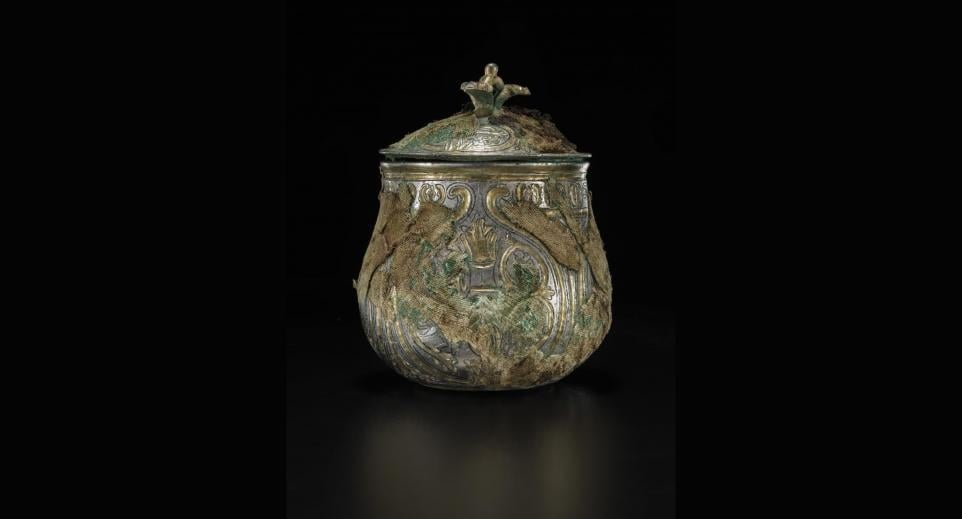
Researchers have revealed the origins of a remarkable lidded vessel from the Galloway Hoard, an exceptional collection of Viking-age treasures discovered a decade ago in Scotland. The silver vessel, estimated to be over 1,000 years old, has been identified as originating from what is now Iran.
The Galloway Hoard, found in 2014 by metal detectorist Derek McLennan near Balmaghie in Kirkcudbrightshire, Scotland, is considered one of the most significant archaeological finds of the 21st century in the United Kingdom. The hoard, dating back to around 900 AD, includes a diverse array of items such as silver, gold, and other precious materials, showcasing the rich cultural interactions of the Viking Age.
Among the various artifacts in the hoard, the lidded silver vessel has captured the attention of archaeologists and historians alike. Initially wrapped in ancient textiles, which are an extremely rare survival, the vessel was only partially visible through X-ray scans. However, recent laser cleaning has revealed intricate designs, including crowns, fire altars, leopards, and tigers, that are not typically seen in western Europe.
The vessel’s origins were confirmed through extensive scientific analysis. Dr. Jane Kershaw, an expert on Viking-age silver from the University of Oxford, explained, “Elemental analysis using portable X-ray fluorescence revealed that the vessel is an alloy of silver and relatively pure copper, which is typical of Sasanian silver, but not contemporary European silver.” She further noted that isotopic analysis indicated the silver and niello (black silver-sulphide inlays outlining the decoration) matched ore from the famous Nakhlak mine in central Iran, confirming the vessel’s origin in the Sasanian Empire, the last Persian empire before the early Muslim conquests.
Dr. Martin Goldberg from National Museums Scotland echoed these findings, stating, “We had suspected from X-ray scanning the vessel that it may have originated somewhere in central or western Asia, but it’s only now that we’ve carefully conserved and analyzed it that we can definitively say this is the case.”


 archaeologymag.com
The Galloway Hoard, found in 2014 by metal detectorist Derek McLennan near Balmaghie in Kirkcudbrightshire, Scotland, is considered one of the most significant archaeological finds of the 21st century in the United Kingdom. The hoard, dating back to around 900 AD, includes a diverse array of items such as silver, gold, and other precious materials, showcasing the rich cultural interactions of the Viking Age.
Among the various artifacts in the hoard, the lidded silver vessel has captured the attention of archaeologists and historians alike. Initially wrapped in ancient textiles, which are an extremely rare survival, the vessel was only partially visible through X-ray scans. However, recent laser cleaning has revealed intricate designs, including crowns, fire altars, leopards, and tigers, that are not typically seen in western Europe.
The vessel’s origins were confirmed through extensive scientific analysis. Dr. Jane Kershaw, an expert on Viking-age silver from the University of Oxford, explained, “Elemental analysis using portable X-ray fluorescence revealed that the vessel is an alloy of silver and relatively pure copper, which is typical of Sasanian silver, but not contemporary European silver.” She further noted that isotopic analysis indicated the silver and niello (black silver-sulphide inlays outlining the decoration) matched ore from the famous Nakhlak mine in central Iran, confirming the vessel’s origin in the Sasanian Empire, the last Persian empire before the early Muslim conquests.
Dr. Martin Goldberg from National Museums Scotland echoed these findings, stating, “We had suspected from X-ray scanning the vessel that it may have originated somewhere in central or western Asia, but it’s only now that we’ve carefully conserved and analyzed it that we can definitively say this is the case.”
Viking-age urn from Galloway Hoard traveled half the world from Iran, researchers discover
Researchers have discovered that a lidded vessel from the rich Galloway Hoard originated from a silver mine in present-day Iran.
archaeologymag.com