• Adults Only Website 18+

    If you are under 18 you are not permitted to submit personal information to us or use this website. If discovered you will be banned.

    We will ban and report anyone posting illegal content.

    We will ban any forum user who breaks our terms.

    Freedom of speech should be wide open as long as it doesn't incite violence.

    We have a 15 year old thriving community here with 400,000+ members and hundreds of people online at any given moment, we encourage you to join!, there are 1000's of topics to discuss. Please be aware before registering and read our terms of service and privacy policy.

    By dismissing this notice and proceeding, you agree to the above.

First-Ever Giant Ichthyosaur Soft Tissues Preserved In “Extraordinary Fossil” Dating Back 183 Million Years

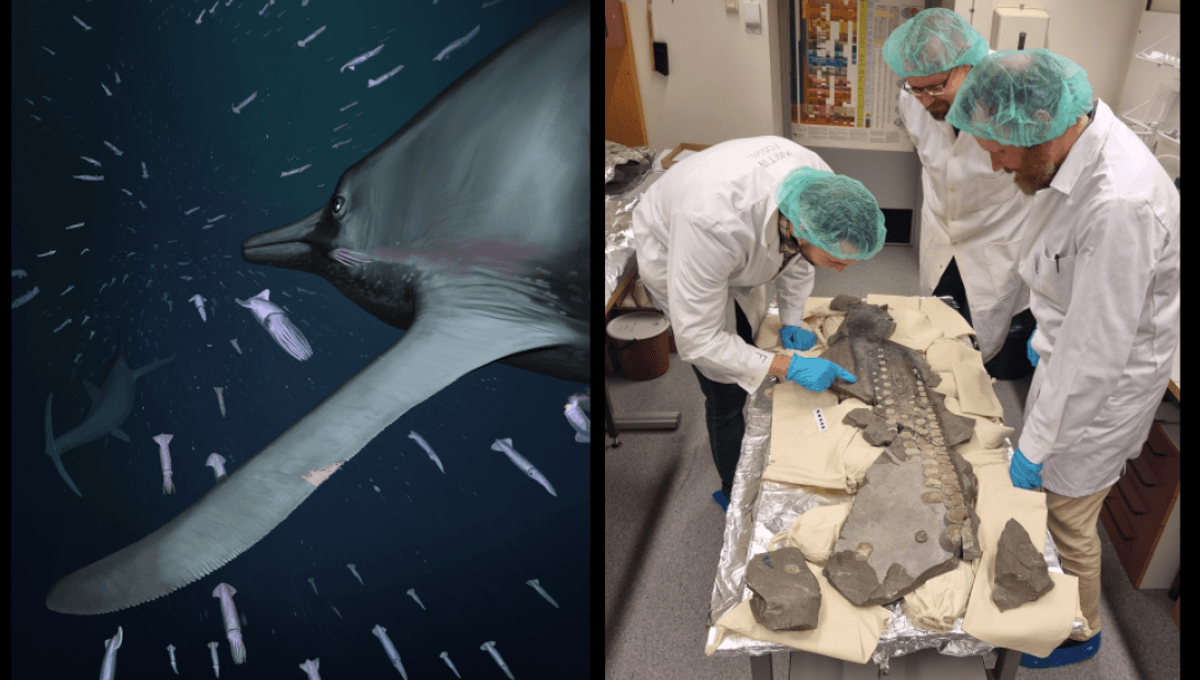
An extraordinary fossil has blown the socks of palaeontologists as it was found to contain the soft tissues of a Temnodontosaurus ichthyosaur, marking the first time we’ve ever found soft tissue remains of a giant ichthyosaur and introducing new-to-science features that reveal how they hunted. The discovery is going to revolutionize the way we look at ichthyosaurs, so said study co-author and palaeontologist Dr Dean Lomax, who knows a thing or two about these extinct marine reptiles.

Honestly, when I first saw this specimen in person, laid out on the kitchen table, no less, at Georg's house (the collector), I was stunned into silence,” Lomax told IFLScience. “That says a lot about me (and this fossil), considering that I usually never shut up talking about fossils. But the extremely remarkable details, not only of the skin, but the striped pattern, the incredible winglike shape and those 'spike-like' structures – that we come to term chondroderms – reveal features that no other human had seen before.

The three of us stared at this fossil in awe. One of those goosebump-type moments where for that split second you just know that this fossil is going to revolutionise the way we look at and reconstruct these creatures. Remarkable for a group of ancient animals that we've known for over two centuries. It is the sort of discovery that 10-year-old 'Dino Dean' could have only ever dreamed of.”

The fossil is that of a meter-long front flipper of the large Jurassic ichthyosaur Temnodontosaurus that lived 183 million years ago. The flipper has a serrated trailing edge that’s reinforced by cartilaginous features scientists had never seen before, and have since named chondroderms. Lomax told IFLScience these chondroderms have “never been observed in any living or extinct animal,” and they reveal what kind of hunter this ichthyosaur was.

It's thought this set-up provided hydroacoustic benefits, effectively enabling “silent swimming” that meant predatory ichthyosaurs could ambush their prey. We already know that ichthyosaurs had big old dinner plates for eyes, and it seems that coupled with these chondroderms, they must have been the ultimate stealth hunters in the dimly lit pelagic environment.

This discovery is already shaping how we view ichthyosaurs going forward, and the fossil could be the key to uncovering many other details about these magnificent marine hunters.

The origins of ichthyosaurs have remained a bit of a mystery, but perhaps these unusual structures might help us to unravel similar features in more ancient creatures.

Dr Dean Lomax
“There are a couple of questions that we hope this fossil will answer, or at least begin to unpack,” said Lomax. “One, particularly, is whether these structures – and this unique behaviour – was restricted to this ichthyosaur, other ichthyosaurs or even other ancient marine reptiles. Or, in fact, whether similar structures evolved in other ancient creatures, but we've just not found them yet.”

All of this, and indeed these structures, also open up further details about ichthyosaur origins. The origins of ichthyosaurs have remained a bit of a mystery, but perhaps these unusual structures might help us to unravel similar features in more ancient creatures, perhaps providing an archaic link. Time will tell.”

The study is published in the journal Nature.

Screenshot_20250718_150737_Chrome.webp
Screenshot_20250718_150639_Chrome.webp
Screenshot_20250718_150440_Chrome.webp


An extraordinary fossil has blown the socks of palaeontologists as it was found to contain the soft tissues of a Temnodontosaurus ichthyosaur, marking the first time we’ve ever found soft tissue remains of a giant ichthyosaur and introducing new-to-science features that reveal how they hunted. The discovery is going to revolutionize the way we look at ichthyosaurs, so said study co-author and palaeontologist Dr Dean Lomax, who knows a thing or two about these extinct marine reptiles.

Honestly, when I first saw this specimen in person, laid out on the kitchen table, no less, at Georg's house (the collector), I was stunned into silence,” Lomax told IFLScience. “That says a lot about me (and this fossil), considering that I usually never shut up talking about fossils. But the extremely remarkable details, not only of the skin, but the striped pattern, the incredible winglike shape and those 'spike-like' structures – that we come to term chondroderms – reveal features that no other human had seen before.

The three of us stared at this fossil in awe. One of those goosebump-type moments where for that split second you just know that this fossil is going to revolutionise the way we look at and reconstruct these creatures. Remarkable for a group of ancient animals that we've known for over two centuries. It is the sort of discovery that 10-year-old 'Dino Dean' could have only ever dreamed of.”

The fossil is that of a meter-long front flipper of the large Jurassic ichthyosaur Temnodontosaurus that lived 183 million years ago. The flipper has a serrated trailing edge that’s reinforced by cartilaginous features scientists had never seen before, and have since named chondroderms. Lomax told IFLScience these chondroderms have “never been observed in any living or extinct animal,” and they reveal what kind of hunter this ichthyosaur was.

It's thought this set-up provided hydroacoustic benefits, effectively enabling “silent swimming” that meant predatory ichthyosaurs could ambush their prey. We already know that ichthyosaurs had big old dinner plates for eyes, and it seems that coupled with these chondroderms, they must have been the ultimate stealth hunters in the dimly lit pelagic environment.

This discovery is already shaping how we view ichthyosaurs going forward, and the fossil could be the key to uncovering many other details about these magnificent marine hunters.

The origins of ichthyosaurs have remained a bit of a mystery, but perhaps these unusual structures might help us to unravel similar features in more ancient creatures.

Dr Dean Lomax
“There are a couple of questions that we hope this fossil will answer, or at least begin to unpack,” said Lomax. “One, particularly, is whether these structures – and this unique behaviour – was restricted to this ichthyosaur, other ichthyosaurs or even other ancient marine reptiles. Or, in fact, whether similar structures evolved in other ancient creatures, but we've just not found them yet.”

All of this, and indeed these structures, also open up further details about ichthyosaur origins. The origins of ichthyosaurs have remained a bit of a mystery, but perhaps these unusual structures might help us to unravel similar features in more ancient creatures, perhaps providing an archaic link. Time will tell.”

The study is published in the journal Nature.

View attachment 903339View attachment 903340View attachment 903341

The serated trailing edge got me thinking...

Have a look at the trailing edge of the Dreamliner engine. I belive it was designed this way to reduce noise.

@chewbok might chime in here as it is my belief that he has forgotten more about aviation than I'll ever know and who may be able to clarify the purpose of these serations.

But it is interesting...

Modern fish and marine predators do not seem to have such serrations.

1752866605312.webp
 
The serated trailing edge got me thinking...

Have a look at the trailing edge of the Dreamliner engine. I belive it was designed this way to reduce noise.

@chewbok might chime in here as it is my belief that he has forgotten more about aviation than I'll ever know and who may be able to clarify the purpose of these serations.

But it is interesting...

Modern fish and marine predators do not seem to have such serrations.

View attachment 903360
Perhaps it has to do with turbulence damping?
 
Perhaps it has to do with turbulence damping?
Could be.

I know that turbofan jets use the fresh cool air that the turbine pushes back to surround the hot core to add thrust but also to quieten it down. if you've ever listened to a 707 take off it's really loud compared to an A380 even though the A380's engines are way more powerful.

You were right:

 
Could be.

I know that turbofan jets use the fresh cool air that the turbine pushes back to surround the hot core to add thrust but also to quieten it down. if you've ever listened to a 707 take off it's really loud compared to an A380 even though the A380's engines are way more powerful.

You were right:

I thought so, since I know owls use the serrated edges of their wings to break up turbulence and reduce air whorls. That's what makes their flight so silent
 
I thought so, since I know owls use the serrated edges of their wings to break up turbulence and reduce air whorls. That's what makes their flight so silent
I didn't know that. I knew owls had fluffy wings to quieten them down but not the finer details.

Nature works out some very complex stuff given enough time.

I like the fact that Darwin did not only come up with a solution to explain the evidence of evolution but one so simple and elegant.
 
I didn't know that. I knew owls had fluffy wings to quieten them down but not the finer details.

Nature works out some very complex stuff given enough time.

I like the fact that Darwin did not only come up with a solution to explain the evidence of evolution but one so simple and elegant.
Here's a cool video that shows how silent owls are. It's amazing:

 
I do love dinosaurs tho. I had a pdf of them big beasts. Lots of them with nice illustrations and details
 
I didn't know that. I knew owls had fluffy wings to quieten them down but not the finer details.

Nature works out some very complex stuff given enough time.

I like the fact that Darwin did not only come up with a solution to explain the evidence of evolution but one so simple and elegant.
All about airflow and weight my dear friend. Higher efficiency, less effort required so less fuel (calories) burned, less turbulence so less noise and less weight due to less/lighter structure. Things any feathered friend or heavier than air designer would appreciate.

The Owl and Dreamliner share so much. Who knew?

More trivia: The trailing edges of large ship and submarine propellers also have a cupped trailing edge. Maybe some sport boat props too…all about maintaining laminar flow and decreasing turbulence. Kool!
 
Last edited:
Dinosaurs have been a focal point of fascination in media and popular culture, often depicted as monstrous, unstoppable killing machines that evoke fear and awe. This portrayal is predominantly influenced by blockbuster films such as "Jurassic Park," where dinosaurs are shown as aggressive predators, emphasizing their size and ferocity. Such representations tend to overshadow the scientific understanding of these creatures as complex organisms that successfully adapted to their environments over millions of years.

In reality, dinosaurs were not merely ruthless killers; they were diverse species with varying diets, social behaviors, and ecological roles. Fossil evidence indicates that many dinosaurs exhibited traits associated with nurturing and social structures, challenging the stereotype of relentless predators. Furthermore, their evolutionary success can be attributed to their ability to adapt to changing climates and ecosystems—qualities that resonate with the broader narrative of survival in nature.

This dichotomy between media portrayals and scientific realities underscores a fundamental misunderstanding of dinosaurs as mere monsters rather than successful evolutionary entities. By perpetuating the image of dinosaurs as fearsome beasts, popular culture diminishes our appreciation for their role in Earth’s biological history and the complexities of evolution itself. At the end of the day, they are not so different from us.
 
Dinosaurs have been a focal point of fascination in media and popular culture, often depicted as monstrous, unstoppable killing machines that evoke fear and awe. This portrayal is predominantly influenced by blockbuster films such as "Jurassic Park," where dinosaurs are shown as aggressive predators, emphasizing their size and ferocity. Such representations tend to overshadow the scientific understanding of these creatures as complex organisms that successfully adapted to their environments over millions of years.

In reality, dinosaurs were not merely ruthless killers; they were diverse species with varying diets, social behaviors, and ecological roles. Fossil evidence indicates that many dinosaurs exhibited traits associated with nurturing and social structures, challenging the stereotype of relentless predators. Furthermore, their evolutionary success can be attributed to their ability to adapt to changing climates and ecosystems—qualities that resonate with the broader narrative of survival in nature.

This dichotomy between media portrayals and scientific realities underscores a fundamental misunderstanding of dinosaurs as mere monsters rather than successful evolutionary entities. By perpetuating the image of dinosaurs as fearsome beasts, popular culture diminishes our appreciation for their role in Earth’s biological history and the complexities of evolution itself. At the end of the day, they are not so different from us.
View attachment 903381
My chickens are great mothers. They nurture their chicks most dilligently.
Birds are the dinosaurs that survived...
 
Back
Top