

Scientists report the discovery of a giant sauropod dinosaur, Tongnanlong zhimingi – Late Jurassic giant from southwestern China estimated at up to 92-feet-long.
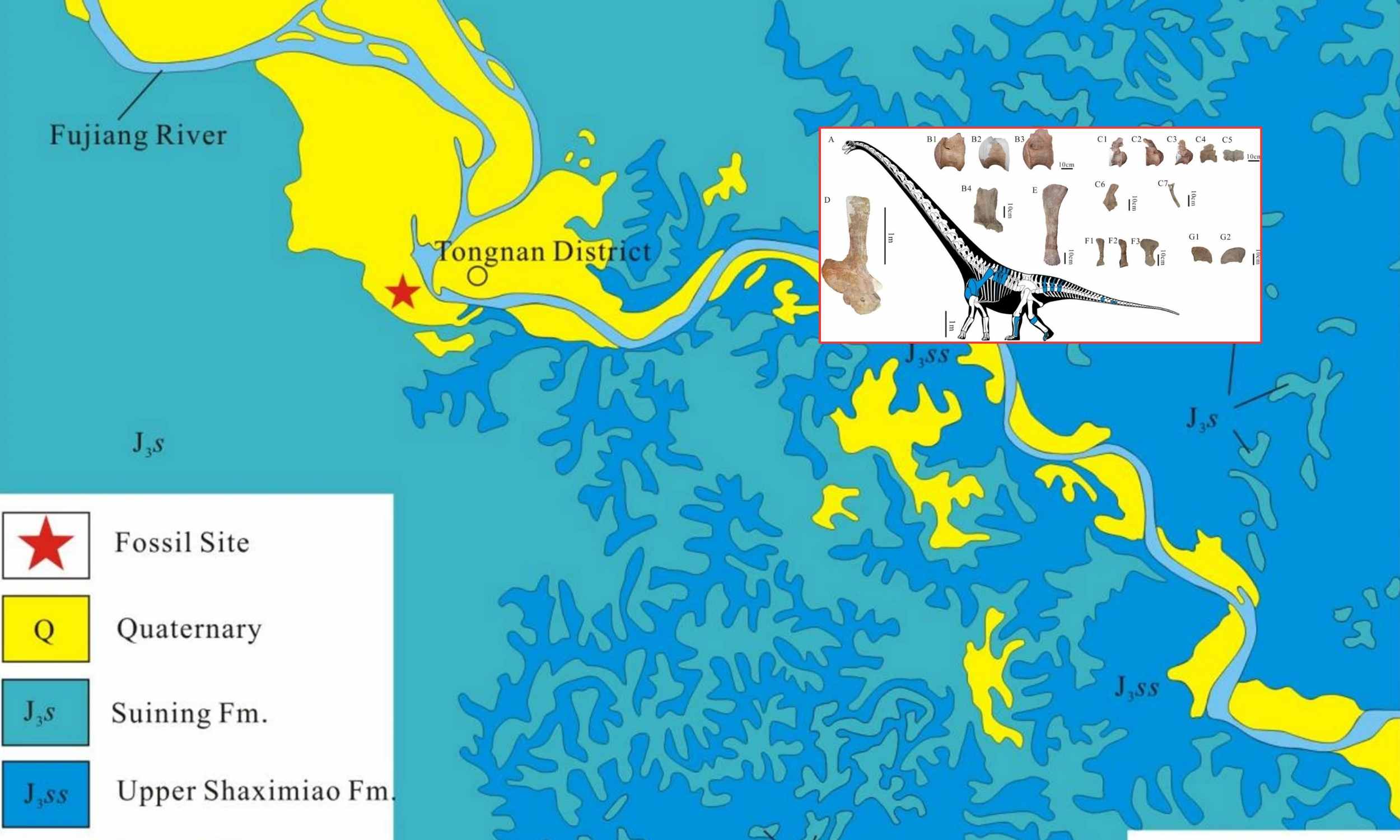
The fossil was found in Chongqing’s Tongnan District, part of the Sichuan Basin, and comes from rocks laid down about 147 million years ago.
Tongnanlong zhimingi is known from a holotype (the single name bearing reference specimen) with three back vertebrae, six tail vertebrae, a shoulder girdle, and hindlimb parts. The bones were unearthed at a construction site and later studied in detail.
The team places Tongnanlong within Mamenchisauridae, a family of long necked sauropods with especially elongated necks.
The bones show telltale internal air spaces and complex ridges that help lighten and brace the skeleton.
The specimen’s shoulder blade is huge, and comparisons with related dinosaurs suggest a body length in the 75 to 92 foot range. That estimate uses measured bones scaled against close relatives with more complete skeletons.
The new specimen enriches the diversity of Mamenchisauridae and provides additional information for understanding the evolution and diversity of eusauropod dinosaurs,” wrote Xuefang Wei of the Chengdu Center of China Geological Survey.
Measuring Tongnanlong zhimingi
Estimating total length from a partial skeleton is tricky. Sauropod necks are rarely complete, and missing pieces can nudge estimates up or down.
A recent paper showed that most famous sauropod necks are incomplete, which adds uncertainty to any whole body reconstruction.
The Tongnanlong zhimingi team handled this by bracketing several plausible estimates and reporting a cautious. range.
Their core size inference comes from long bones like the scapula and fibula. Those elements scale well with overall length in related dinosaurs.
The upshot is simple. Even the conservative value makes Tongnanlong zhimingi an extremely large animal by any standard.
What makes a mamenchisaurid
Members of this group share long, heavy duty neck vertebrae and air filled bone tissue that reduced weight. Those features supported long reach without overwhelming the body.
Tongnanlong also sits within Eusauropoda, a major group including most classic sauropods, based on a matrix of skeletal traits. The analysis ties it more closely to Mamenchisaurus than to Omeisaurus.
To put the find in context, the Suining Formation also yielded Qijianglong guokr, another long necked form from nearby beds. The original paper emphasized that Qijianglong broadened the Late Jurassic diversity in this basin
Those neighbors matter because they show that several large, long necked lineages shared the region during the same slice of time. Tongnanlong adds a much bigger body plan to that roster.
Relatives of Tongnanlong zhimingi
For years, some researchers argued that Jurassic East Asia was cut off from other landmasses, a view called the East Asian Isolation hypothesis, the idea that Jurassic East Asia was faunally cut off.
Tongnanlong’s family has been popping up outside East Asia, which complicates that story.
An African species named Wamweracaudia keranjei comes from Tanzania’s Tendaguru beds. The naming study argued it is a mamenchisaurid, signaling a wider distribution.
“Mamenchisauridae was distributed globally in the Late Jurassic rather than an endemic fauna which was previously considered limited to East Asia,” wrote Wei.

Why sauropods could get so huge
Size like this does not happen by accident. A suite of traits, small heads, long necks, and bird-like lungs, let sauropods eat fast, breathe efficiently, and carry less skeletal mass.
An influential model described this as an evolutionary cascade. Each trait made the next advantage easier, and the cycle favored ever larger bodies.
Earlier cross disciplinary review work reached a similar conclusion. Sauropods combined fast growth, efficient respiration, and high reproductive output in a way no land mammals ever matched
These insights help frame Tongnanlong’s bulk. Its air filled vertebrae and reinforced neural spines fit the pattern of an animal engineered by evolution for scale.
Gigantism also changes an animal’s risks and rewards. Larger herbivores face fewer predators, but they need reliable food and space to move.
What the rocks say
Tongnanlong zhimingi comes from the Suining Formation, a Late Jurassic sedimentary unit in Sichuan, with purple red mudstones and sandstones. The bone bed’s rippled sand hints at a lakeshore setting under a relatively dry climate.
That environment would have offered clustered vegetation along water margins. It also would have preserved carcasses rapidly when floods spread sand over the shore.
The fossil was nearly in place when buried, which suggests it did not travel far before burial. That detail strengthens the link between the bones and the local habitat.
The Suining Formation has also produced freshwater bivalves, conchostracans, and turtles. Together, those fossils paint a picture of interconnected lakes and shallows.
Lessons from Tongnanlong zhimingi
Tongnanlong plugs a meaningful gap in the Sichuan Basin’s Late Jurassic record. It shows that truly massive mamenchisaurids were present alongside smaller, long necked kin.
It also supports a bigger biogeographic story by aligning East Asian forms with relatives far to the west. That broader range undercuts simple isolation narratives.
Future work will test whether Tongnanlong zhimingi’s size reflects local conditions, broader climate shifts, or lineage level trends. More bones from the skull and neck would sharpen the picture.
For now, the message is clear and carefully bounded. A gigantic mamenchisaurid lived on the ancient shores of what is now Chongqing.
 www.earth.com
The fossil was found in Chongqing’s Tongnan District, part of the Sichuan Basin, and comes from rocks laid down about 147 million years ago.
Tongnanlong zhimingi is known from a holotype (the single name bearing reference specimen) with three back vertebrae, six tail vertebrae, a shoulder girdle, and hindlimb parts. The bones were unearthed at a construction site and later studied in detail.
The team places Tongnanlong within Mamenchisauridae, a family of long necked sauropods with especially elongated necks.
The bones show telltale internal air spaces and complex ridges that help lighten and brace the skeleton.
The specimen’s shoulder blade is huge, and comparisons with related dinosaurs suggest a body length in the 75 to 92 foot range. That estimate uses measured bones scaled against close relatives with more complete skeletons.
The new specimen enriches the diversity of Mamenchisauridae and provides additional information for understanding the evolution and diversity of eusauropod dinosaurs,” wrote Xuefang Wei of the Chengdu Center of China Geological Survey.
Measuring Tongnanlong zhimingi
Estimating total length from a partial skeleton is tricky. Sauropod necks are rarely complete, and missing pieces can nudge estimates up or down.
A recent paper showed that most famous sauropod necks are incomplete, which adds uncertainty to any whole body reconstruction.
The Tongnanlong zhimingi team handled this by bracketing several plausible estimates and reporting a cautious. range.
Their core size inference comes from long bones like the scapula and fibula. Those elements scale well with overall length in related dinosaurs.
The upshot is simple. Even the conservative value makes Tongnanlong zhimingi an extremely large animal by any standard.
What makes a mamenchisaurid
Members of this group share long, heavy duty neck vertebrae and air filled bone tissue that reduced weight. Those features supported long reach without overwhelming the body.
Tongnanlong also sits within Eusauropoda, a major group including most classic sauropods, based on a matrix of skeletal traits. The analysis ties it more closely to Mamenchisaurus than to Omeisaurus.
To put the find in context, the Suining Formation also yielded Qijianglong guokr, another long necked form from nearby beds. The original paper emphasized that Qijianglong broadened the Late Jurassic diversity in this basin
Those neighbors matter because they show that several large, long necked lineages shared the region during the same slice of time. Tongnanlong adds a much bigger body plan to that roster.
Relatives of Tongnanlong zhimingi
For years, some researchers argued that Jurassic East Asia was cut off from other landmasses, a view called the East Asian Isolation hypothesis, the idea that Jurassic East Asia was faunally cut off.
Tongnanlong’s family has been popping up outside East Asia, which complicates that story.
An African species named Wamweracaudia keranjei comes from Tanzania’s Tendaguru beds. The naming study argued it is a mamenchisaurid, signaling a wider distribution.
“Mamenchisauridae was distributed globally in the Late Jurassic rather than an endemic fauna which was previously considered limited to East Asia,” wrote Wei.
Why sauropods could get so huge
Size like this does not happen by accident. A suite of traits, small heads, long necks, and bird-like lungs, let sauropods eat fast, breathe efficiently, and carry less skeletal mass.
An influential model described this as an evolutionary cascade. Each trait made the next advantage easier, and the cycle favored ever larger bodies.
Earlier cross disciplinary review work reached a similar conclusion. Sauropods combined fast growth, efficient respiration, and high reproductive output in a way no land mammals ever matched
These insights help frame Tongnanlong’s bulk. Its air filled vertebrae and reinforced neural spines fit the pattern of an animal engineered by evolution for scale.
Gigantism also changes an animal’s risks and rewards. Larger herbivores face fewer predators, but they need reliable food and space to move.
What the rocks say
Tongnanlong zhimingi comes from the Suining Formation, a Late Jurassic sedimentary unit in Sichuan, with purple red mudstones and sandstones. The bone bed’s rippled sand hints at a lakeshore setting under a relatively dry climate.
That environment would have offered clustered vegetation along water margins. It also would have preserved carcasses rapidly when floods spread sand over the shore.
The fossil was nearly in place when buried, which suggests it did not travel far before burial. That detail strengthens the link between the bones and the local habitat.
The Suining Formation has also produced freshwater bivalves, conchostracans, and turtles. Together, those fossils paint a picture of interconnected lakes and shallows.
Lessons from Tongnanlong zhimingi
Tongnanlong plugs a meaningful gap in the Sichuan Basin’s Late Jurassic record. It shows that truly massive mamenchisaurids were present alongside smaller, long necked kin.
It also supports a bigger biogeographic story by aligning East Asian forms with relatives far to the west. That broader range undercuts simple isolation narratives.
Future work will test whether Tongnanlong zhimingi’s size reflects local conditions, broader climate shifts, or lineage level trends. More bones from the skull and neck would sharpen the picture.
For now, the message is clear and carefully bounded. A gigantic mamenchisaurid lived on the ancient shores of what is now Chongqing.
Colossal dinosaur measuring 92-feet-long challenges the limits of imagination
Scientists reveal Tongnanlong zhimingi, a giant dinosaur from the late Jurassic period in China that reached up to 92-feet-long.