


Michigan State University researchers have discovered that honeybees can detect biomarkers or chemical concentrations associated with lung cancer in human breath. The researchers have also shown that the honeybees can distinguish between different lung cancer cell types using only the ‘smell’ of the cell cultures. These findings could be used as a model for developing new tests to diagnose lung cancer early.
“Insects have an amazing sense of smell the same way dogs do,” said Debajit Saha, an assistant professor in the College of Engineering and MSU’s Institute for Quantitative Health Science and Engineering.
Saha and his team wanted to see if honeybees could distinguish between the chemicals in human breath from someone who was healthy compared to someone with lung cancer. Elyssa Cox, Saha’s former lab manager, and Michael Parnas, a doctoral candidate working in Saha’s lab, developed a “recipe” for a synthetic breath mixture using different levels of six compounds such as trichloroethylene and 2-methylheptane to create the chemical makeup of the breath of someone with lung cancer and a synthetic healthy breath mixture.
“It took a steady hand to create the recipe,” said Cox. “We tested the synthetic lung cancer versus healthy human breath mixtures on approximately 20 bees.”
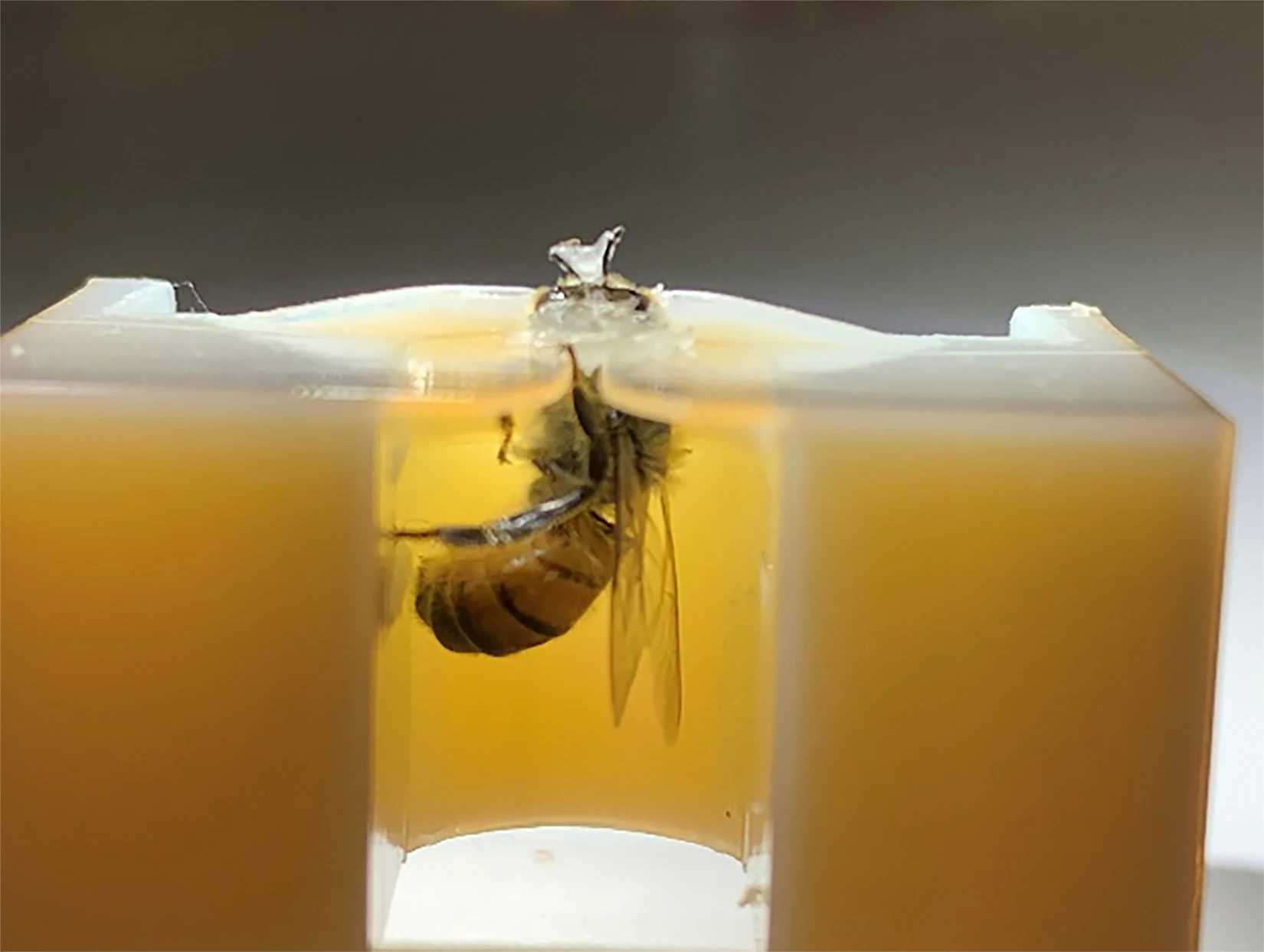
Cox helped design a custom 3D-printed harness to hold a live honeybee while she attached a tiny electrode to its brain to measure any changes in the bee’s brain signals.
“We pass those odors on to the antenna of the honeybees and recorded the neural signals from their brain,” said Saha. “We see a change in the honeybee’s neural firing response.”
The researchers also wanted to measure how much of the cancer-indicating compounds needed to be present in someone’s breath for the honeybee to detect cancer.
“The honeybees detected very small concentrations; it was a very strong result,” said Saha. “Bees can differentiate between minute changes in the chemical concentrations of the breath mixture which is in the parts per 1 billion range.”
Parnas analyzed the neural data and saw the spikes in the bees’ brain signals.
“We can see differences in how the honeybees are smelling,” said Parnas. “We detected several different neurons firing in the honeybees’ brains that clearly differentiated between the synthetic lung cancer breath and healthy breath.”
Another graduate student from Saha's team, Autumn McLane-Svoboda and an undergrad, Summer McLane-Svoboda jointly led the human lung cancer cell culture experiments with the help of Christopher Contag, director of Michigan State University’s Institute for Quantitative Health Science and Engineering, and his lab. For these experiments, different types of human lung cancer cell cultures were grown in closed, airtight flasks and the honeybee brain-based sensor was used to test the odor of the lung cancer cells. The researchers have successfully demonstrated that using this honeybee brain-based sensor can distinguish between small cell lung cancer, non-small lung cancer cells and healthy cells.
What’s amazing is the honeybees ability to not only detect cancer cells, but also distinguish between cell lines of various types of lung cancer,” said Autumn McLane-Svoboda. “The future implications for this are huge as our sensor could allow for patients to receive specific cancer diagnoses quickly which is imperative for correct treatment routes.”
Saha envisions this work will open the door for more biological and smell-based disease detection technologies. In the future, Saha’s team plans to develop a noninvasive test that only requires patients breathe into a device and the sensor inside, based on honeybee brains, would analyze the breath and wirelessly report back in real time if cancer chemicals are present.
The research was published in the journal Biosensors and Bioelectronics.
 msutoday.msu.edu
“Insects have an amazing sense of smell the same way dogs do,” said Debajit Saha, an assistant professor in the College of Engineering and MSU’s Institute for Quantitative Health Science and Engineering.
Saha and his team wanted to see if honeybees could distinguish between the chemicals in human breath from someone who was healthy compared to someone with lung cancer. Elyssa Cox, Saha’s former lab manager, and Michael Parnas, a doctoral candidate working in Saha’s lab, developed a “recipe” for a synthetic breath mixture using different levels of six compounds such as trichloroethylene and 2-methylheptane to create the chemical makeup of the breath of someone with lung cancer and a synthetic healthy breath mixture.
“It took a steady hand to create the recipe,” said Cox. “We tested the synthetic lung cancer versus healthy human breath mixtures on approximately 20 bees.”
Cox helped design a custom 3D-printed harness to hold a live honeybee while she attached a tiny electrode to its brain to measure any changes in the bee’s brain signals.
“We pass those odors on to the antenna of the honeybees and recorded the neural signals from their brain,” said Saha. “We see a change in the honeybee’s neural firing response.”
The researchers also wanted to measure how much of the cancer-indicating compounds needed to be present in someone’s breath for the honeybee to detect cancer.
“The honeybees detected very small concentrations; it was a very strong result,” said Saha. “Bees can differentiate between minute changes in the chemical concentrations of the breath mixture which is in the parts per 1 billion range.”
Parnas analyzed the neural data and saw the spikes in the bees’ brain signals.
“We can see differences in how the honeybees are smelling,” said Parnas. “We detected several different neurons firing in the honeybees’ brains that clearly differentiated between the synthetic lung cancer breath and healthy breath.”
Another graduate student from Saha's team, Autumn McLane-Svoboda and an undergrad, Summer McLane-Svoboda jointly led the human lung cancer cell culture experiments with the help of Christopher Contag, director of Michigan State University’s Institute for Quantitative Health Science and Engineering, and his lab. For these experiments, different types of human lung cancer cell cultures were grown in closed, airtight flasks and the honeybee brain-based sensor was used to test the odor of the lung cancer cells. The researchers have successfully demonstrated that using this honeybee brain-based sensor can distinguish between small cell lung cancer, non-small lung cancer cells and healthy cells.
What’s amazing is the honeybees ability to not only detect cancer cells, but also distinguish between cell lines of various types of lung cancer,” said Autumn McLane-Svoboda. “The future implications for this are huge as our sensor could allow for patients to receive specific cancer diagnoses quickly which is imperative for correct treatment routes.”
Saha envisions this work will open the door for more biological and smell-based disease detection technologies. In the future, Saha’s team plans to develop a noninvasive test that only requires patients breathe into a device and the sensor inside, based on honeybee brains, would analyze the breath and wirelessly report back in real time if cancer chemicals are present.
The research was published in the journal Biosensors and Bioelectronics.
MSU researchers discover honeybees can detect lung cancer
Michigan State University researchers have discovered that honeybees can detect biomarkers or chemical concentrations associated with lung cancer in human breath.
msutoday.msu.edu