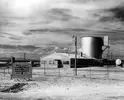
Not long after dropping the first two nuclear bombs on Japan, the United States began to devise ways of applying its innovations in atomic science to making not only weapons but energy. The country, which lagged slightly behind the USSR and the UK. in the construction of nuclear power plants, established one of its first testing facilities in the small military town of Arco, Idaho.

January 3rd, 1961, three military men, all in their twenties, went to the SL-1 to begin gearing it back up after its annual Christmas shutdown. As the team worked all around the National Reactor Testing Station, two false alarms went off, to which the fire department responded. But the third alarm, sounding off around 9:01 p.m., was not crying wolf.
To flash back to a lesson you probably learned in high school physics class, nuclear power plants work by using the heat energy from the fission of radioactive material in order to boil water into steam, steam which is then used to spin a turbine. Engineers can control the rate and intensity of this fission by using control rods, that is, objects that absorb free-flowing neutrons in a reactor’s core, before those neutrons could collide with unstable atoms nearby, which themselves would break down and release energy and even more fission-inducing neutrons.

On the night of January 3rd, all three of the men were working around the reactor (two were off to the side, one was standing on top) when one of them took the 84-pound main control rod several inches too far from the core. In just four milliseconds — practically an instant — the core superheated and vaporized the surrounding water, sending steam and liquid water upwards. The force of this flash-boiling propelled the reactor up nine feet into the air, before it was stopped by the ceiling of the building. Twenty-six-year-old Richard Legg, who had been standing on top of the reactor cylinder at the time, was impaled by part of the structure, pinning his body to the ceiling.

The fire department responded to the alarm, a bit disgruntled from the two false alarms earlier in the day, coming to a scene that looked at first glance pretty normal. The building was still standing, but as they turned to the reactor room, their radiation meters maxed out. The crew hastily exited and enlisted the help of a doctor, who suggested that no one was to spend more than a minute at a time in the facility. After establishing a plan, around 10:30, about 90 minutes after the malfunction, rescuers witnessed the grotesque scene: one man was dead on the floor, with another moaning, still hanging on to the last threads of life. They would not find the third man for several more hours, his body hidden in plain sight, stuck to the ceiling above their heads.

Rescuers were able to retrieve John Byrnes, unconscious but breathing, from the building before he died at 11 p.m. Once the matter of saving lives was no longer a concern, the safety of rescuers took priority. Still restricted to a minute inside the building at a time, the team worked to dislodge the remains of the last man from the ceiling, and rigged up a stretcher to a crane to bring him down. Their corpses were now hazardous radioactive material, and they were treated as such. Some body parts were buried on site, along with parts of the facility, which still posed a risk to public health. The men were interred in lead-lined caskets, and shipped where their families wished, all in accordance to radioactive shipping standards set by the the Interstate Commerce Commission.

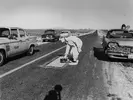
Physicists check Highway 20 for contamination on the morning after the SL-1 accident. (Idaho National Laboratory)
Noone knows for sure why the rod was taken too far from the reactor core. Some speculate that the cadmium-aluminium rod was corroded or otherwise warped, so that a manual pull turned into an inadvertent, sudden yank. Others believe these three men, who were technicians, not scientists or engineers, simply may not have understood the dangers of moving the rod themselves. Though a more juicy theory has it that it was an intentional disaster, a murder-suicide, stemming from marital strife, in which another technician may have been an illicit paramour. A 1983 movie called SL-1 explored this possibility, certainly appealing and dramatic, while exploring the more substantive details about what really happened.

But the field of nuclear engineering has learned from the incident:
Ever since, such facilities are designed to ensure no one has the power to manually manipulate a control rod. That responsibility is now only entrusted to computers.

VIDEO -
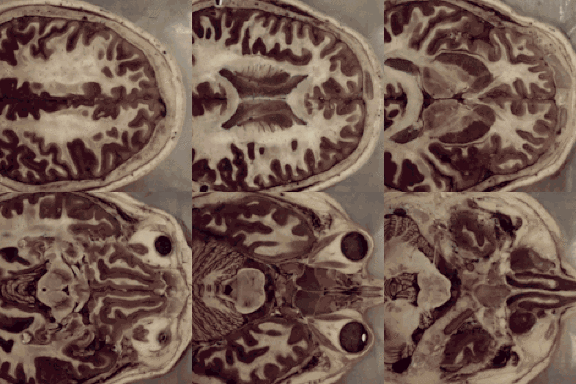
AUTOPSY REPORT - http://www.alternatewars.com/WW3/WW3_Documents/US_DOE/LAMS-2550/LAMS-2550_SL-1_Autopsy.htm
January 3rd, 1961, three military men, all in their twenties, went to the SL-1 to begin gearing it back up after its annual Christmas shutdown. As the team worked all around the National Reactor Testing Station, two false alarms went off, to which the fire department responded. But the third alarm, sounding off around 9:01 p.m., was not crying wolf.
To flash back to a lesson you probably learned in high school physics class, nuclear power plants work by using the heat energy from the fission of radioactive material in order to boil water into steam, steam which is then used to spin a turbine. Engineers can control the rate and intensity of this fission by using control rods, that is, objects that absorb free-flowing neutrons in a reactor’s core, before those neutrons could collide with unstable atoms nearby, which themselves would break down and release energy and even more fission-inducing neutrons.
On the night of January 3rd, all three of the men were working around the reactor (two were off to the side, one was standing on top) when one of them took the 84-pound main control rod several inches too far from the core. In just four milliseconds — practically an instant — the core superheated and vaporized the surrounding water, sending steam and liquid water upwards. The force of this flash-boiling propelled the reactor up nine feet into the air, before it was stopped by the ceiling of the building. Twenty-six-year-old Richard Legg, who had been standing on top of the reactor cylinder at the time, was impaled by part of the structure, pinning his body to the ceiling.
The fire department responded to the alarm, a bit disgruntled from the two false alarms earlier in the day, coming to a scene that looked at first glance pretty normal. The building was still standing, but as they turned to the reactor room, their radiation meters maxed out. The crew hastily exited and enlisted the help of a doctor, who suggested that no one was to spend more than a minute at a time in the facility. After establishing a plan, around 10:30, about 90 minutes after the malfunction, rescuers witnessed the grotesque scene: one man was dead on the floor, with another moaning, still hanging on to the last threads of life. They would not find the third man for several more hours, his body hidden in plain sight, stuck to the ceiling above their heads.
Rescuers were able to retrieve John Byrnes, unconscious but breathing, from the building before he died at 11 p.m. Once the matter of saving lives was no longer a concern, the safety of rescuers took priority. Still restricted to a minute inside the building at a time, the team worked to dislodge the remains of the last man from the ceiling, and rigged up a stretcher to a crane to bring him down. Their corpses were now hazardous radioactive material, and they were treated as such. Some body parts were buried on site, along with parts of the facility, which still posed a risk to public health. The men were interred in lead-lined caskets, and shipped where their families wished, all in accordance to radioactive shipping standards set by the the Interstate Commerce Commission.
Physicists check Highway 20 for contamination on the morning after the SL-1 accident. (Idaho National Laboratory)
Noone knows for sure why the rod was taken too far from the reactor core. Some speculate that the cadmium-aluminium rod was corroded or otherwise warped, so that a manual pull turned into an inadvertent, sudden yank. Others believe these three men, who were technicians, not scientists or engineers, simply may not have understood the dangers of moving the rod themselves. Though a more juicy theory has it that it was an intentional disaster, a murder-suicide, stemming from marital strife, in which another technician may have been an illicit paramour. A 1983 movie called SL-1 explored this possibility, certainly appealing and dramatic, while exploring the more substantive details about what really happened.
But the field of nuclear engineering has learned from the incident:
Ever since, such facilities are designed to ensure no one has the power to manually manipulate a control rod. That responsibility is now only entrusted to computers.
VIDEO -
AUTOPSY REPORT - http://www.alternatewars.com/WW3/WW3_Documents/US_DOE/LAMS-2550/LAMS-2550_SL-1_Autopsy.htm